
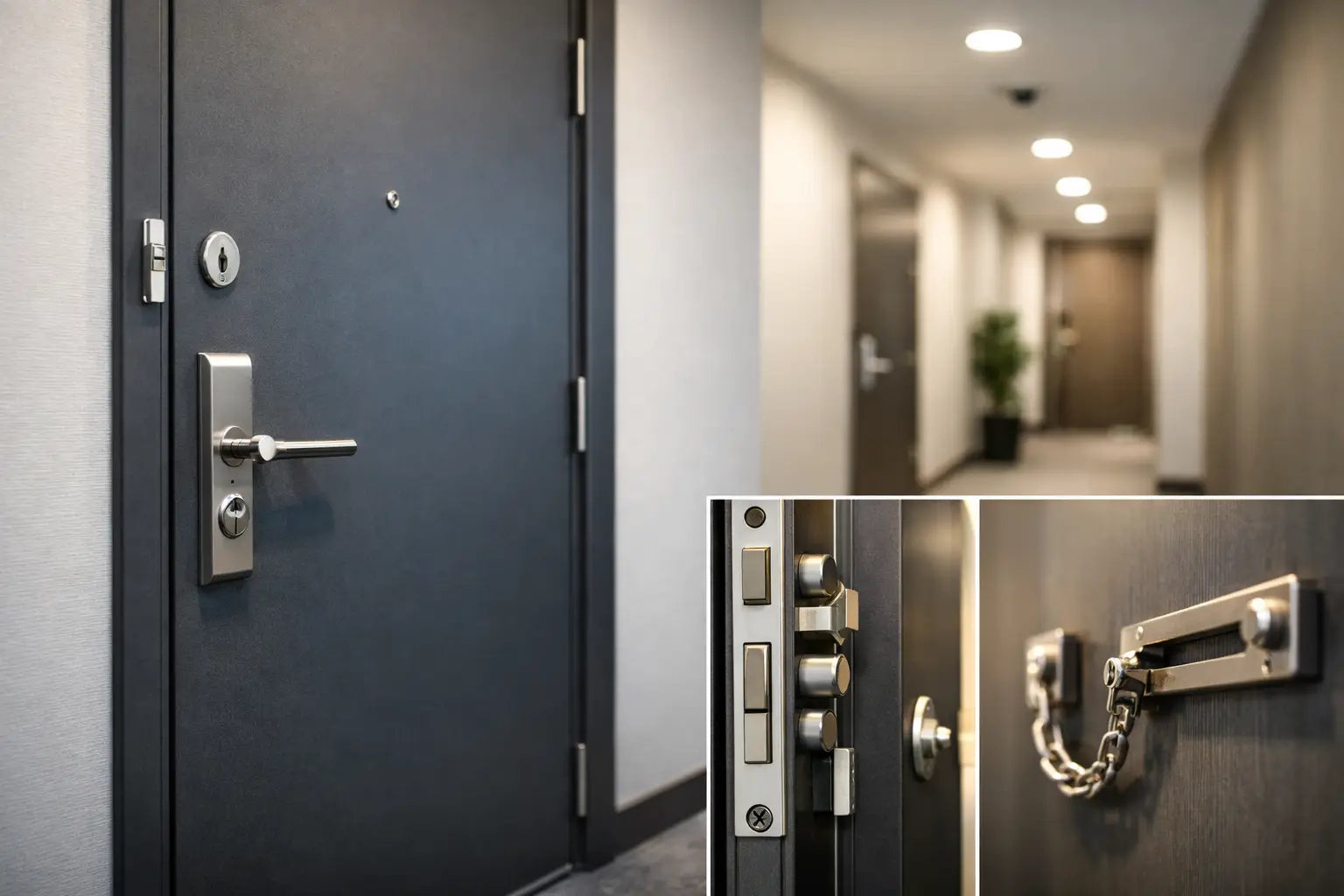
A PAS24 flat entrance door has a far more demanding role than a standard entrance door. It forms the critical barrier between a private residence and a communal corridor, providing enhanced security, fire resistance, and, in many cases, smoke control, while complementing the overall appearance of the building. Because of these combined requirements, a PAS24 flat entrance door set must be designed, manufactured, and tested as a complete assembly. The door leaf, frame, glazing (where applicable), locks, hinges, intumescent seals, and other ironmongery all work together to deliver certified performance against forced entry, fire, and everyday use.
For developers, landlords, housing associations, builders, and refurbishment contractors, specifying a PAS24 flat entrance door involves much more than selecting an FD30 fire door and fitting a high-security lock. The entire doorset must be appropriate for its intended location and comply with the relevant performance standards before installation begins. This is particularly important where UK Building Regulations, Approved Document B, Approved Document Q, Secured by Design requirements, planning conditions, or insurer specifications apply.
What PAS24 flat entrance doors are tested to do
PAS 24 is a British security standard for enhanced security performance. In practical terms, it assesses how a doorset resists common methods of attack, including manual force and attempts to compromise locking points, hinges, glazing, or vulnerable areas of the frame. It is not a generic label that can be applied to any door with a multipoint lock.
The keyword is doorset. A PAS 24 claim relates to the tested combination of door leaf, frame, lock, hinges, glazing where fitted, security hardware, and fixing method. Changing a component may affect that certification. For example, a particular handle, viewer, letterplate, or lock cylinder may be part of the tested specification rather than an interchangeable finishing detail.
This matters most on flat schemes because an entrance corridor can give an intruder privacy and time that a street-facing front door may not. A well-specified PAS 24 doorset provides a defined level of resistance at the point where residents expect to feel most secure.
Security is only one part of the specification
A PAS 24 flat entrance door will frequently be required to meet more than one performance standard. The security rating is vital, but it does not replace fire testing, smoke control, acoustic ratings, or the practical requirements of the building’s access-control strategy.
Fire and smoke performance
Many flat entrance doors need an FD30 or FD60 fire rating, depending on the building design and fire strategy. FD30 indicates 30 minutes of fire resistance, and FD60 indicates 60 minutes. The correct rating must be confirmed by the project’s fire strategy, approved inspector, or building control body. It should never be assumed from the age, height, or appearance of the block.
Where smoke protection is required, the doorset may also carry an S suffix. This refers to smoke leakage performance and is commonly achieved through suitable seals. Intumescent strips, which expand in heat to seal gaps during a fire, are also a central part of a tested fire doorset. Their size, location, and compatibility with the frame are not details to improvise on-site.
A fire-rated PAS 24 doorset must satisfy both disciplines together. A security upgrade that involves swapping ironmongery, drilling extra apertures, or fitting an unsuitable letterplate can compromise the fire certification. Equally, a fire door with a standard domestic lockset is not automatically a PAS 24 security door.
Acoustic privacy
Noise transfer from communal corridors is a frequent complaint in flat buildings. Conversation, lifts, stairwell activity, and closing doors can all travel into a flat through gaps around a poorly fitted entrance door. Acoustic performance is measured in decibels, typically expressed as Rw values, and higher figures generally indicate better sound reduction.
The right acoustic rating depends on the scheme and the wall construction around the opening. A high-performing door cannot compensate for gaps around the frame, unsealed service penetrations, or weak surrounding partitions. Nevertheless, specifying an acoustic doorset from the outset is far more effective than trying to add draught seals after handover.
Appearance and day-to-day durability
Flat entrance doors are seen by residents every day, so finish matters. Veneered timber, painted finishes, laminate faces, and contemporary panel designs can all be suitable when offered within the certified doorset construction. The priority is to choose from finishes that are available for the required performance, rather than selecting a decorative leaf first and trying to engineer compliance around it later.
Communal environments also place heavy demands on hardware. Handles, closers, viewers, access-control components, and protective plates should be specified for the anticipated use. In a busy build-to-rent block, durability and easy maintenance may take precedence over a more delicate design-led handle. In a smaller premium development, a coordinated finish can be equally important, provided it remains within the tested configuration.
Start with the building, not the door design
The most efficient way to buy PAS24 flat entrance doors is to establish the required performance schedule before comparing styles and prices. Ask what fire rating is needed, whether smoke control is required, the target acoustic rating, the handing and opening direction, and whether the door will connect to an access-control system.
It is also worth confirming the opening dimensions and wall build-up early. Flat entrance doors are usually supplied as complete doorsets because the frame is fundamental to fire, security, and acoustic performance. A made-to-measure or pre-assembled set can reduce site cutting, minimise fitting uncertainty, and help maintain the tested construction, especially on projects with numerous identical openings.
Where doors open into a communal corridor, check clear opening requirements and closer operation as part of the design. A heavier, higher-performing leaf can affect the closer selected and the force needed to open the door. The door must be secure and controlled, but it must also be usable by residents and compatible with the building’s accessibility requirements.
Ironmongery must match the certification
Ironmongery is where otherwise sound specifications can go wrong. The lock case, cylinder, escutcheon, handles, hinges, door closer, security chain or limiter, viewer, and letterplate all need consideration. On a PAS 24 doorset, these components should be selected from the manufacturer’s approved schedule.
For electronic access, establish whether the system uses a keypad, fob reader, electric strike, magnetic locking, or another arrangement. Flat entrance doors normally need residents to be able to exit without delay, so access control must be coordinated with fire safety and the building’s emergency arrangements. This is a design and installation issue, not simply a hardware purchase.
Letterplates deserve particular attention. They can introduce a security and fire-performance weakness if they are not specifically tested for the doorset. Where post is delivered to a communal lobby, omitting a letterplate from the flat door may offer a cleaner, more secure solution. It depends on the postal arrangement and the intended look of the scheme.
Installation is part of performance
A certified doorset can lose much of its value if it is installed poorly. The frame must be fixed using the specified method, correctly packed and aligned, with suitable gaps around the leaf. Seals need continuous contact, hinges must be adjusted accurately, and the closer must shut the door reliably from every position.
On fire doors, excessive gaps, incorrect seals, and damaged edges are recurring defects. On security doors, weak frame fixings, incorrect lock adjustment, or substitutions to hardware can undermine resistance. Installation records, product data, and a clear handover file make later inspection and maintenance much easier.
For larger schemes, consistency matters. Using one approved doorset specification across comparable openings makes procurement, fitting, and future replacement more straightforward. It also reduces the risk of a mixture of near-matching doors with different ratings, lock arrangements, and maintenance requirements.
Buying with confidence
When comparing PAS 24 options, request clear evidence of the complete tested specification, not just a statement that the leaf is suitable. Check the fire rating, smoke performance, acoustic rating, finish options, frame type, lock and hardware package, handing, lead time, and supplied documentation. If the project has a specific Secured by Design requirement, confirm that the exact product and configuration meet the relevant brief before placing an order.
Door Supplies Online can assist with specification-led requirements, from FD30 and FD60 entrance doors to coordinated frames and ironmongery. The practical aim is to order a doorset that arrives ready for the required opening and performance level, rather than creating costly questions once fitting has begun.
A well-chosen flat entrance door gives residents a reassuring first line of defence while supporting the fire, acoustic, and visual standards of the whole building. Get the tested doorset and approved hardware agreed early, and the rest of the installation has a far better chance of going right.
For more information about our interior or exterior doors or door accessories, give us a call at 01603 622261 and speak to a member of our expert team today, or email us at sales@doorsuppliesonline.co.uk. We look forward to hearing from you.