
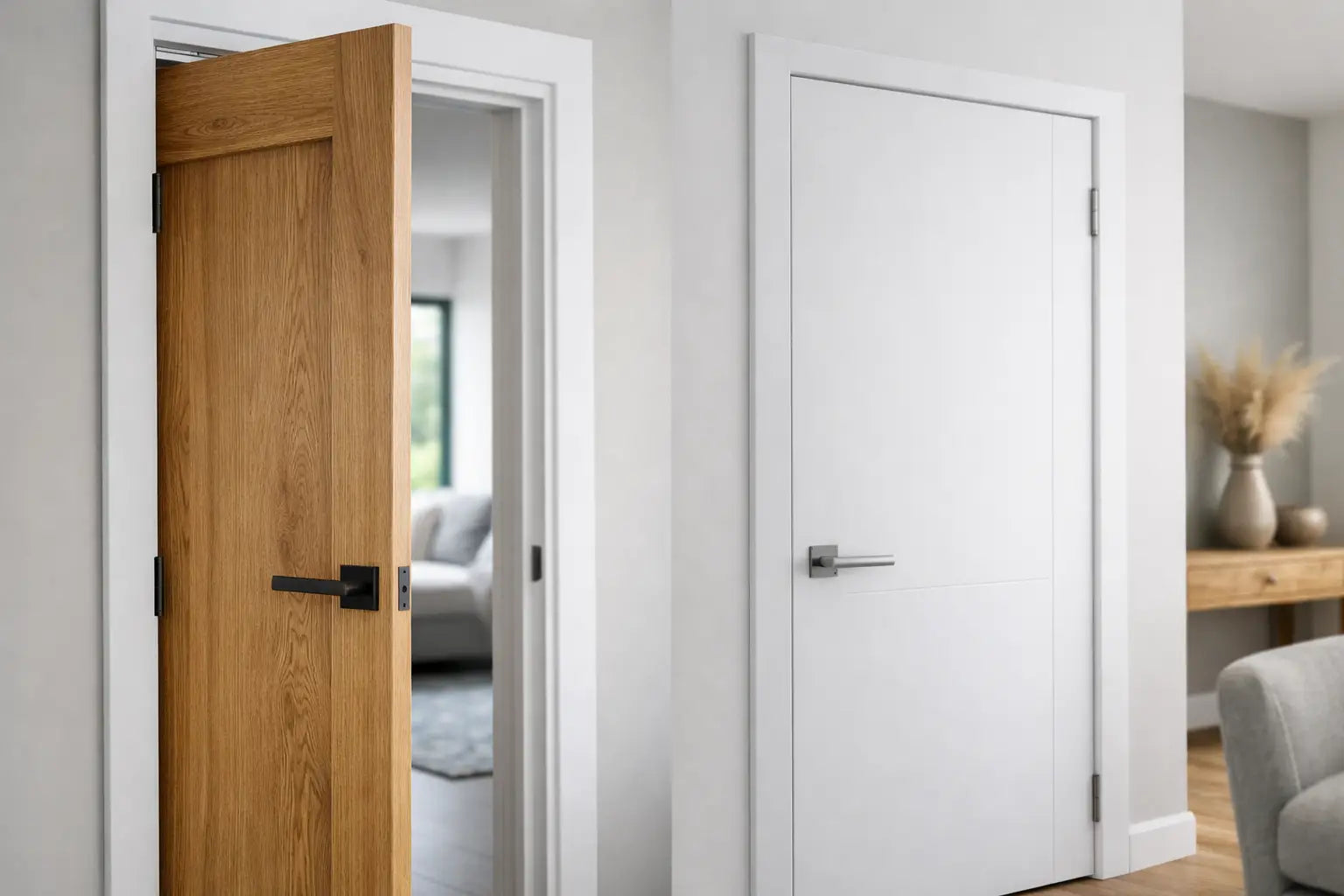
When a standard-sized door leaves uneven gaps, catches on flooring or carpets, or simply doesn't sit correctly within the frame, bespoke internal doors become more than a luxury; they become the most practical solution. Many older properties, period homes, loft conversions, extensions, and architect-designed renovations feature non-standard openings that cannot always accommodate off-the-shelf doors. In these situations, made-to-measure internal doors provide a precise fit, reduce the need for extensive trimming or joinery work, and deliver a cleaner, more professional finish.
Choosing the right bespoke internal door is about more than achieving the perfect size. A custom-made door allows you to tailor every aspect of the specification, including the style, finish, glazing, core construction, and performance requirements. Whether you're looking for solid oak internal doors, Shaker doors, glazed internal doors, or fire-rated bespoke doors, a made-to-measure solution ensures your new door complements both the character of your property and your interior design vision.
When bespoke internal doors make sense
Not every project needs a made-to-order door. Many internal door ranges are designed with enough tolerance to allow modest trimming, which can solve straightforward sizing issues at a lower cost and with shorter lead times. If your opening is only slightly out, that may be the practical answer.
Bespoke internal doors come into their own when the opening is significantly non-standard, when the design brief is specific, or when multiple details need to line up across a scheme. Period homes are a common example. Openings in Victorian terraces, converted barns, and listed renovations rarely behave like modern standard frames. A door that is too narrow or too short will always look like a compromise, even if it technically fits.
They are also a strong option in contemporary projects where visual consistency matters. If you are trying to match flush doors across different ceiling heights, coordinate glazing patterns, or continue the same style through a pocket door system and hinged doors, bespoke sizing makes that possible without forcing the design around stock limitations.
What can be customised on bespoke internal doors?
Size is usually the starting point, but it is rarely the only variable. Depending on the door style and manufacturer, bespoke internal doors can often be tailored by height, width, and thickness, with further options around finish, glazing, and core construction.
For residential projects, the most common request is made-to-measure sizing for awkward openings. That said, many buyers also want a specific look - unfinished oak ready for site finishing, a primed white surface for paint, a black internal door for a more architectural scheme, or glazed panels to move light through darker hallways and landings.
On more technical jobs, the brief may go beyond appearance. Fire performance matters in flats, HMOs, some loft conversions, and commercial settings. Where a fire door is required, bespoke sizing has to be considered alongside certification, compatible frames, intumescent strips, hinges, latches, and the overall fire door set-up. This is where specialist advice is worth having, because appearance alone is not enough.
Style, material, and finish
Most buyers start by choosing a style that suits the property. Oak remains a popular choice because it works in both modern and traditional interiors, while white primed doors offer flexibility for decorating on site. Black and dark-stained finishes continue to grow in popularity, especially in renovation projects aiming for a stronger contrast.
Glazed bespoke doors are worth considering where natural light is limited. Frosted glass can maintain privacy in home offices or bathrooms, while clear glazing is often used between kitchens, hallways, and living spaces to keep rooms feeling open.
Performance and specification
A bespoke door still needs to perform like a door, not just look the part. Core type affects weight, feel, and acoustic performance. Lippings matter if any final adjustment may be needed on site. Thickness matters if the door is being fitted into an existing frame or paired with particular hardware.
If the requirement includes fire resistance, acoustic reduction, or heavy-use durability, those details need to be confirmed before the order is placed. On specification-led projects, it is always better to work from the performance requirement backwards rather than choose on appearance first and hope the technical side can be added later.
Measuring bespoke internal doors properly
This is the point where many costly mistakes happen. A bespoke door is made to order, so inaccurate measurements can create delays and unnecessary replacement costs. Measuring the existing door is not always enough, especially in older properties where frames are out of square or the opening varies from top to bottom.
The more reliable approach is to measure the structural opening or the finished frame, depending on how the door is being installed. Width should be checked in several places, and height should account for the final floor finish, not just the subfloor. A new carpet, underlay, or tiled threshold can change the clearance more than expected.
It is also important to establish whether the opening is plumb and square. If it is not, a bespoke leaf alone may not solve the issue. In some cases, the correct answer is a new frame, lining or complete door set. That adds cost, but it usually produces a better long-term result than trying to force a made-to-measure leaf into a poor opening.
For trade buyers, this is standard practice. For homeowners ordering online, it is one of the main reasons to speak to a specialist supplier before committing.
Bespoke internal doors vs standard sizes
The biggest advantage of standard internal doors is simple: they are quicker, cheaper, and easier to source. If the opening suits a common size and the style is available off the shelf, they are often the right commercial decision. This is particularly true on larger developments or straightforward room-by-room replacements where programme and budget are tight.
Bespoke internal doors earn their keep where standard products create visible compromise, site labour increases, or the design intent gets diluted. A made-to-measure door can reduce packing out, excessive trimming, and awkward frame adjustments. It can also help maintain symmetry, especially in hallways or open-plan spaces where doors are seen together.
The trade-off is lead time and price. Bespoke products generally cost more and take longer to manufacture. If your project is on a fixed installation schedule, that timing needs planning early. There is no benefit in selecting a made-to-order option if the site is not ready for it or if measurements are still likely to change.
What to check before ordering bespoke internal doors
Before placing an order, it helps to think beyond the door leaf itself. The most successful installations are planned as a complete package. That means checking the frame or lining, handing, swing direction, hinge positions, latch choice, finish requirements, and whether matching architrave or skirting is part of the wider scheme.
If the door is glazed, confirm the glass type and whether privacy or light transfer is the priority. If the door is for a pocket system, verify compatibility with the cassette and track arrangement. If it is a fire door, make sure the full specification is suitable for the application rather than assuming all components are interchangeable.
This is also the point to think about consistency. On many projects, one bespoke door becomes several once the client sees the difference in finish. Matching styles across bedrooms, en-suites, studies and reception rooms usually gives a stronger result than mixing door types without a clear reason.
Are bespoke internal doors worth it?
For the right project, yes. They are particularly worthwhile when standard doors would leave obvious gaps, require too much adjustment, or fail to meet the design brief. In refurbishment work, they often provide a neater answer than trying to force modern stock sizes into older openings. In new-build and self-build settings, they allow more control over proportion and detailing.
That said, bespoke is not automatically better. If a standard door fits, meets the specification, and suits the room, there is no commercial logic in paying more just for the label. The value is in solving a real problem - sizing, style, performance, or all three.
At Door Supplies Online, the projects that benefit most from bespoke options are usually the ones where the buyer already knows compromise will cost more later, whether that is in labour, visual quality, or compliance risk. A well-specified door bought once is usually a better value than trying to rescue the wrong product on site.
If you are weighing up bespoke against standard, start with the opening, the finish you want, and any technical requirements. Once those are clear, the right route tends to become obvious - and the end result looks like it was meant to be there all along.
For more information about our interior or exterior doors or door accessories, give us a call at 01603 622261 and speak to a member of our expert team today, or email us at sales@doorsuppliesonline.co.uk. We look forward to hearing from you.