
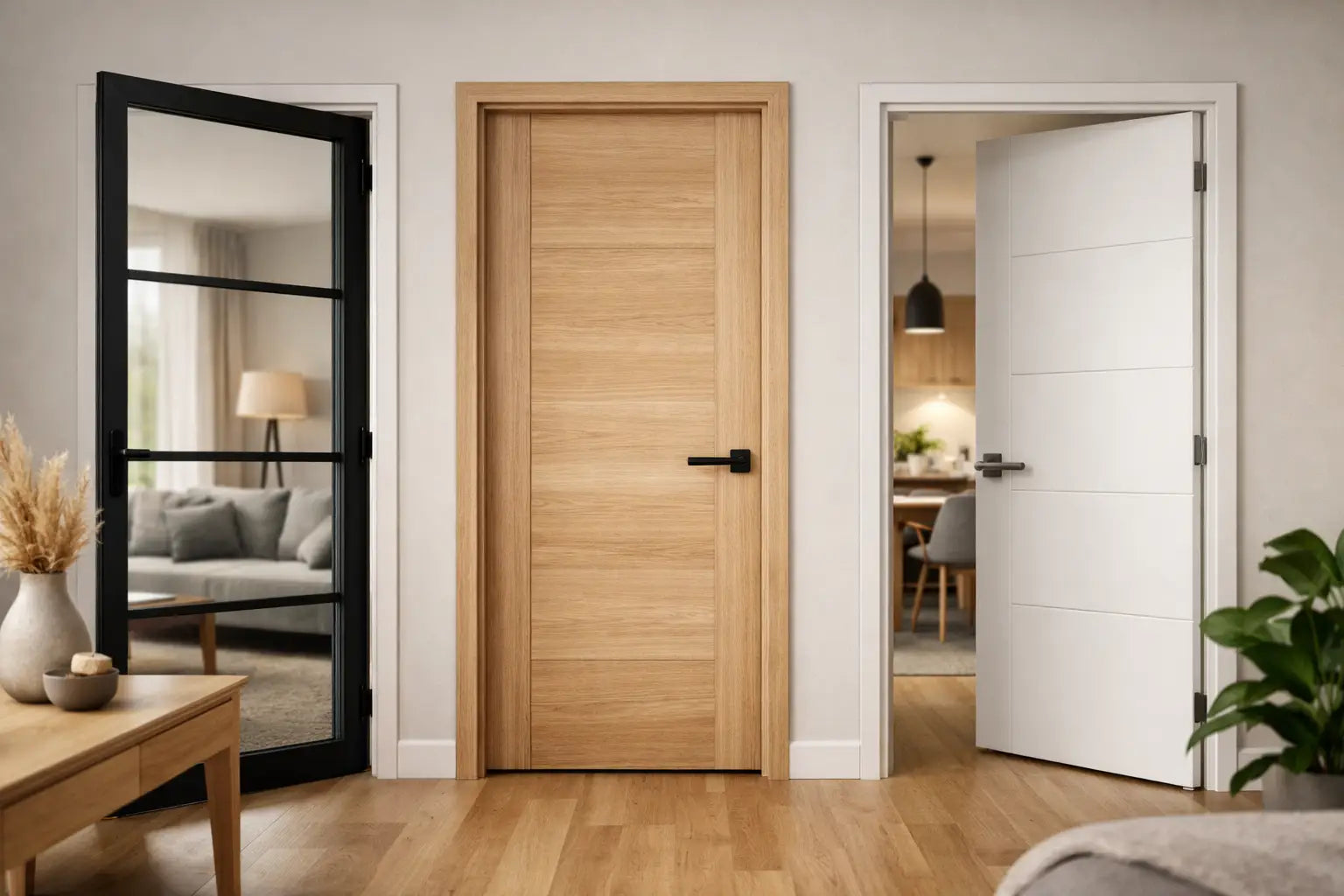
If you're planning a home renovation, self-build project, or simply updating your interiors room by room, the internal door trends for 2026 are already shaping the way UK homeowners approach interior design. Internal doors are no longer viewed as a finishing touch; they have become a key design feature that influences the style, functionality, and value of a property. Alongside aesthetics, buyers are placing greater emphasis on fire-rated internal doors, pre-assembled door sets, natural light, premium ironmongery, and high-quality finishes that simplify installation while enhancing everyday living.
This shift reflects changing priorities in modern homes, where an internal door is expected to do far more than separate one room from another. The right internal door should complement flooring, skirting boards, wall panelling and architectural mouldings, while also improving privacy, reducing noise transfer and supporting a cohesive interior design. For many renovation and new-build projects, considerations such as solid core construction, glazed internal doors, acoustic performance, and compliance with FD30 or FD60 fire door standards are now just as important as the overall appearance.
Black internal doors are settling into the mainstream
Black-framed and black-finished internal doors are no longer a niche design choice. They have become a reliable option for contemporary homes, especially in extensions, kitchen-diners, and renovation projects aiming for stronger architectural lines.
The reason they work is simple. Black creates definition. It frames wall openings, complements modern glazing, and pairs well with popular finishes such as stone, concrete-effect flooring, pale timber, and neutral paint colours. This is especially true with clear glazed or reeded glazed designs.
There is a trade-off, though. In compact rooms or dark hallways, too many black doors can make the space feel heavier. For that reason, many buyers are using black more selectively - perhaps on key feature openings downstairs, while keeping lighter doors in bedrooms and secondary rooms.
Glazed doors are being used more strategically
One of the most practical internal door trends 2026 is the rise of glazed doors for light-sharing rather than pure decoration. In many UK homes, especially terraces, semis and converted properties, the challenge is getting daylight to travel further through the floorplan. Internal glazing helps solve that.
Single-glazed doors, glazed pairs, and doors with slim vertical panes are proving popular because they keep rooms feeling connected without removing separation altogether. This is particularly useful between hallways and kitchens, lounges and dining rooms, or home offices and landings.
Reeded and frosted glazing are also growing in appeal where buyers want borrowed light with more privacy. That makes them a strong option for utility rooms, studies, and bathrooms, depending on the layout. Clear glazing still suits open-plan spaces best, but privacy glass is where many schemes become more practical.
Slim profiles and shaker details are leading style choices
In terms of design language, shaker doors remain one of the safest and strongest categories going into 2026. Their appeal is broad because they can sit comfortably in modern homes, period renovations, and developer-led schemes without dating quickly.
What is changing is the detailing. More buyers are moving towards slimmer rails, cleaner panel proportions, and less fussy designs. That gives the door a more contemporary edge while keeping the familiar framed look that customers trust. Fully flush doors are still relevant in very minimal interiors, but shaker styles tend to offer more flexibility across a full property.
For projects where resale matters, this is worth noting. A highly unusual design can be attractive in a showroom or on a mood board, but classic proportions often hold value better.
Fire doors are becoming more design-conscious
A notable development for 2026 is that fire-rated internal doors are no longer being treated as a compromise option. With better ranges across oak, primed, white, black, and glazed styles, buyers can now meet specification requirements without making a landing or corridor feel institutional.
This matters for loft conversions, HMOs, flats, mixed-use buildings, and any domestic setting where compliant fire door installation is required. More customers are specifically searching for FD30 fire doors that match their standard internal doors visually, rather than settling for an obvious mismatch.
That shift also reflects greater awareness. Buyers understand that the leaf is only part of the picture. The frame, intumescent strips, hinges, latch, and closer, where required, and the quality of installation all play a part. A stylish fire door is only a good product choice if it is specified and fitted correctly.
Door sets and pre-assembled options are gaining ground
As projects become more specification-led, there is more interest in complete door solutions rather than just individual door leaves. Pre-assembled door sets and coordinated systems are attractive because they can simplify ordering, reduce fitting issues, and offer greater consistency across larger jobs.
This is especially relevant for developments, landlord refurbishments, and commercial work, but homeowners are also seeing the value. If you are trying to avoid delays caused by incompatible components, a more complete system can make sense. It may cost more upfront than buying loose parts, but it can save time on site and reduce mistakes.
Space-saving doors are moving beyond specialist projects
Pocket doors and sliding systems are becoming more common in ordinary domestic layouts, not just architect-designed homes. With smaller extensions, en-suites, utility rooms, and box rooms all under pressure to work harder, saving swing space has obvious appeal.
In 2026, the difference is that these products are being chosen earlier in the planning stage. Instead of treating a pocket system as a late upgrade, buyers are building it into the layout from the outset. That leads to a better result because wall construction, lining dimensions, and ironmongery can all be considered properly.
This trend will not suit every opening. Standard hinged doors remain the most straightforward and cost-effective option in most rooms. But where circulation space is limited, a pocket or sliding door can be a practical gain rather than a design gimmick.
Hardware finishes are shaping the final look
Door trends are no longer just about the leaf. Ironmongery now has a stronger role in the finished scheme, and buyers are paying attention to handle style, hinge finish, and latch colour as part of the wider interior palette.
Matt black remains popular, particularly with black-framed or shaker doors, but it is not the only finish worth considering. Satin brass continues to perform well in warmer schemes, while satin nickel and polished chrome still suit more neutral or traditional interiors. The right choice depends on the level of contrast you want and how much continuity you need with lighting, sockets, and cabinetry.
The practical point is that hardware should not be chosen in isolation. A premium door can lose its impact if the ironmongery looks like a late compromise.
What buyers should prioritise before following a trend
Not every trend will suit every property. A Victorian terrace, a modern flat, and a new-build family home all have different proportions, light levels, and compliance needs. The best buying decisions usually come from filtering style through function.
Start with room use. Bedrooms may need better acoustic separation, bathrooms need privacy, hallways often benefit from glazing, and upper-floor escapes may require fire-rated solutions. Then consider finish consistency across the property, followed by practical details such as core construction, hardware compatibility, and installation method.
This is where a specialist supplier has a real advantage. A broad product range makes it easier to compare standard internal doors, glazed options, pocket door systems, FD30 and FD60 products, and matching ironmongery in one place, rather than piecing together a scheme from mixed sources.
For 2026, the strongest direction is clear. Buyers want internal doors that look sharper, work harder, and fit the project properly, whether the priority is design impact, compliance, or speed on site. If you choose with that in mind, trends stop being a distraction and start becoming a useful shortcut to a better result.
The smart approach is not to chase every new look. It is to choose doors that still feel right when the paint is dry, the hardware is fitted, and the property is being lived in.
For more information about our interior or exterior doors or door accessories, give us a call at 01603 622261 and speak to a member of our expert team today, or email us at sales@doorsuppliesonline.co.uk. We look forward to hearing from you.