
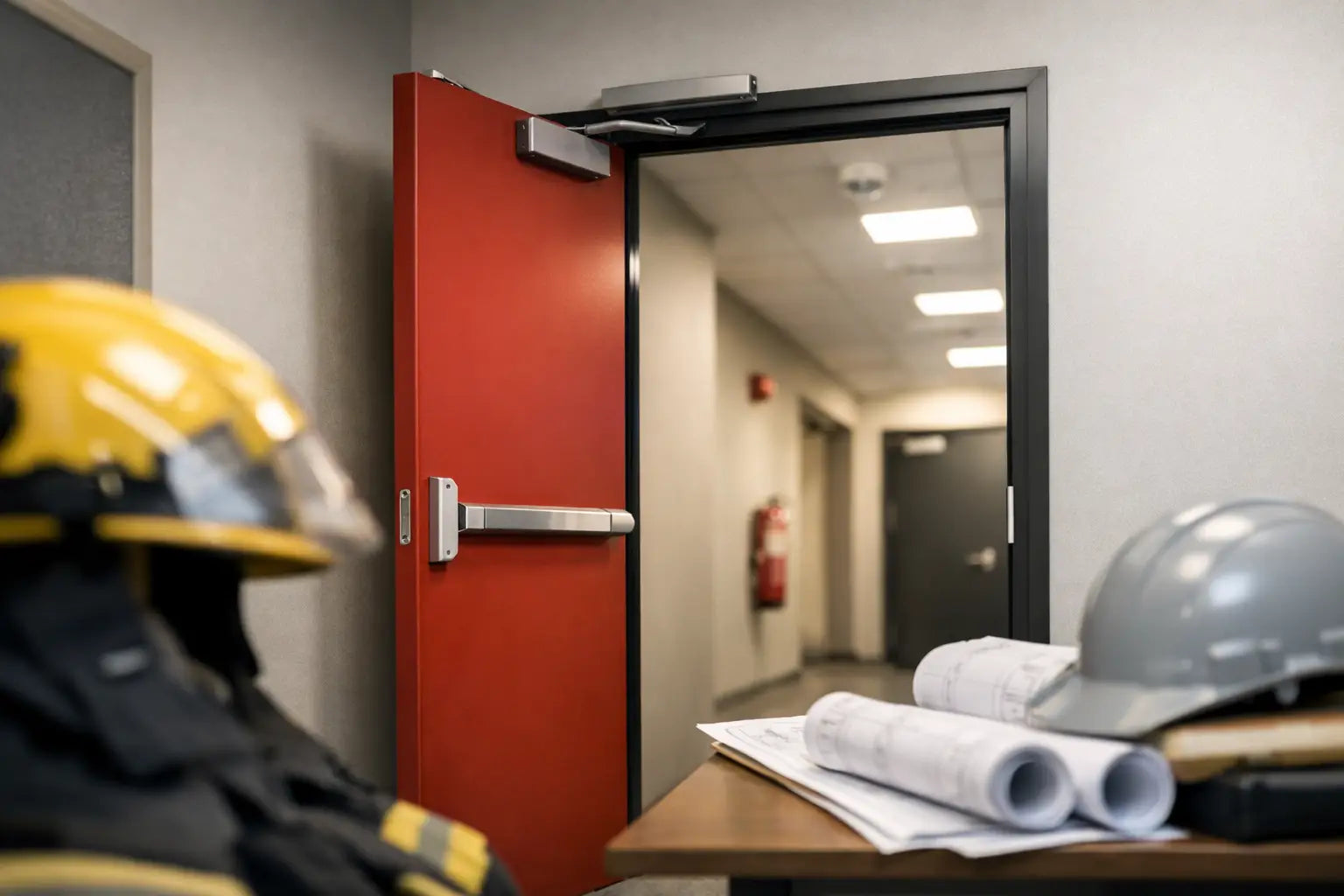
A fire door set may appear to meet the specification on paper, but problems often arise during installation if the individual components have not been designed and tested to work together. Common issues include separately sourced frames, incompatible ironmongery, incorrect clearances, and uncertainty over whether the complete assembly has been certified as a single unit. These seemingly minor mistakes can affect both installation quality and fire performance. That is why fire door sets are increasingly specified across residential, commercial, and multi-occupancy developments, offering a fully tested, factory-prepared solution that helps reduce risk, minimise delays, and improve compliance with UK building regulations.
Whether you're specifying an apartment entrance fire door, fitting out a communal corridor, upgrading a commercial property, or managing a high-specification refurbishment, choosing the right fire door solution is essential. The decision is no longer simply about selecting a fire-rated door, it is about determining whether a complete fire door set, comprising the door leaf, frame, seals, glazing (where applicable), and compatible ironmongery, provides a more reliable, compliant, and cost-effective option than sourcing each component separately. For homeowners, landlords, developers, and contractors alike, a certified fire door set offers greater confidence in performance, simpler installation, and long-term peace of mind.
What are fire doorsets?
A fire doorset is a complete assembly supplied to work together as a single tested unit. That usually includes the door leaf, frame, or lining, intumescent seals, hinges, and any compatible glazing or hardware required by the test evidence and certification. In many cases, it is also pre-machined or pre-assembled, which reduces the amount of interpretation needed during installation.
That matters because fire performance is not only about the door leaf itself. A certified leaf fitted into the wrong frame, with the wrong latch, closer, or seal arrangement, may no longer reflect the tested specification. A doorset removes much of that uncertainty by keeping the components aligned from the start.
For buyers, the practical appeal is straightforward. You are not trying to build a compliant fire door assembly from mixed parts and assumptions. You are buying a system.
Why fire doorsets make sense on real projects
The biggest advantage is control. On specification-led jobs, especially where building control, housing requirements, or commercial compliance are in play, control saves time. Instead of checking whether the frame density is right, whether the hinges match the test data, and whether the glazing system is approved, you are working from a tested package.
That does not mean a doorset is always the cheapest route on first glance. Buying components separately can sometimes look less expensive, particularly on small jobs. But the trade-off is complexity. If any part is wrong, the cost quickly moves from the product to remedial work, replacement hardware, wasted labour, or delays on handover.
For landlords, developers, and contractors, that is often the deciding factor. A doorset can reduce snagging, simplify ordering, and create a clearer paper trail for compliance. For homeowners and renovators, it can simply make an otherwise technical purchase much easier to get right.
Fire doorsets and fire door assemblies - what is the difference?
This is where buyers often get caught out. A fire door assembly is commonly created by combining individual components on site - door leaf, frame, seals, and hardware sourced separately. That approach can work, but only when every element is suitable and installed exactly in line with the relevant certification and manufacturer guidance.
A fire doorset, by contrast, is supplied as a tested unit. The distinction is important because the more products that are selected separately, the more responsibility sits with the person specifying and fitting them. That may be perfectly manageable for an experienced joiner working on detailed test evidence. It is less attractive for buyers who want a more straightforward route.
In simple terms, if you want fewer variables, a doorset is usually the stronger option.
Choosing the right fire rating
Most buyers will start with FD30 or FD60. An FD30 doorset is intended to provide 30 minutes of fire resistance, while an FD60 doorset is designed for 60 minutes. The right rating depends on the location, building type, and specification requirements.
For many domestic settings, FD30 is the common choice - particularly on internal routes where 30-minute protection meets the design intent and regulatory need. In larger buildings, commercial settings, or higher-risk applications, FD60 may be required. Flat entrance doors can introduce another layer of complexity, especially where security performance, smoke control, and acoustic properties are also under consideration.
This is one of those areas where guessing is expensive. If the requirement is not crystal clear, it is worth confirming the fire rating before placing the order rather than trying to adapt later.
Where fire doorsets are commonly used
The obvious applications are flat entrance doors, communal areas, stairwells, riser cupboards, and plant rooms, but they are equally relevant in houses, extensions, loft conversions, and garage access points where fire separation is required. Commercially, they are widely used in offices, schools, healthcare environments, hospitality settings, and mixed-use developments.
The setting affects the specification. A landlord replacing a corridor door may focus on compliance and durability. A homeowner may need a fire-rated door that works with a specific interior style, such as oak veneer, primed white, black, or glazed designs where appropriate. A developer may need consistency across multiple openings with dependable lead times and coordinated hardware.
That is why product range matters. Fire safety is non-negotiable, but buyers still need the right format, finish, and performance for the building.
What to check before you buy fire doorsets
The first check is certification and test evidence. A product should be clearly described, with the rating, configuration, and compatible components easy to understand. If glazing, sidelights, or overpanels are involved, those need to be considered as part of the overall specification rather than as visual extras.
The second is size and handling. This sounds basic, but it causes plenty of avoidable ordering errors. Confirm the structural opening, finished floor levels, swing direction, and whether the doorset is intended for new build or retrofit conditions. A pre-assembled set can save installation time, but only if the dimensions are right from the outset.
Third, pay close attention to hardware. Hinges, latches, locks, handles, closers, thresholds, and seals are not decorative afterthoughts. They are part of the tested performance. If security is also required, for example, on flat entrance doors, the ironmongery specification becomes even more important.
Finally, think about site conditions. A premium doorset specified for a clean internal environment may not be the right choice for a heavily trafficked commercial entrance. Finish, core construction, edge detail, and maintenance expectations all matter.
The role of pre-assembled fire doorsets
Pre-assembled fire doorsets are popular because they reduce workshop and site labour. The machining is done in advance, the compatibility question is largely dealt with, and installation can be more consistent. For trade buyers managing multiple plots or repetitive openings, that efficiency is a real commercial benefit.
There is also a quality advantage. Factory preparation can deliver better consistency than piecing everything together under site pressure. That does not remove the need for correct installation, of course, but it gives installers a cleaner starting point.
For one-off domestic projects, the value is different but still clear. If you are not used to specifying fire door components, a pre-assembled option can remove much of the complexity.
Style still matters
Fire-rated products are often assumed to be purely functional, but the market has moved well beyond basic institutional designs. Buyers can now source fire doorsets in a wide range of finishes and styles, from traditional panelled looks to modern flush designs, with options that coordinate more naturally with the rest of the property.
That is especially useful in renovations and flat developments where visual consistency matters. A fire door should do its job, but it should not feel like an awkward compromise if the wider interior scheme is carefully considered.
The balance is simple. Start with the performance requirement, then choose the look within that framework. Not the other way round.
Getting the specification right the first time
A good supplier should make fire doorsets easier to buy, not harder. Clear categorisation by rating, use case, finish, and configuration helps buyers narrow down quickly, whether they are ordering a single replacement or specifying across a larger project. That is where a specialist range earns its place over a general merchant offer.
Door Supplies Online serves this part of the market well because the range covers both style-led and compliance-led buying, from standard internal fire doors to more technical categories such as flat entrance and commercial solutions. For buyers who want product choice without losing sight of specification, that specialist focus makes a practical difference.
It is still worth asking the right questions before checkout. Is this the required rating? Is the hardware included or specified? Is the doorset supplied assembled, unfinished, primed, or factory finished? Does the application call for extra performance such as smoke seals, security, or acoustic control? The more precise the brief, the easier the purchase.
Fire safety products should not be bought on guesswork or visuals alone. When the opening matters, a tested system is often the most sensible route - not because it is the most complicated option, but because it removes complication where it counts.
For more information about our interior or exterior doors or door accessories, give us a call at 01603 622261 and speak to a member of our expert team today, or email us at sales@doorsuppliesonline.co.uk. We look forward to hearing from you.