
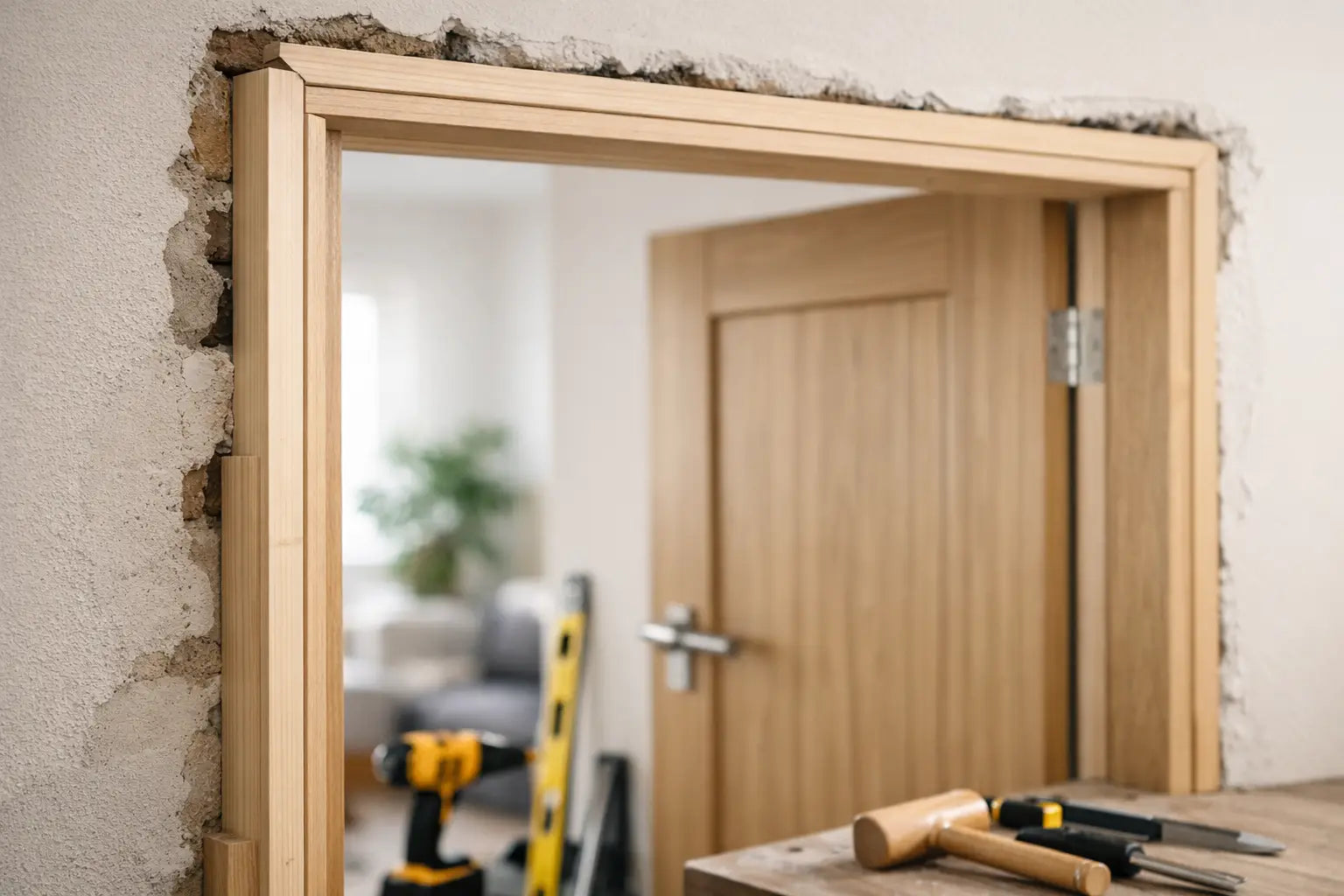
If you're planning to replace an internal door, renovate your home or undertake a full property refurbishment, you may come across terms such as door lining, door casing, door stops and architraves. One of the most common questions is: What is an internal door lining? Understanding its purpose is essential, as the door lining forms the foundation of every well-installed internal door.
An internal door lining is the timber framework fitted inside a wall opening to create the structural opening for an internal door. It forms the two sides and the head of the doorway, providing a secure and stable surface for hanging the door leaf. The lining also supports the installation of door stops, hinges and architraves, helping to create a neat, professional finish. Without a properly fitted door lining, even the highest-quality internal door may not operate correctly or achieve the desired appearance.
For homeowners, choosing the correct internal door lining is crucial for ensuring a precise fit, smooth door operation and an attractive finish. It also plays an important role in the overall performance of the door, particularly where fire doors, acoustic doors or pre-assembled door sets are concerned. A well-installed lining helps maintain correct clearances, supports long-term durability and contributes to improved insulation and sound reduction.
What is internal door lining used for?
The main job of an internal door lining is to create a square, secure and properly sized opening for the door. It is installed within the structural opening in the wall, then the door is hung onto one side using hinges. Once the lining is fixed and packed plumb, the rest of the door set-up becomes much more straightforward.
It also helps bring the wall thickness and the doorway into one clean finished detail. That is why linings are commonly paired with architraves, which cover the joint between the wall and the timber lining. Door stops are then added to control how far the door closes.
In everyday residential work, internal door linings are used for bedrooms, bathrooms, living rooms, cupboards and utility spaces. In larger renovation and trade projects, they can also be specified alongside fire doors, glazed doors and bespoke-sized internal doors, although the exact lining requirement depends on the door type and performance standard.
Internal door lining vs door frame
This is where confusion usually starts. Many people use the terms interchangeably, but they are not always the same thing.
A door lining is generally a simpler internal joinery component designed to fit inside the wall opening. It usually arrives as a set of timber sections that can be cut and assembled on site. A door frame is often seen as a more complete or heavier-duty structure, and in some product categories, it may come factory-machined, complete with stops or prepared for specific hardware.
In domestic internal applications, a lining is commonly the standard choice. For more specialist uses, such as some fire-rated, commercial or pre-assembled door sets, the frame specification may be more technical and tightly controlled. That distinction matters if performance is part of the brief, not just appearance.
So if you are fitting a standard internal oak door in a house, a door lining may be exactly what you need. If you are dealing with an FD30 or FD60 door set, you should not assume a standard lining will do the same job. The construction, certification and preparation requirements can differ.
What is an internal door lining made of
Most internal door linings are manufactured from softwood, MDF-based materials or engineered timber products. Softwood remains common because it is cost-effective, easy to work with on-site and suitable for painting, priming, or further finishing depending on the product.
The best choice depends on the project. For straightforward domestic work, a standard softwood lining often makes sense. If you want a very consistent painted finish, some buyers prefer engineered or primed options where available. If the project involves higher traffic, tighter tolerances or specific fire performance, the lining specification should match the door requirement rather than simply the cheapest option on the shelf.
Material choice also affects how the lining behaves over time. Timber is a natural product, so site conditions matter. Poor storage, damp environments or rushed fitting can lead to movement, twisting or uneven gaps. A properly selected lining, fitted correctly, gives the door a better chance of opening and closing cleanly for years.
The parts of an internal door lining
A standard internal door lining is made up of two vertical legs, often called jambs, and one horizontal headpiece across the top. Together, they form the basic opening.
Once the lining is in place, door stops are fitted around the inside edge so the door has something to close against. Architrave is then added around the outside face for a neat finish against the wall. The threshold area at the bottom may be left open on many internal doors, although some installations have a sill or floor transition depending on the design.
That is why ordering only the door leaf is rarely the whole job. In many refurbishments, the existing lining can be reused if it is sound, square and correctly sized. In plenty of projects, though, replacing the lining is the smarter route because it gives you a clean starting point and avoids trying to make a new door fit a poor opening.
Why sizing matters
The size of the door lining has to suit both the door leaf and the wall thickness. These are two separate measurements, and both matter.
First, the internal opening of the lining needs to accommodate the door size with suitable clearance. Too tight and the door can bind. Too loose and the gaps will look poor. Second, the lining depth needs to suit the finished wall thickness, including plasterboard and plaster where relevant. If the lining is too narrow, it will not sit flush with the wall faces. If it is too deep, you create unnecessary finishing work.
This is one reason internal door projects can become more involved than expected. Older properties are rarely perfectly standard, and renovated walls can vary from room to room. A lining that works well in a new-build partition may not suit a solid wall opening in a Victorian terrace.
For trade buyers and experienced renovators, measuring the structural opening and the finished wall build-up before ordering is the sensible approach. It saves trimming, packing and compromise later.
When should you replace an internal door lining?
If the existing lining is damaged, out of square, heavily painted, split around the hinge area or simply the wrong size for the new door, replacement is usually the cleaner solution. Trying to upgrade the door while keeping a poor lining often creates more labour than fitting a new one.
You should also think carefully about replacement when changing door type. Moving from a lightweight old moulded door to a heavier solid core door, for example, can expose weaknesses in the existing lining and hinge fixings. The same applies when upgrading for fire performance. Not every existing lining is suitable, and assumptions can become costly.
That said, replacement is not always necessary. If the current lining is structurally sound, square and compatible with the new door dimensions, retaining it can reduce disruption and keep costs down. This is one of those areas where it depends on the condition of the opening, the finish you want and the door specification.
What is internal door lining in fire door projects?
In standard domestic door replacements, a basic lining may be enough. In fire door installations, the question of what is internal door lining becomes more technical.
A fire door assembly relies on compatible components working together. That can include the door leaf, frame or lining, hinges, intumescent protection, seals, glazing where applicable, and ironmongery. A standard non-fire-rated lining should never be assumed suitable for an FD30 or FD60 application without checking the specification.
In many fire door projects, the safest option is a tested or clearly specified system where the frame or lining is part of the intended assembly. That is particularly relevant in HMOs, flats, commercial premises and anywhere compliance is not optional. Product-led specification is critical here because appearance alone tells you very little about performance.
Buying the right lining for your project
The best internal door lining is not always the most expensive one. It is the one that matches the wall construction, the door size, the finish level and, where relevant, the required performance.
For a straightforward internal refurbishment, focus on accurate sizing, a stable material and compatibility with your chosen door style. If you are coordinating multiple doors across a property, consistency matters as much as unit price. Matching linings, architraves and hardware usually creates a better result than buying each part in isolation.
For more technical projects, especially where fire rating or pre-assembled solutions are involved, it makes sense to buy from a specialist supplier rather than a general merchant with a limited range. Door Supplies Online supports both domestic and trade customers with a broad choice of door categories, frames, linings and hardware, which makes it easier to source components that actually belong together.
The key point is simple. An internal door lining is not just a bit of timber around a hole in the wall. It is the foundation of how the door fits, functions and finishes. Get that detail right at the start, and the rest of the job tends to fall into place far more smoothly.
For more information about our interior or exterior doors or door accessories, give us a call at 01603 622261 and speak to a member of our expert team today or email us at sales@doorsuppliesonline.co.uk. We look forward to hearing from you.