
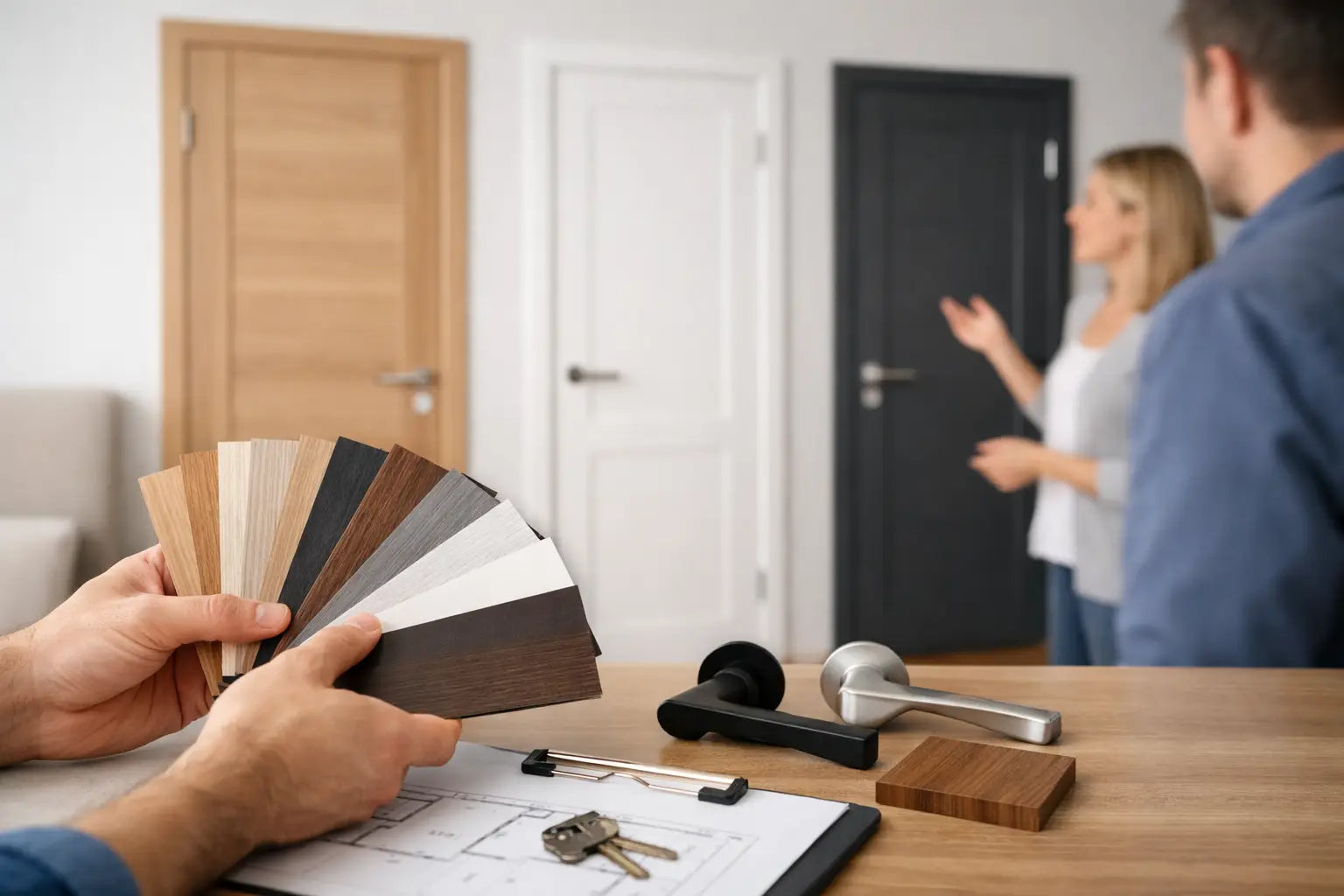
Replacing an old moulded door with a stylish solid oak Shaker door may seem like a simple upgrade, but the process can quickly become more complex if the doorway is non-standard, the frame is out of square, or certain rooms require fire-rated internal doors. Understanding how to buy internal doors is about more than choosing a design you like, it's about balancing style with the correct size, construction, and performance. Taking both the aesthetic and technical aspects into account from the outset will help you choose the right internal door for your home and avoid costly fitting issues later.
A high-quality internal door does far more than divide one room from another. The right choice can improve the flow of natural light, enhance privacy, reduce noise transmission, increase durability, and, where required, support fire safety compliance. Whether you're selecting oak internal doors, glazed internal doors, solid-core doors, or complete pre-assembled door sets, every decision influences the appearance, functionality, and long-term performance of your interior.
How to buy internal doors: start with the opening
Before looking at styles, measure properly. This is where most buying mistakes begin. You need the structural opening or existing door size, as well as a clear sense of whether you are replacing a door leaf only or the full door set, including frame, linings, and architraves.
In many homes, especially older properties, the opening is not perfectly square, and standard sizes do not always drop straight in. If you are replacing like-for-like, measure the current door slab in millimetres - height, width, and thickness. Then check how much can realistically be trimmed. Different doors allow different trim tolerances, and that matters. A solid core door may offer more flexibility than a heavily glazed design, while some factory-finished doors have more limited trimming allowances to protect the finish and structure.
If the frame is damaged, twisted, or poorly fitted, replacing the slab alone can be a false economy. In that case, a complete door set or pre-assembled option can save fitting time and produce a better final result. This is particularly useful on projects with multiple doors where consistency matters.
Choose the right door type for the room
Internal doors are not one category. Bedrooms, bathrooms, utility areas, lounges, and loft conversions all have different demands, so the best choice depends on use as much as style.
For most general living areas, standard internal doors will do the job. In bedrooms and studies, solid core construction is often preferred because it feels better in use and offers improved sound reduction. In bathrooms and en-suites, privacy is usually the priority, though glazing can still work if it is frosted or obscure.
Where space is limited, bi-fold or pocket door systems can make far better use of the room than a traditional swing door. These options suit en-suites, cupboards, utility rooms, and smaller extensions, but they need planning. Pocket systems in particular should be considered early, because wall construction and lining details affect the installation.
Then there is fire performance. If a door sits on a protected route, between a house and an integral garage, or in a flat or multi-occupancy setting, a standard internal door may not be suitable. That is where FD30 or FD60 fire doors come in, along with the correct frame, seals, and compatible ironmongery.
Style matters, but so does consistency
Most buyers start with appearance, and that is fair enough. Internal doors have a big visual impact. The key is to choose a style that works across the property rather than picking each door in isolation.
In modern interiors, clean-lined shaker, flush or ladder-style designs are popular because they sit comfortably with contemporary flooring, black ironmongery and minimalist joinery. In more traditional homes, panelled oak doors, white primed classics, and glazed heritage styles tend to feel more natural. If you are renovating for resale or letting, neutral and broadly appealing designs usually make more commercial sense than highly specific statement styles.
Finish is just as important. Unfinished doors give you flexibility if you want to stain, oil, or paint to match existing woodwork. Primed doors reduce preparation and are ideal if you plan to top-coat in a chosen colour. Fully finished doors are often the quickest route to a consistent result, especially on larger jobs, though you need to handle them carefully during installation.
If you are buying several doors at once, think about how they will look along a hallway or landing. Mixed styles can work, but only if there is a clear reason. Most of the time, keeping one family of designs throughout the property gives a cleaner, more considered finish.
Think carefully about glazing and light
Glazed internal doors can transform darker parts of a home. A partly glazed door between a hallway and lounge, for example, can help borrowed light travel through the space and make the whole layout feel less enclosed.
That said, glazing is not right everywhere. Bedrooms and bathrooms usually call for more privacy. Frosted or obscure glass can offer a practical compromise, while clear glazed doors are better suited to reception rooms, kitchens, and home offices where openness matters more.
You also need to think about safety and specification. If the door requires a fire rating, the glazing and bead detail must be part of an approved fire door construction. You cannot assume that a glazed door offers the same performance as a solid standard model simply because the sizes look similar.
Fire doors are about the full specification
One of the most common errors in learning how to buy internal doors is assuming the fire label on the door leaf is enough. It is not. Fire performance relies on the complete assembly working together.
An FD30 door is designed to provide 30 minutes of fire resistance, while an FD60 is designed for 60 minutes, but only when installed with the correct components. That may include a compatible frame, intumescent strips, smoke seals, hinges, latch, and approved glazing where applicable. If the opening requires a compliant fire door, the detail matters as much as the door itself.
This is where specialist supply makes a difference. Buying from a door-led retailer rather than a general merchant makes it easier to source matching frames, ironmongery, and pre-assembled fire door sets without second-guessing compatibility. For landlords, developers, and trade buyers, that reduces risk as well as installation time.
Do not overlook thickness, core, and feel
Two doors can look similar online and perform very differently once fitted. Thickness, core construction, and weight all affect quality.
Lightweight hollow or semi-solid options can suit low-traffic areas and tighter budgets, but they do not usually deliver the same acoustic performance or premium feel as solid core designs. A heavier door tends to close better, sound better, and stand up to everyday use more convincingly. In family homes, rentals, and commercial settings, that extra durability is often worth paying for.
Door thickness also matters because it must work with the frame and hardware specifications. Standard internal doors and fire doors often differ here, so always check product details before ordering hinges, latches, and handles.
Match the ironmongery and finishing products
A well-chosen door can still look underwhelming if the hardware is wrong. Handles, hinges, latches, privacy turns, and stops should be considered as part of the purchase, not as an afterthought.
Black hardware creates a crisp modern contrast against white, oak, or grey finishes. Satin chrome remains a reliable all-rounder. In more traditional schemes, polished brass or antique finishes may be a better fit. The important point is consistency. If your hinges are satin chrome and your latch faceplate is brass, the mismatch shows.
You should also think about what else is needed to complete the job. That may include frames, linings, architraves, casings, intumescent strips, drop seals, pocket door kits, and finishing products. Buying the whole package at once generally avoids delays and helps ensure all parts are suitable for the chosen door.
Budget properly, not just cheaply
Internal doors are available at many price points, and the cheapest option is not always a poor value. If you are refreshing a rental property or upgrading a box room, a more economical range may be entirely appropriate. But cost should be weighed against lifespan, appearance, installation time, and the likelihood of replacement.
A factory-finished door may cost more upfront than an unfinished equivalent, yet save time and decorating labour. A pre-assembled set can look more expensive on paper, but makes sense where labour costs are high or programme time is tight. For larger projects, coordinated ordering also tends to make budgeting clearer because the hidden extras are identified earlier.
The final check before you order
Once you have shortlisted a door, pause and confirm the full specification. Check the handing if relevant, size, thickness, finish, trimming allowance, glazing type, fire rating, hardware requirements, and whether you need just the leaf or a complete set. If the project includes multiple rooms, review them together rather than one by one. That helps catch inconsistencies before they become returns or site delays.
For buyers who want range, technical support, and strong pricing in one place, a specialist supplier such as Door Supplies Online makes this process easier because the categories are built around how people actually buy - by style, finish, fire rating, brand, and hardware compatibility.
The best internal door purchase is rarely the one that looks nicest in isolation. It is the one that fits properly, suits the room, meets the spec, and still looks right every time you walk through it.
For more information about our interior or exterior doors or door accessories, give us a call at 01603 622261 and speak to a member of our expert team today, or email us at sales@doorsuppliesonline.co.uk. We look forward to hearing from you.