
Choosing the right internal door style, timber finish and glazing design is only part of creating a complete interior. Even the most premium door can feel unfinished if it is fitted with the wrong hardware. That is why many homeowners and trade professionals ask, what is internal door furniture, and which components are essential?
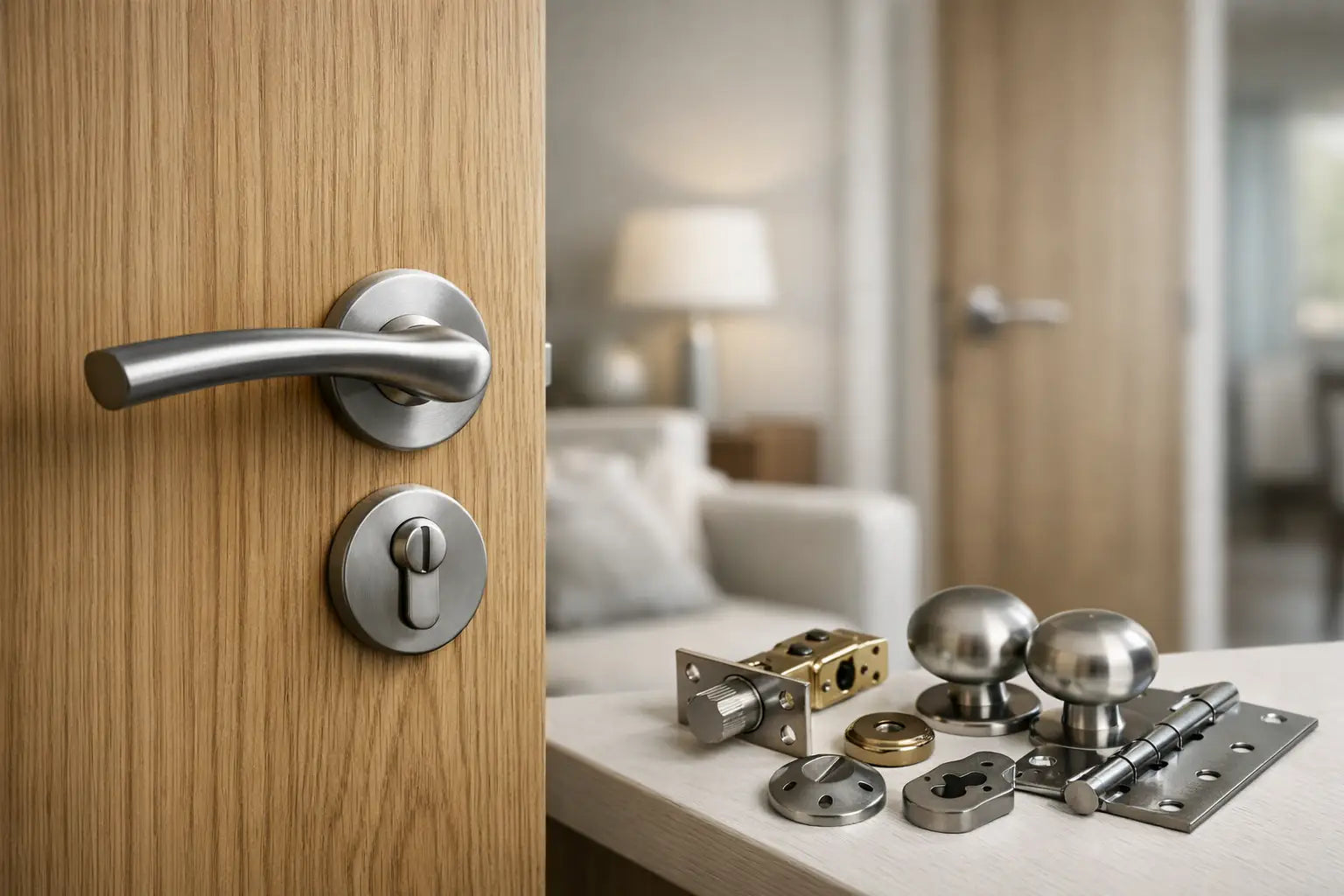
Internal door furniture refers to the collection of functional and decorative hardware fitted to an internal door. This includes door handles, door knobs, hinges, latches, locks, privacy thumbturns, escutcheons, and other fittings that allow a door to operate smoothly while complementing the overall interior design.
Choosing the right internal door furniture is about far more than appearance. High-quality door hardware enhances everyday usability, improves durability, and ensures each door performs as intended in different areas of the home. For example, bathrooms require privacy locks, bedrooms benefit from secure latches, while fire-rated doors must be fitted with certified hardware to maintain their safety performance.
What is internal door furniture made up of?
When people use the phrase internal door furniture, they usually mean the ironmongery fitted to the door leaf and frame that allows the door to open, close, latch, lock or offer privacy. Some buyers use the term narrowly to mean handles and knobs only, but in practical product terms it covers a wider set of components.
The most common items are door handles on rose, lever handles on backplate and mortice door knobs. These are the parts you see and touch most often, so they tend to drive the overall look. Alongside them sit the working components such as tubular latches, bathroom locks, sashlocks and hinges. If you are fitting a bathroom or WC door, you may also need a thumbturn and release set. If the door is a fire door, the specification can become more technical, with fire-rated hinges, compatible latches and intumescent protection forming part of the overall package.
This is why internal door furniture is best thought of as a set rather than a single product. A handle on its own will not complete an installation. It needs the correct latch or lock case, the right spindle, suitable hinges and a finish that works across the full door.
The main types of internal door furniture
For most projects, the choice starts with the operating style. Lever handles are the most popular option because they are easy to use, suit both modern and traditional interiors, and are available in a wide range of finishes. You will see them in satin chrome, polished chrome, matt black, brass, stainless steel and more decorative styles designed to complement oak, white primed or black internal doors.
Door knobs remain a strong choice in period properties and more traditional schemes. They can look excellent on cottage-style, panelled or heritage doors, but they are not always the best fit for every setting. Accessibility and ease of use can be a factor, particularly in homes with children, older occupants or anyone who may find a knob harder to grip than a lever handle.
Backplates and roses also change the appearance of the door. A handle on rose gives a cleaner, more contemporary look, while a handle on backplate often feels more classic and can combine the lever with a keyhole or bathroom turn arrangement.
Then there are the functional fittings. Tubular latches are used where you simply need the door to close and stay shut. Bathroom locks add privacy. Mortice sashlocks allow keyed locking, which may be useful in home offices, shared houses or some landlord settings. Hinges, although less visible, are just as important. The wrong hinge size, finish or grade can spoil operation and reduce longevity.
Handles, knobs and pull handles
Most internal hinged doors use either a lever handle or a knob. Pull handles are more common on sliding doors, pocket door systems or doors where no latch operation is needed. The right choice depends on how the door functions, not just how it looks.
A passage door between a lounge and hallway may only need a lever handle and latch. A bedroom may use the same setup unless privacy or security is required. A bathroom will usually need a bathroom lock with a turn and release. That is why it helps to decide room by room rather than trying to buy one identical setup for the whole property without checking function.
Hinges, latches and locks
These are the working parts that make the furniture set perform properly. Hinges need to support the door weight and suit the door type. Heavier solid core doors and many fire doors require more considered hinge selection than a lightweight hollow door.
Latches and locks also need to match the handle style and the door thickness. Backset, case size and spindle compatibility all matter. This is where many avoidable fitting problems begin. A good-looking handle will not solve a poorly matched latch.
Why internal door furniture matters beyond appearance
The obvious role of internal door furniture is visual. It helps tie together the finish of the door, skirting, lighting, switches and other architectural details. A black handle can sharpen a modern scheme, while antique brass or aged bronze can soften a more traditional interior.
But there is also a practical side. Poor quality door furniture can loosen, stick, tarnish or wear quickly in busy households and rental properties. In commercial or high-traffic settings, the wrong specification can lead to repeated maintenance. Spending slightly more on better hardware is often cheaper than replacing worn fittings a year later.
There is also a compliance angle. On fire doors, not every handle, hinge or latch is suitable. Components should be compatible with the fire door assembly and selected with care. That matters for developers, landlords and anyone upgrading doors where fire performance is part of the requirement, not an afterthought.
How to choose the right internal door furniture
The simplest way to choose well is to work through style, function and specification in that order, then sense-check the whole set before you buy. Buyers often begin with finish alone, but a matt black handle that looks right on the screen still needs to suit the lock type, hinge finish and room use.
Start with the door itself. Is it a standard internal door, a bathroom door, a pocket door or an FD30 fire door? Then think about the room. Does it need privacy, a key lock or just a latch? After that, decide on the visual style. Contemporary flush and shaker doors generally suit cleaner handle designs, while traditional panelled doors often work well with more detailed levers or knobs.
Finish should then be carried consistently across the visible items. Mixed finishes can work, but only if done deliberately. In most homes and developments, consistency gives a more polished result and makes future replacements simpler.
What is internal door furniture for bathrooms and bedrooms?
Bathroom and bedroom requirements are where the differences become clearer. Bathroom door furniture usually includes a handle or knob, a bathroom mortice lock, and a thumbturn with emergency release on the outside. This provides privacy without using a key.
Bedrooms are more flexible. In a standard family home, many bedroom doors use a simple latch only. In shared accommodation, HMOs or some landlord properties, keyed locking may be preferred. It depends on the use of the building and the level of privacy or access control required.
Common mistakes when buying internal door furniture
One of the most common mistakes is treating all internal doors as if they need the same pack. They do not. The en suite door, cupboard door and lounge door may all need different hardware arrangements.
Another issue is forgetting the door thickness. Not all latches, locks and spindles suit every door. This is especially relevant with heavier doors, fire doors and some premium internal ranges. Buyers also sometimes overlook handing, hinge quantity or the need for fire-rated components.
Finish mismatch is another frequent problem. A satin chrome handle paired with polished chrome hinges can look slightly off, even if both are technically chrome. On a single door it may seem minor, but across a full renovation it becomes more noticeable.
Finally, there is the quality question. Decorative hardware that feels light or loose in the hand may not stand up well in busy properties. Trade buyers and experienced renovators usually know that everyday performance matters just as much as first impressions.
Buying internal door furniture as a coordinated set
For most projects, the easiest route is to think in complete door sets rather than separate impulse purchases. That means checking you have the correct handle or knob, latch or lock, hinges, privacy turn where required, and the right finish across the package.
This approach reduces delays on site and helps avoid the familiar problem of fitting doors, then realising a bathroom turn has been missed or the latch depth is wrong for the chosen handle. For larger jobs, consistency also helps with specification, ordering and future maintenance.
At Door Supplies Online, buyers often shop this category alongside internal doors, fire doors and matching ironmongery because it simplifies the process. That is particularly useful when you are balancing design, performance and value across multiple rooms or a whole development.
Internal door furniture is not just a finishing touch. It is what makes the door usable, keeps the look consistent and helps the installation feel properly considered. Choose it with the same care as the door itself, and the result will work better from day one and still look right years later.
For more information about our interior or exterior doors or door accessories, give us a call at 01603 622261 and speak to a member of our expert team today or email us at sales@doorsuppliesonline.co.uk. We look forward to hearing from you.