
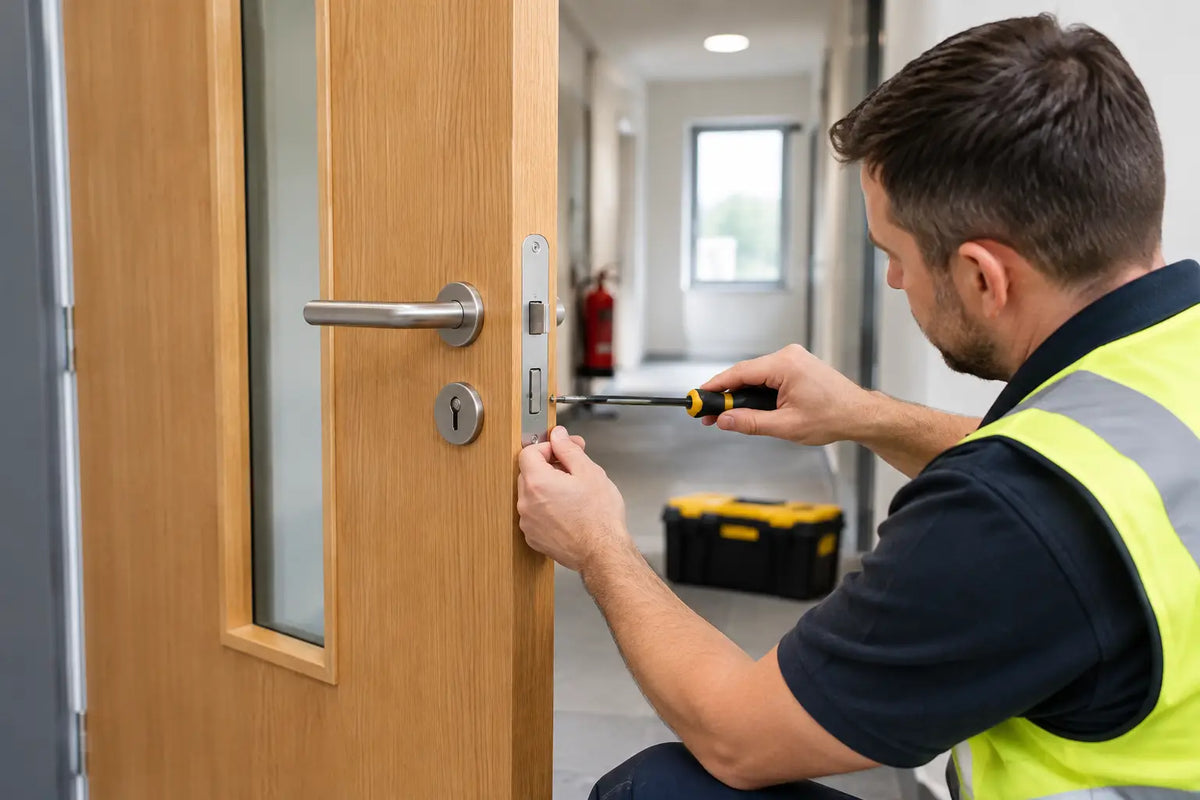
A fire door may appear to be in good condition while hiding defects that compromise its fire resistance. Excessive gaps, loose hinges, damaged or missing intumescent seals, unsuitable glazing and faulty door closers can all affect its ability to contain fire and smoke. These fire door refurbishment examples explain common defects, when fire door repairs and remedial work may be appropriate, and when a complete fire door replacement is the safer option.
Refurbishing a fire door involves more than repairing visible damage or improving its appearance. A fire door forms part of a tested or assessed assembly that includes the door leaf, frame, intumescent and smoke seals, hinges, glazing, ironmongery and installation details. Replacing or modifying individual components without suitable supporting evidence can compromise its fire resistance and compliance with relevant UK fire safety requirements.
Whether you are maintaining fire doors in a residential building, commercial property or communal area, the right approach depends on the door's condition, required fire rating and available certification or test evidence. Understanding when to refurbish or replace a fire door helps property owners, landlords and building managers make informed decisions while maintaining fire safety and compliance.
Start with an informed condition assessment
Before ordering hardware, filling damage or applying a new finish, establish what the existing door is and what it needs to achieve. Look for a certification label or plug, manufacturer information and any previous inspection records. An FD30 door may be suitable for a particular location, while another opening may require an FD60 door or a purpose-made fire door set.
A competent fire door inspector, installer or fire risk professional should assess doors in communal areas, commercial premises and other higher-risk settings. Building regulations and fire safety duties vary according to the building and location across the UK, so a repair specification should not be based on appearance alone.
A useful assessment normally considers the door leaf and frame, the perimeter gaps, intumescent and smoke seals, hinges, latch or lock, self-closing device, glazing, signage and any alterations. It should also identify whether the leaf is warped, delaminated, cut down, drilled excessively or damaged around the lock area.
Fire door refurbishment examples in practice
1. Refreshing an FD30 flat entrance door with a sound leaf
In a block of flats, an existing flat entrance door may have a structurally sound FD30 leaf but tired paintwork, worn handles and poorly performing seals. Provided the door’s rating and condition can be confirmed, refurbishment may involve redecorating with a compatible coating, replacing damaged intumescent strips, fitting suitable hinges and renewing the closer so the door closes fully onto the latch.
This is often a good example of targeted refurbishment. The visible finish improves, but the key work is functional: consistent gaps, a secure latch and a closing action that is not defeated by residents. A new spyhole, letterplate or security fitting should only be selected where it is suitable for the fire door construction and rating. Cutting an unapproved opening into the leaf can quickly turn an otherwise viable repair into a replacement job.
2. Repairing a commercial corridor door after impact damage
Busy office, school and healthcare corridors place heavy demands on doors. Repeated trolley strikes can damage the lower edge or face veneer, while loose kick plates and handles can leave fixings enlarged and unstable. If damage is superficial and the door core remains intact, a specialist repair can reinstate the finish and secure compatible ironmongery.
The trade-off is clear. A cosmetic patch may be acceptable on a painted door in a back-of-house corridor, but a split edge, exposed core or deep impact damage needs closer scrutiny. Fire doors rely on their construction remaining intact. If the leaf is severely damaged or has been repaired repeatedly, replacement with a new certified fire door or pre-assembled fire door set may offer better value and clearer assurance.
3. Upgrading seals and closing hardware on a communal door
A door can have the right fire rating on paper yet fail in day-to-day use because it does not close. This is common on communal corridor doors where worn overhead closers, unsuitable hold-open devices or misaligned latches leave the leaf ajar.
A refurbishment programme may include replacing the closer with a correctly specified unit, adjusting the latch engagement, renewing intumescent strips and smoke seals, and checking that the frame is stable. The door must close from the angles people actually use, without being slammed or propped open. If access control, magnetic retainers or automatic operators are involved, their fire-alarm release function must also be checked by competent professionals.
This work sounds straightforward, but it is not a case of fitting any closer that suits the budget. The closer, hinges and latch must be compatible with the door’s size, weight, rating and tested configuration.
4. Retaining period character in a converted property
Older properties and conversions can present the most difficult refurbishment decisions. Original panelled doors, moulded architraves and decorative glazing may be central to the character of a building, but the door may not offer the required fire performance for its new use.
There are specialist upgrading systems for certain door types, but they should be supported by appropriate test evidence and a clearly defined specification. Adding intumescent strips to an ordinary internal door does not automatically make it an FD30 fire door. Nor does applying a fire-retardant coating solve a weak core, unsuitable panels or unprotected glazing.
Where the original door cannot be reliably upgraded, a made-to-measure fire door can often achieve a closer visual match while delivering the necessary rating. This may cost more initially, particularly where a bespoke frame, glazing detail or finish is needed, but it avoids guessing with a critical safety component.
5. Refurbishing a fire door set during a wider office fit-out
During a commercial refurbishment, it is tempting to treat doors as part of the finishing package: new black lever handles, fresh paint and matching signage. This can work where the existing fire door sets are in good condition and the proposed ironmongery is suitable.
The risk comes when a contractor changes too much without recording it. Replacing a lock case can require a larger cut-out. Fitting a decorative flush pull may introduce an unapproved recess. Changing the hinge grade or quantity can affect how the leaf behaves under fire conditions. A planned schedule should identify every door by location, rating, size, existing components and proposed repairs before work starts.
For large programmes, replacement can be more efficient than piecemeal repairs if several components have reached the end of their service life. Pre-assembled fire door sets reduce uncertainty because the leaf, frame, seals and key elements are supplied as a coordinated system. They can also speed up installation where there are many repeat openings.
When refurbishment should stop and replacement should begin
Not every defective fire door is a refurbishment candidate. Replacement is usually the safer option where the rating cannot be established, the leaf has extensive damage, the door has been significantly cut down, the core is exposed, the frame is badly distorted or the glazing system is unknown.
The same applies when the existing door cannot meet the required specification for the opening. A basic internal door cannot be converted into a compliant fire door simply with strips, a closer and three hinges. The leaf, frame and fitted components must work together as a tested or appropriately assessed system.
Cost matters, particularly for landlords and facilities managers responsible for multiple openings. However, a low-cost repair that needs revisiting within months is rarely good value. Compare the complete scope: inspection, repairs, compatible hardware, installation, decoration, certification records and future maintenance. In some cases, a new FD30 or FD60 door set is the more predictable commercial decision.
Specify refurbishment work with the whole assembly in mind
The best fire door refurbishment examples are not defined by a dramatic visual transformation. They are the projects where every change has a clear purpose and the finished door closes, latches and seals as intended.
For homeowners, landlords and trade buyers, the practical next step is to document each opening before purchasing parts. Confirm the required fire rating, measure the leaf and frame, note the existing hardware, and take advice where the door protects an escape route or shared area. Then choose compatible fire door components or a complete replacement set with the same care you would apply to the door leaf itself.
For more information about our interior or exterior doors or door accessories, give us a call at 01603 622261 and speak to a member of our expert team today, or email us at sales@doorsuppliesonline.co.uk. We look forward to hearing from you.