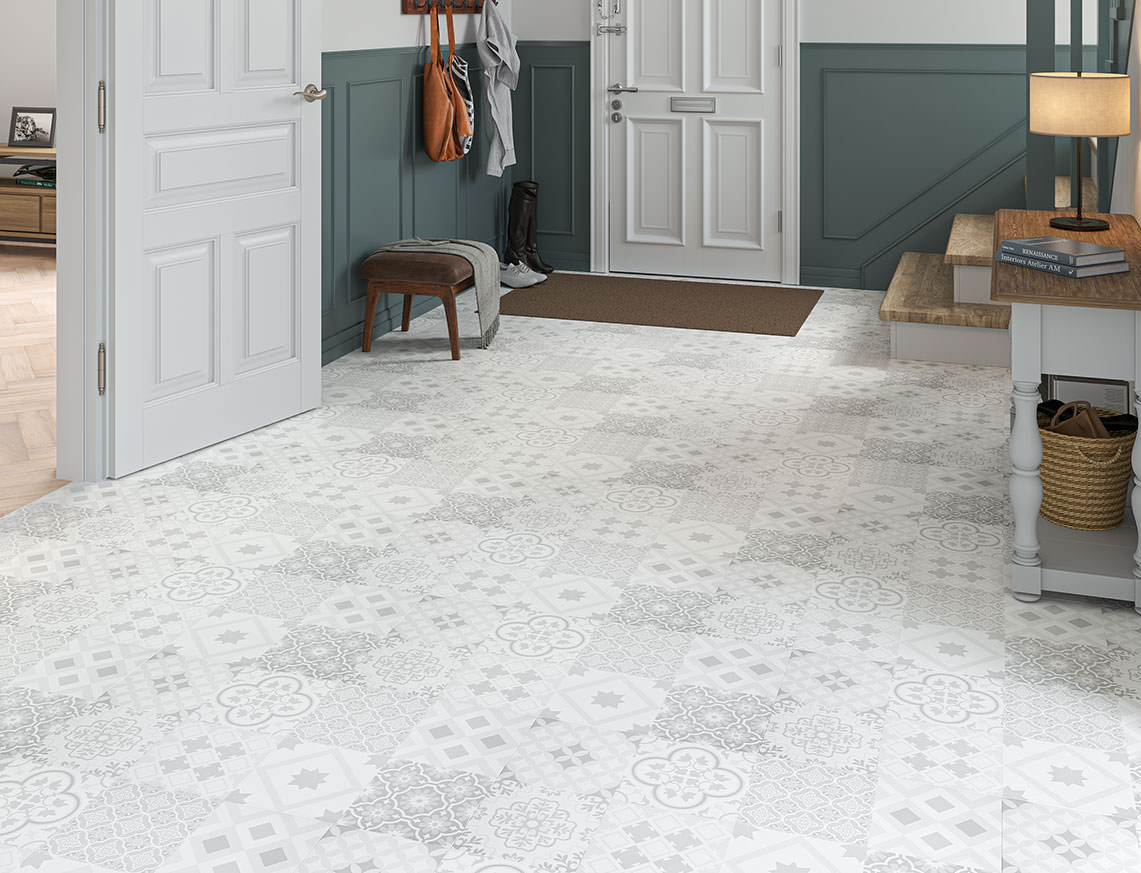
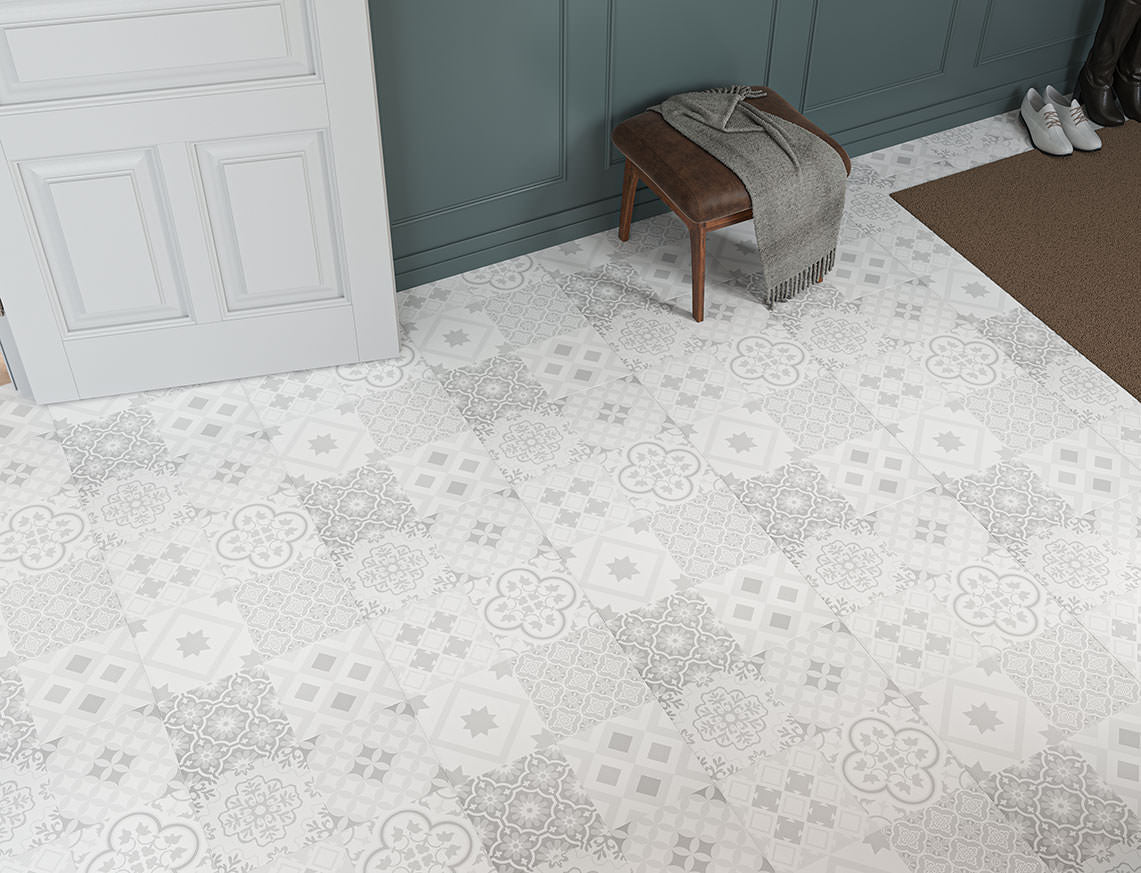
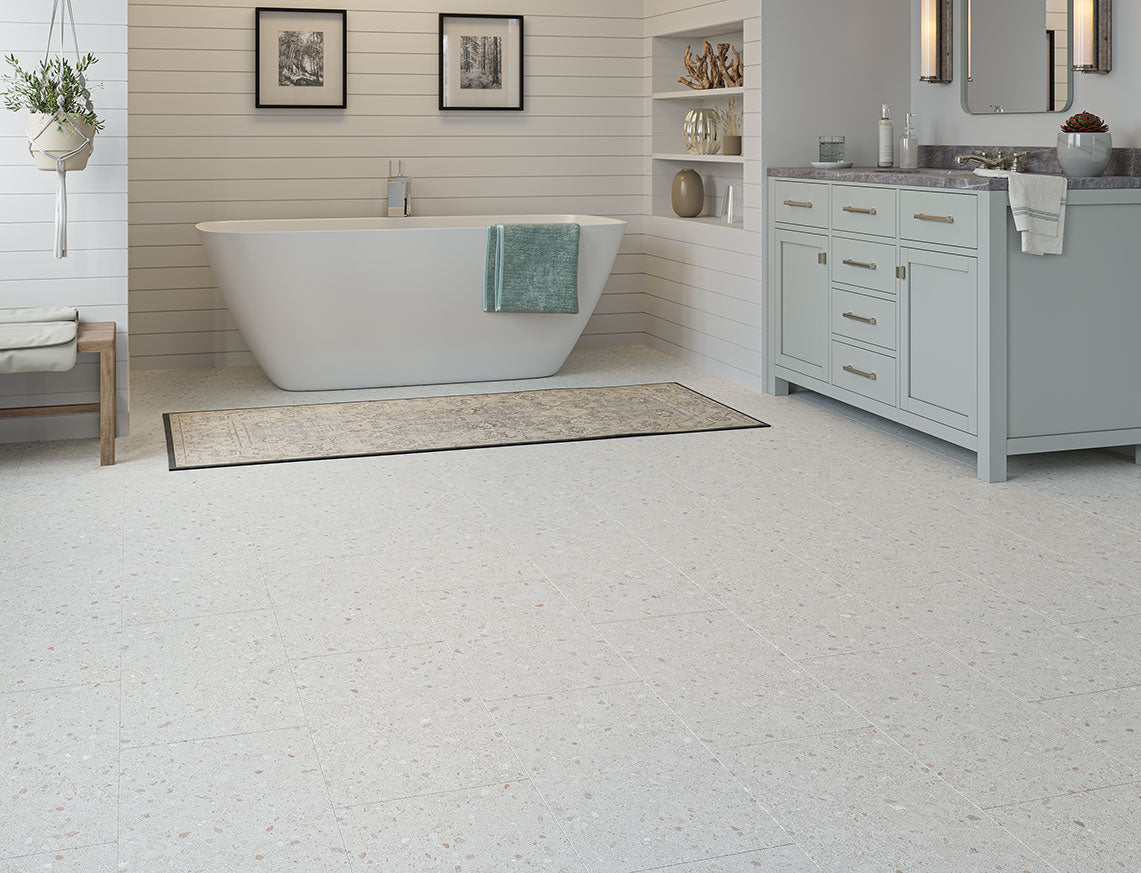
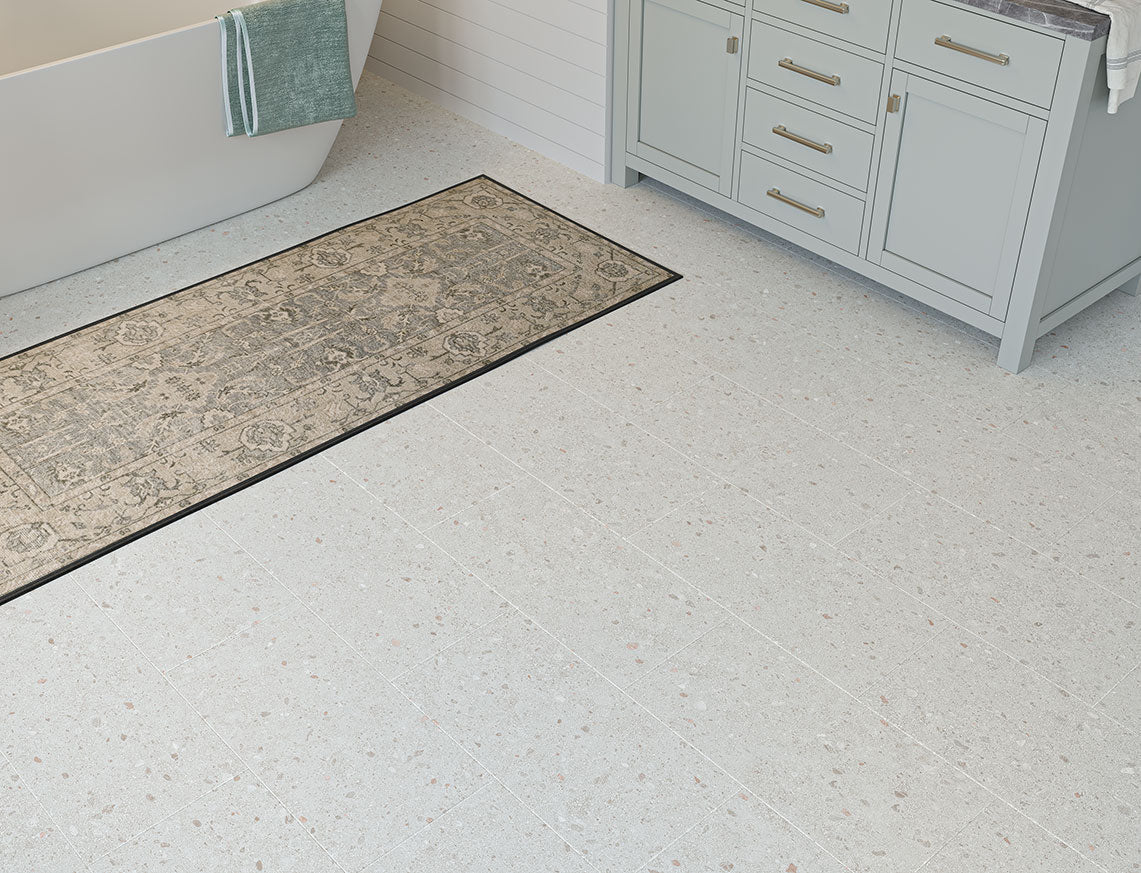
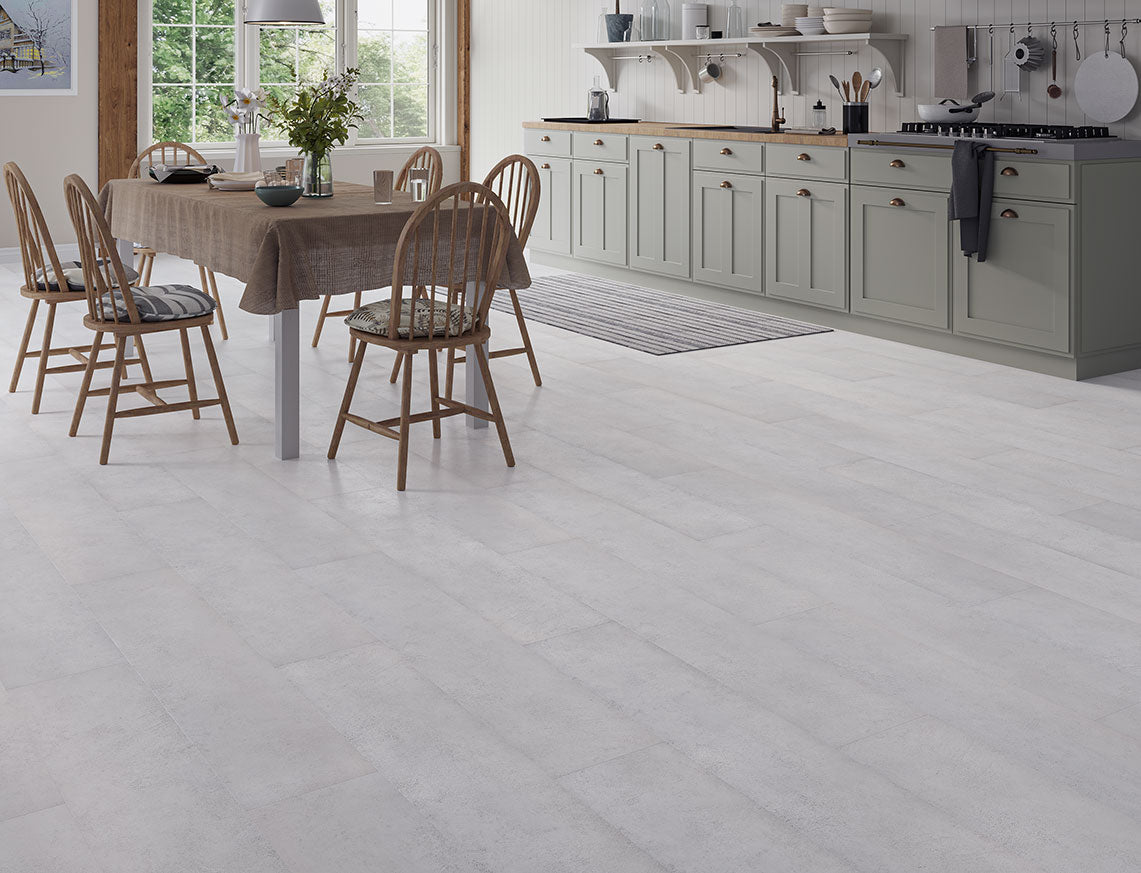
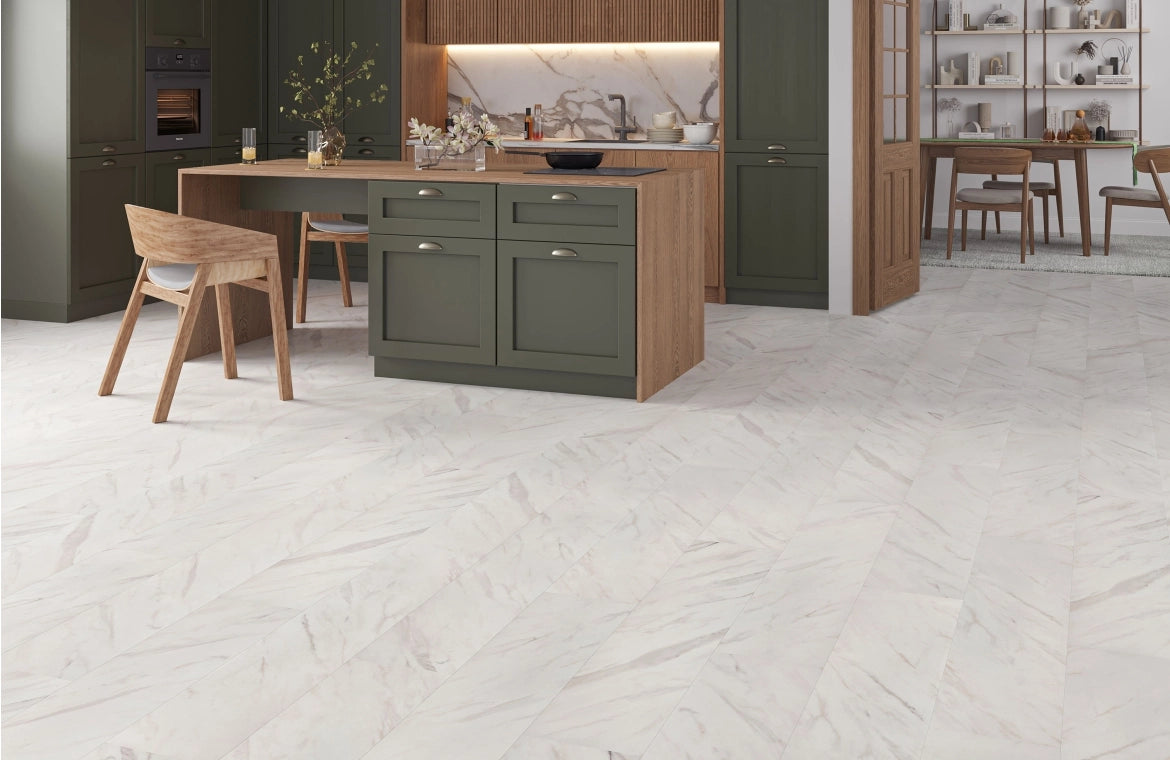
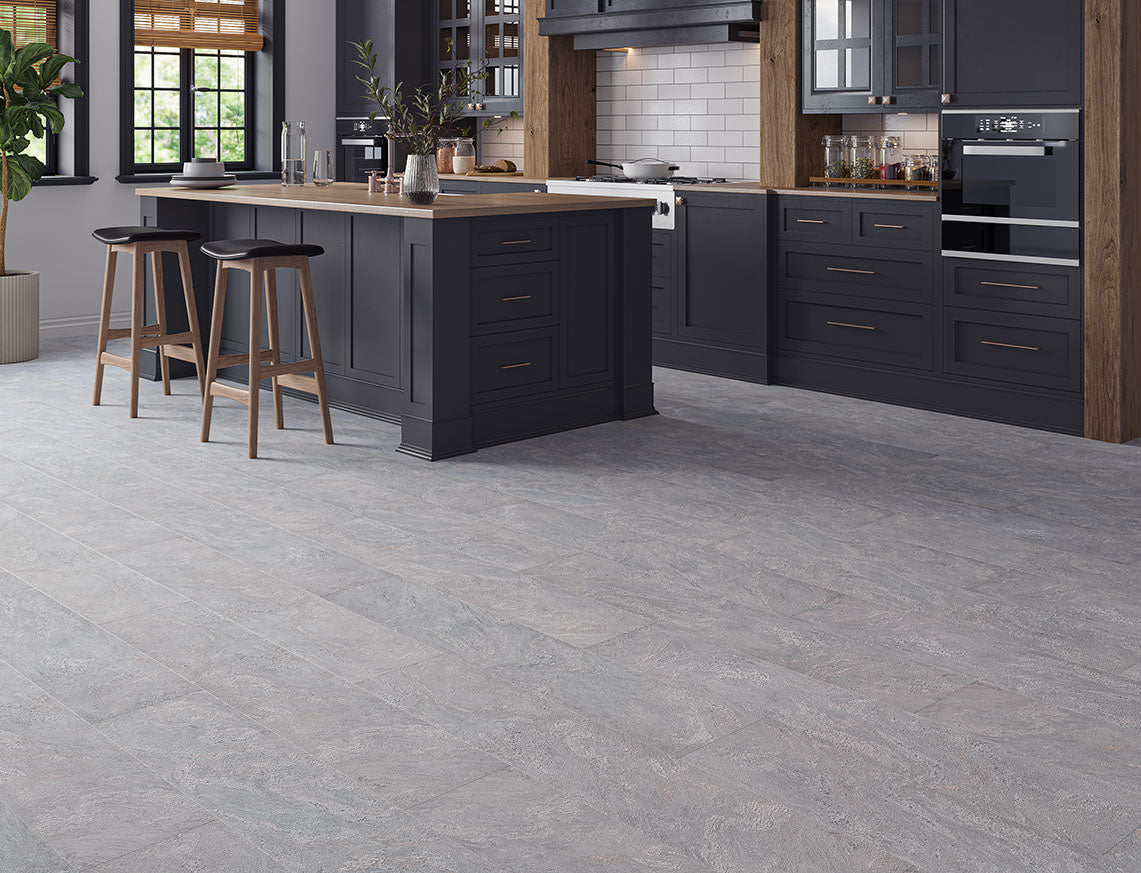
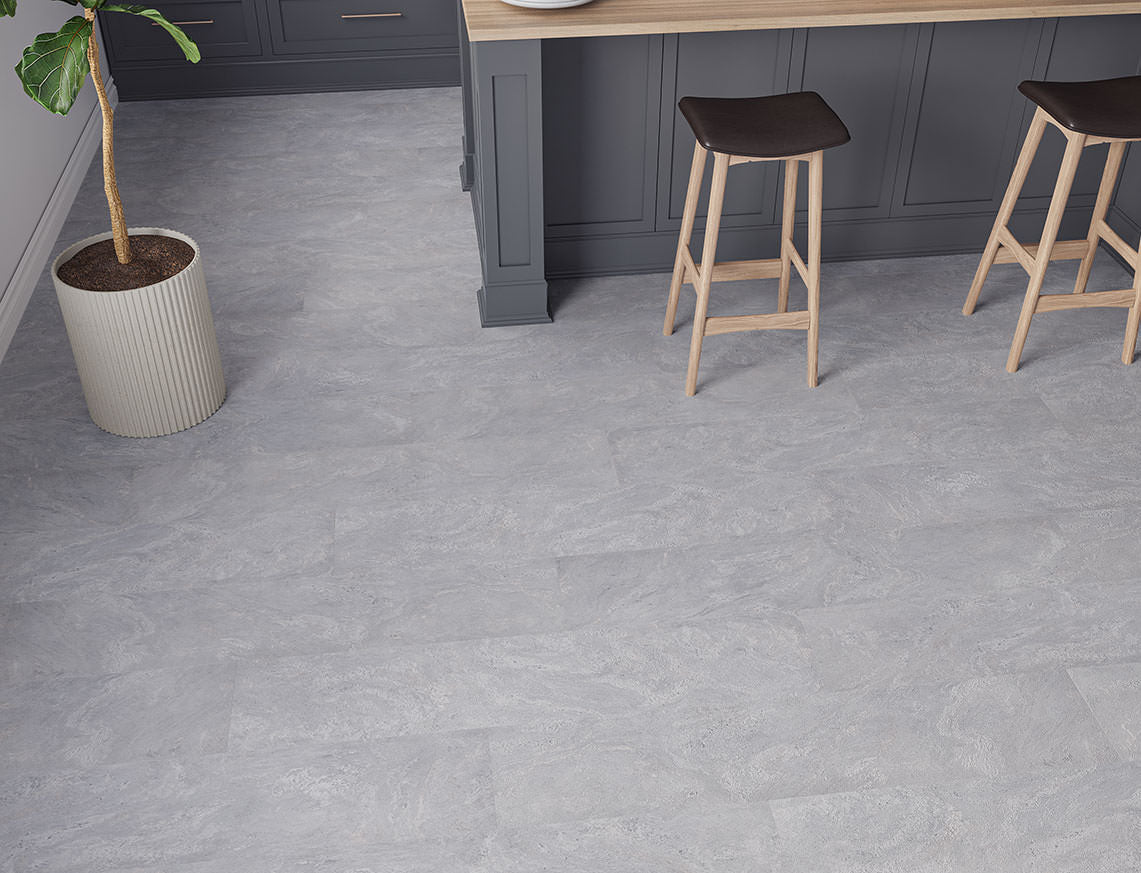
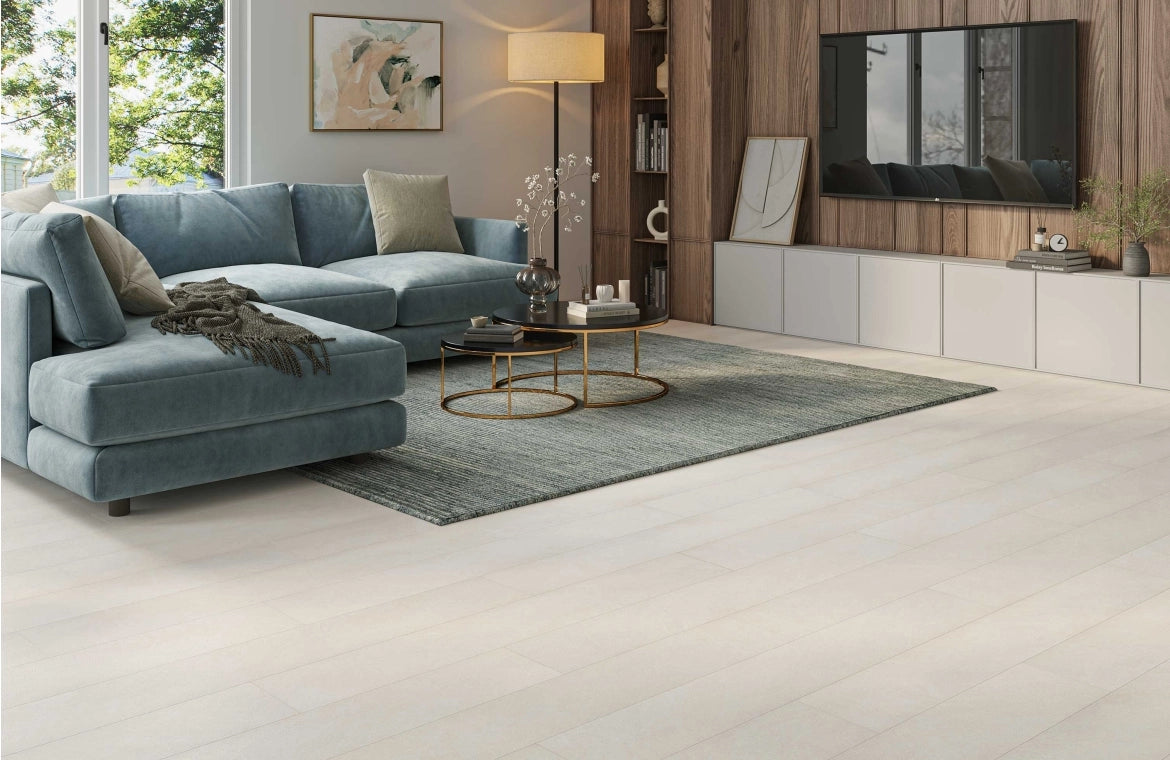
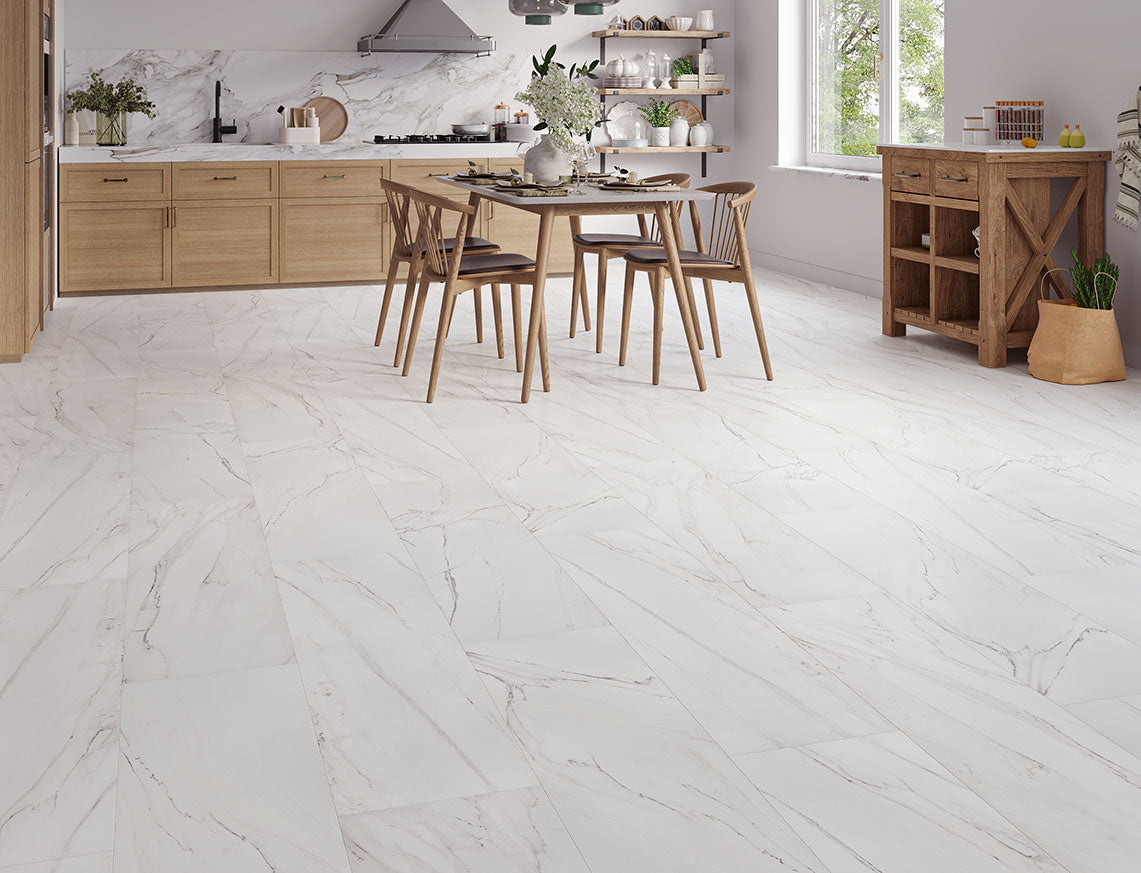
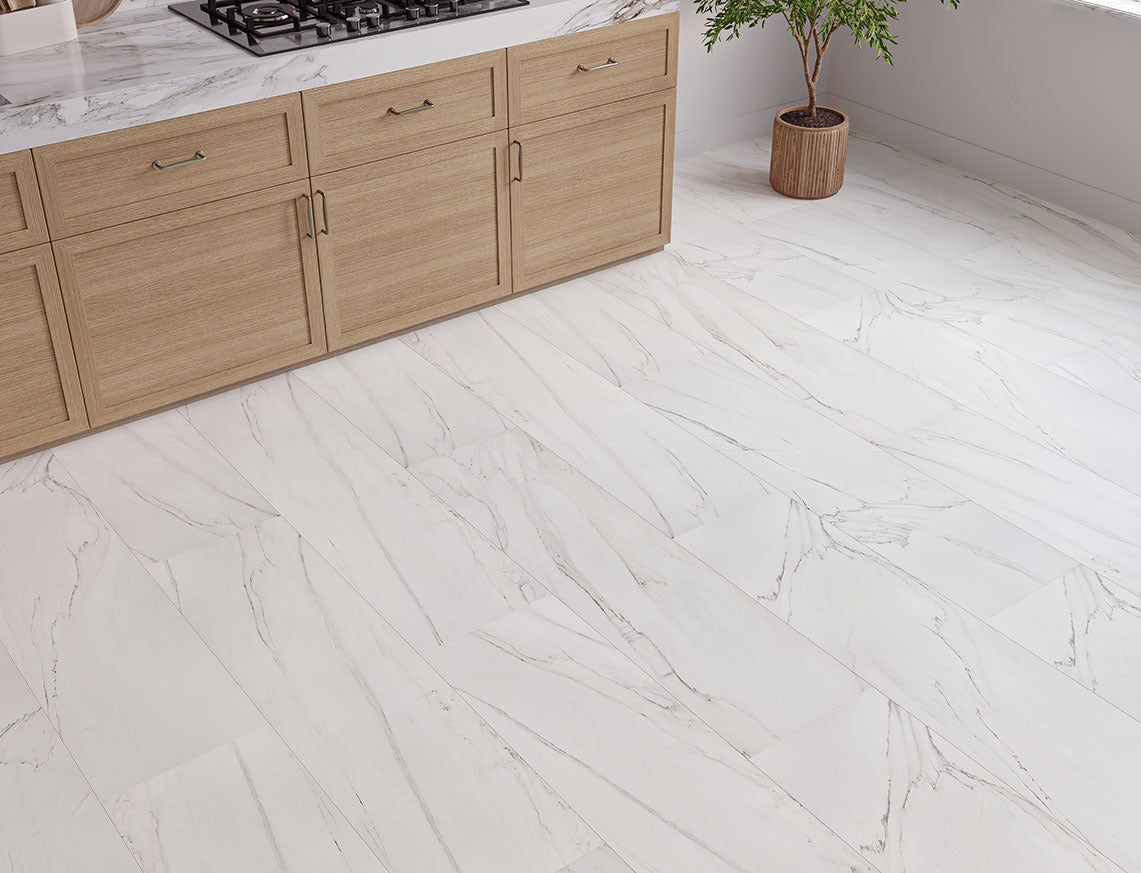
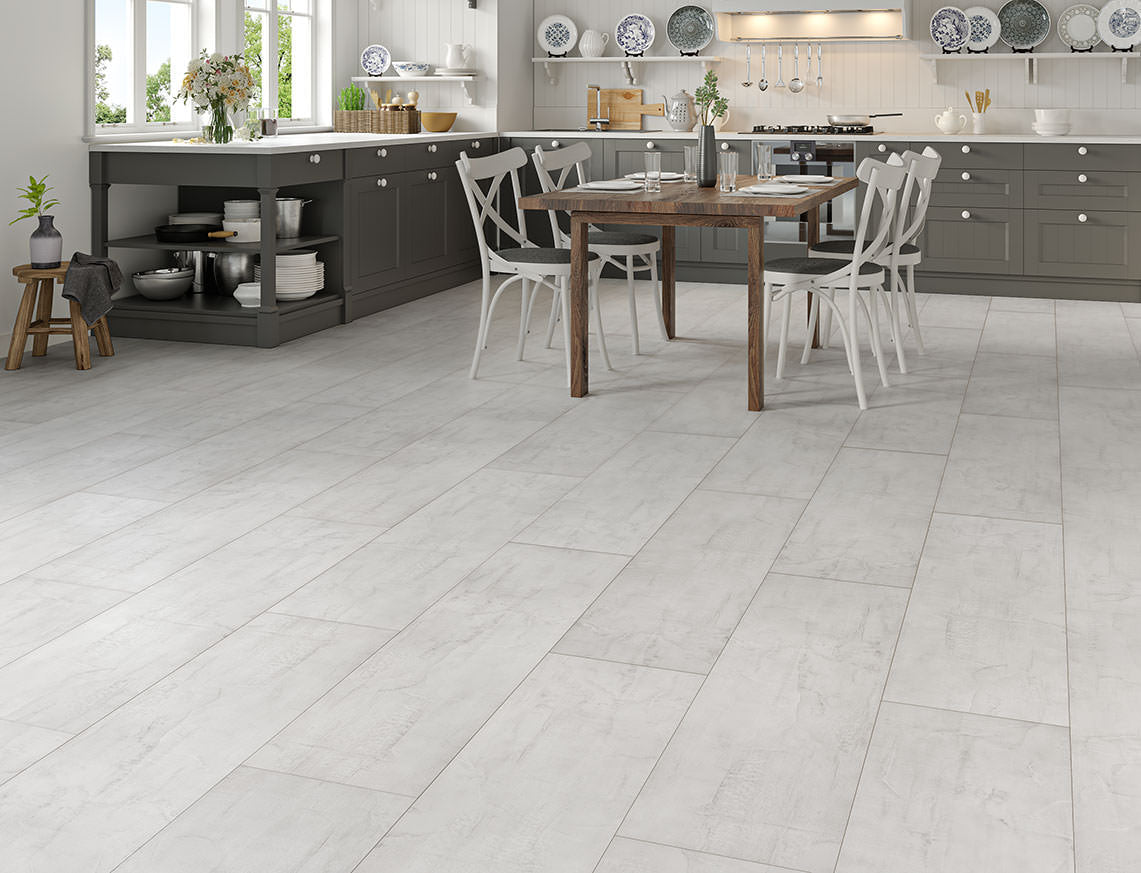
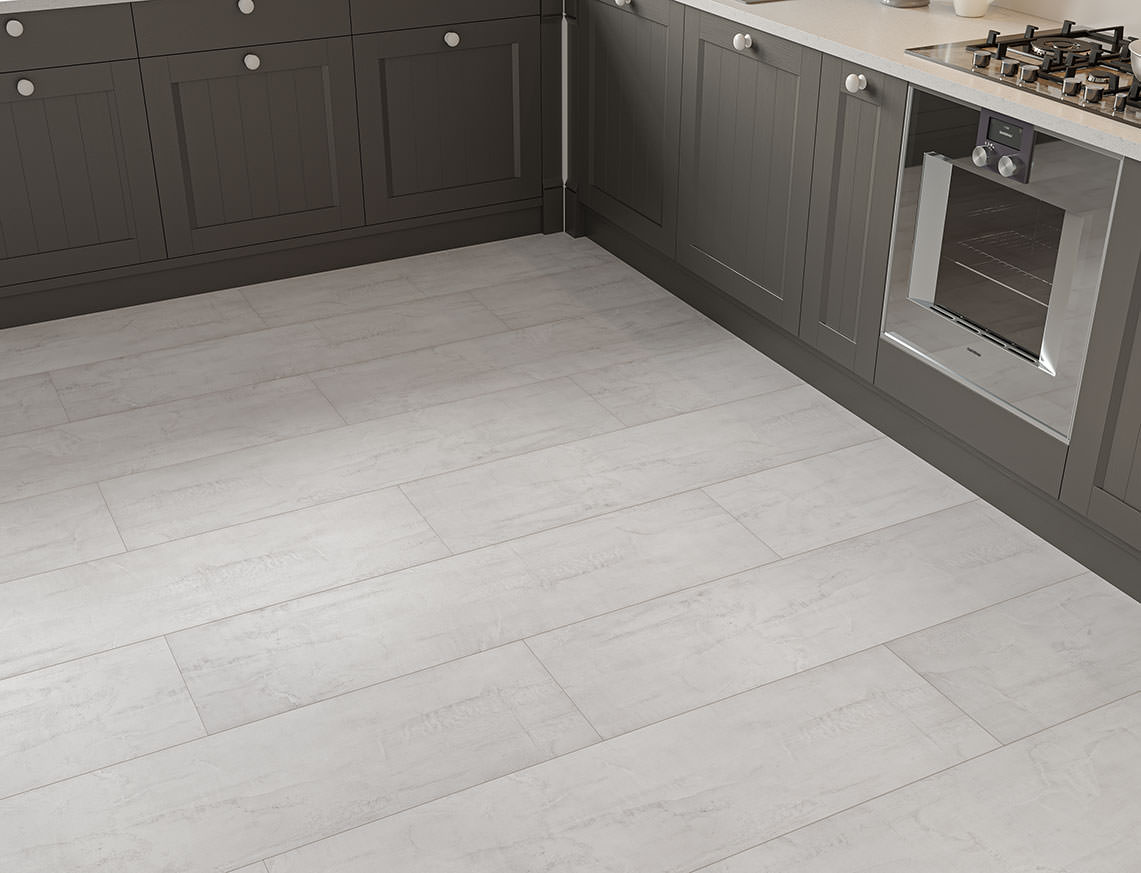
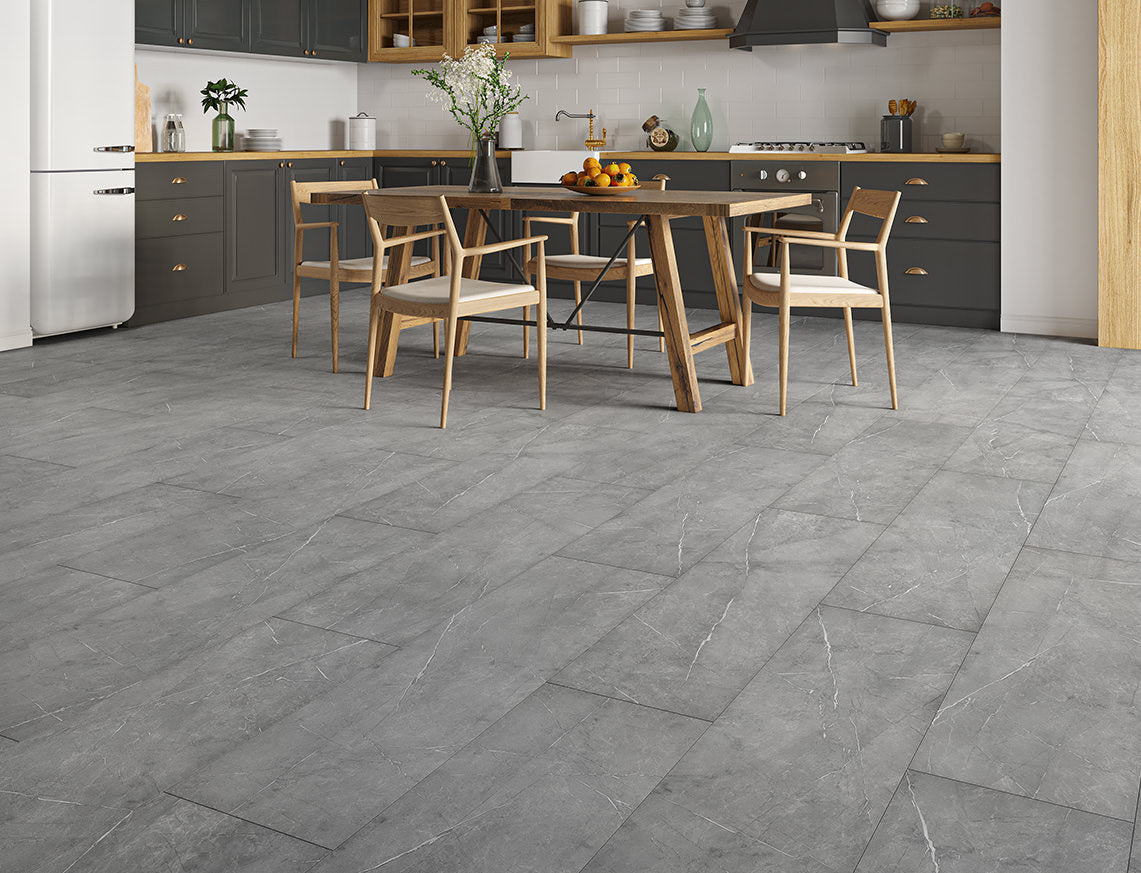
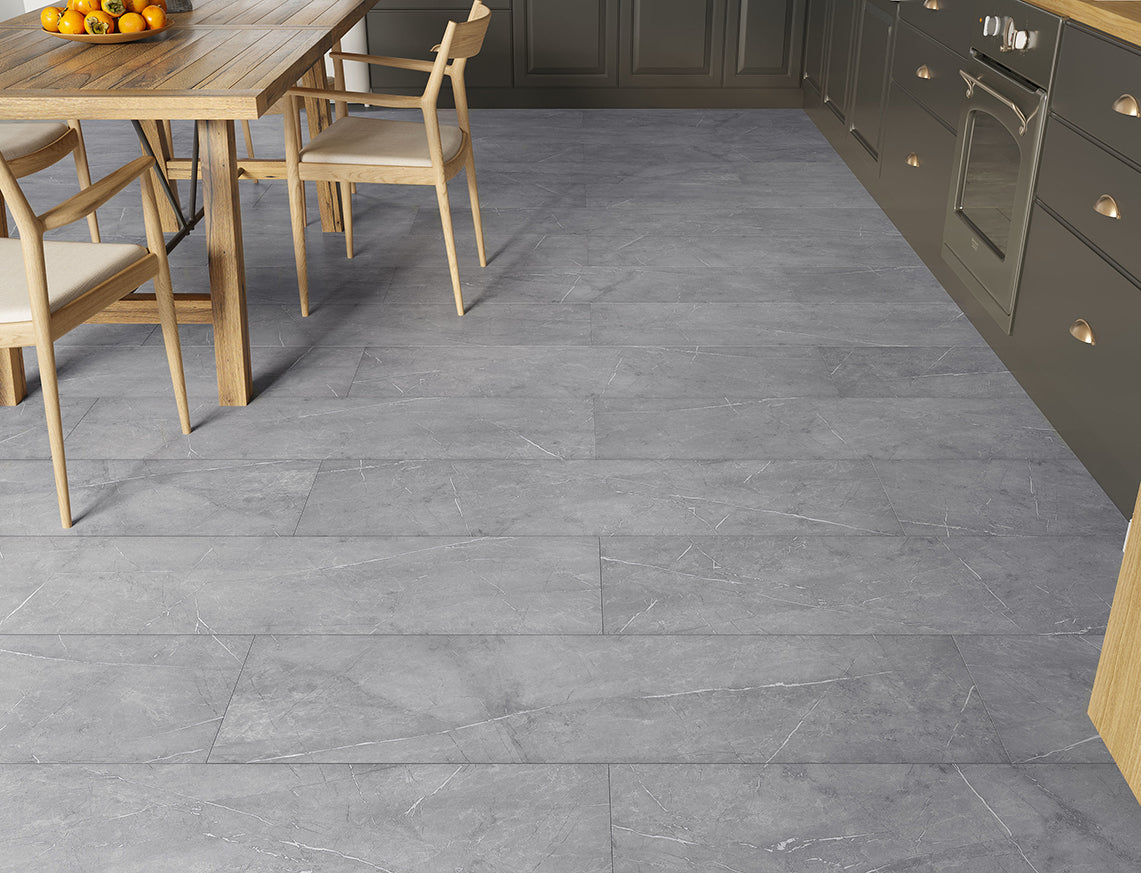
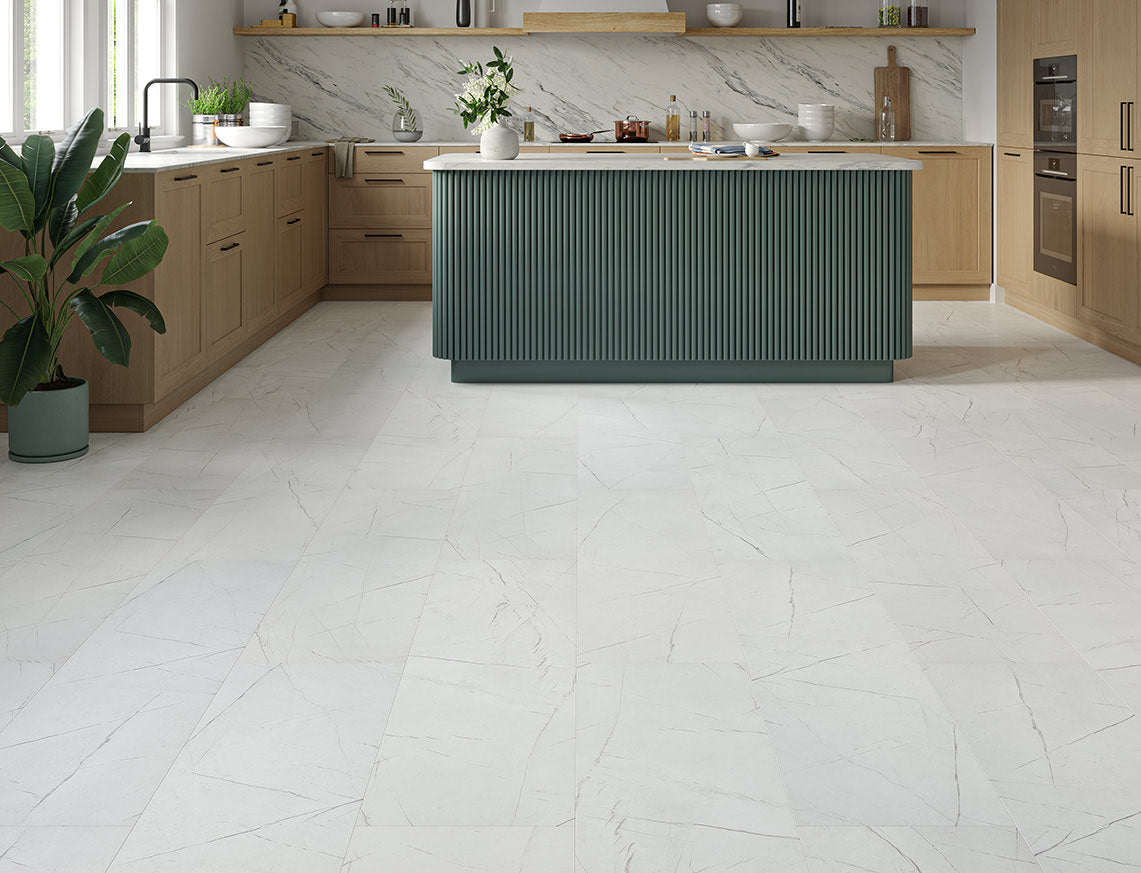
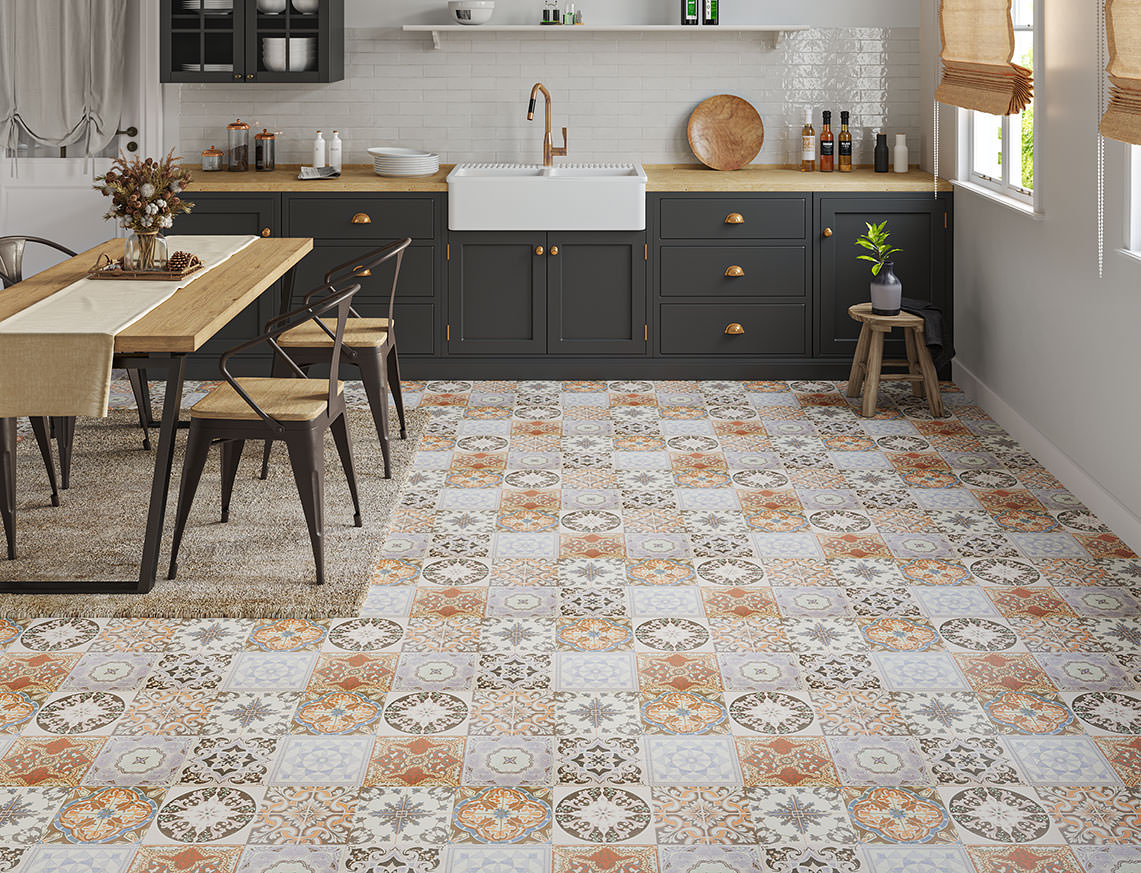
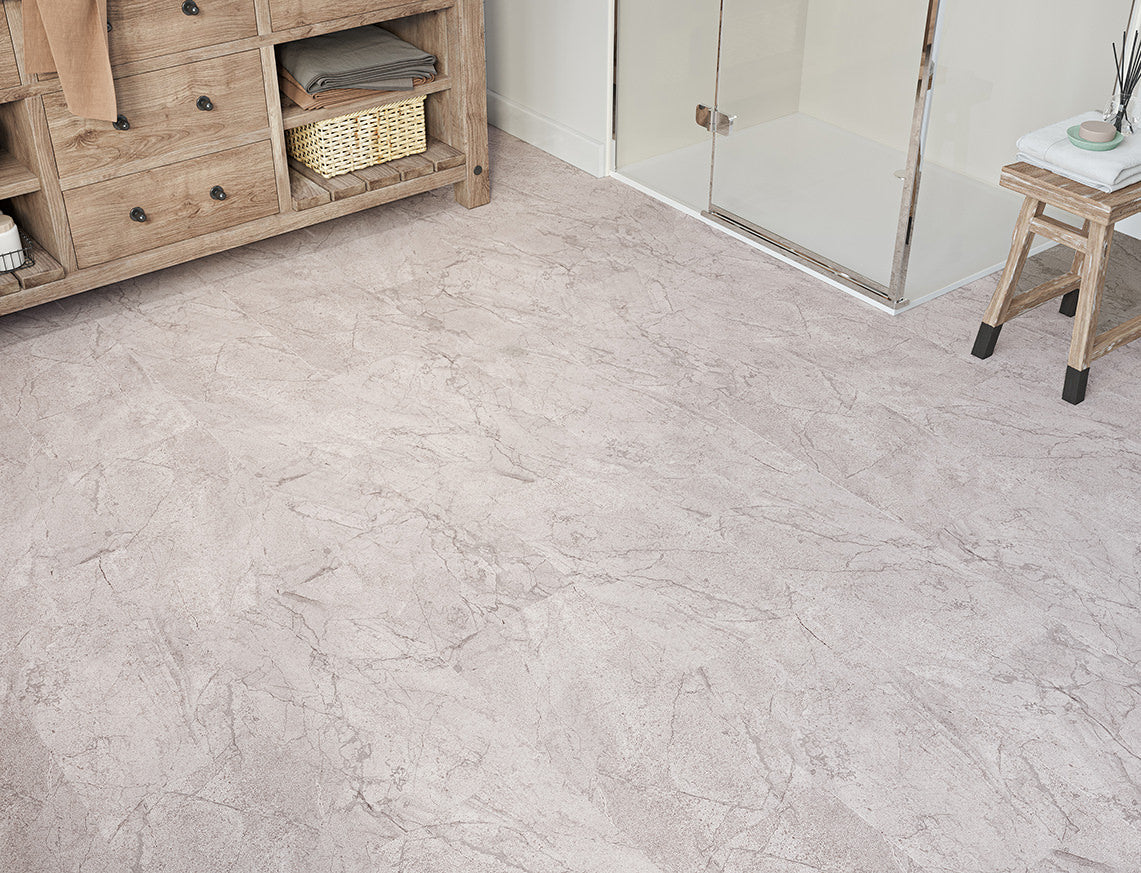
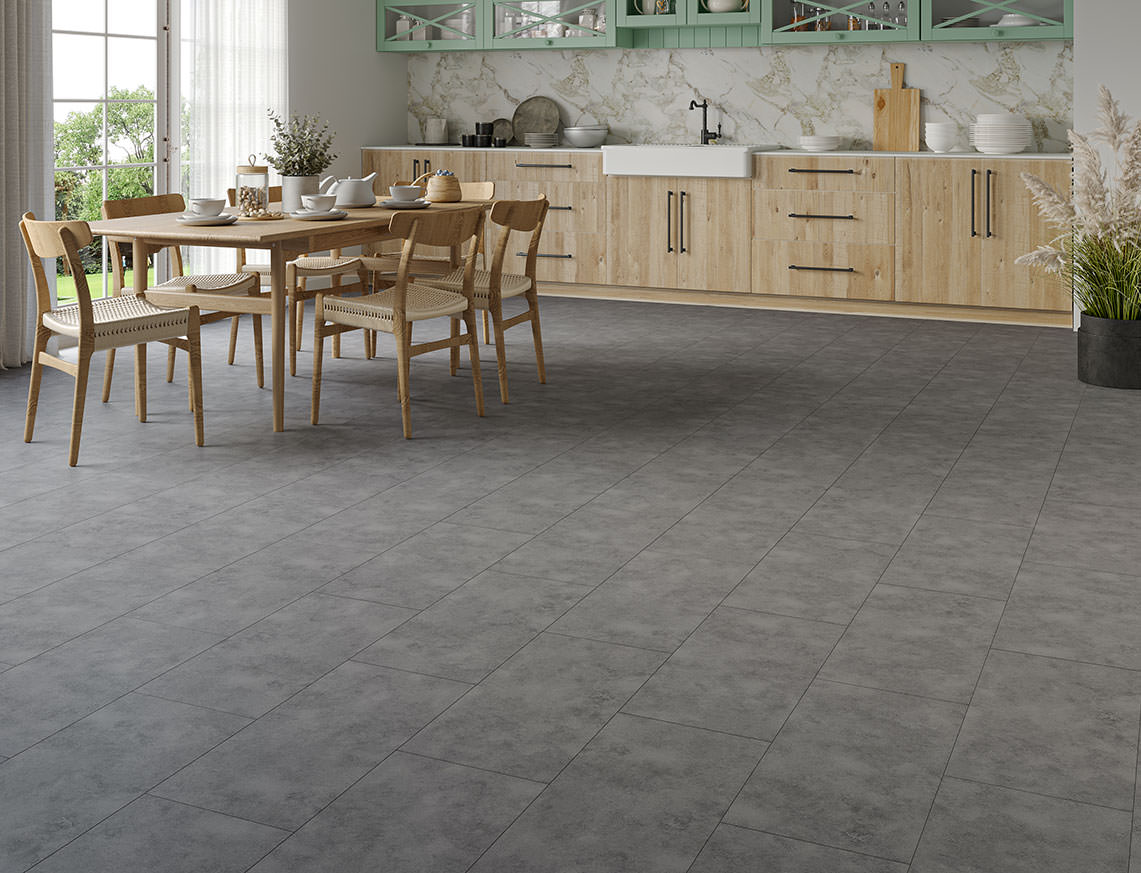
The look of stone, marble or Victorian encaustic tiles, in a floor that is warm underfoot, quicker to fit and far more forgiving of a dropped mug. Tile effect flooring gives you the appearance of a tiled floor without the cold, the grout or the weight.
Fourteen designs in laminate and SPC vinyl, running from pale marbled whites and light greys through weathered natural stone and granite to deep charcoals, plus two patterned Victorian designs.
Free A5 samples on every design, delivered to your door, so you can see the colour and surface texture in the room it is destined for before you commit.
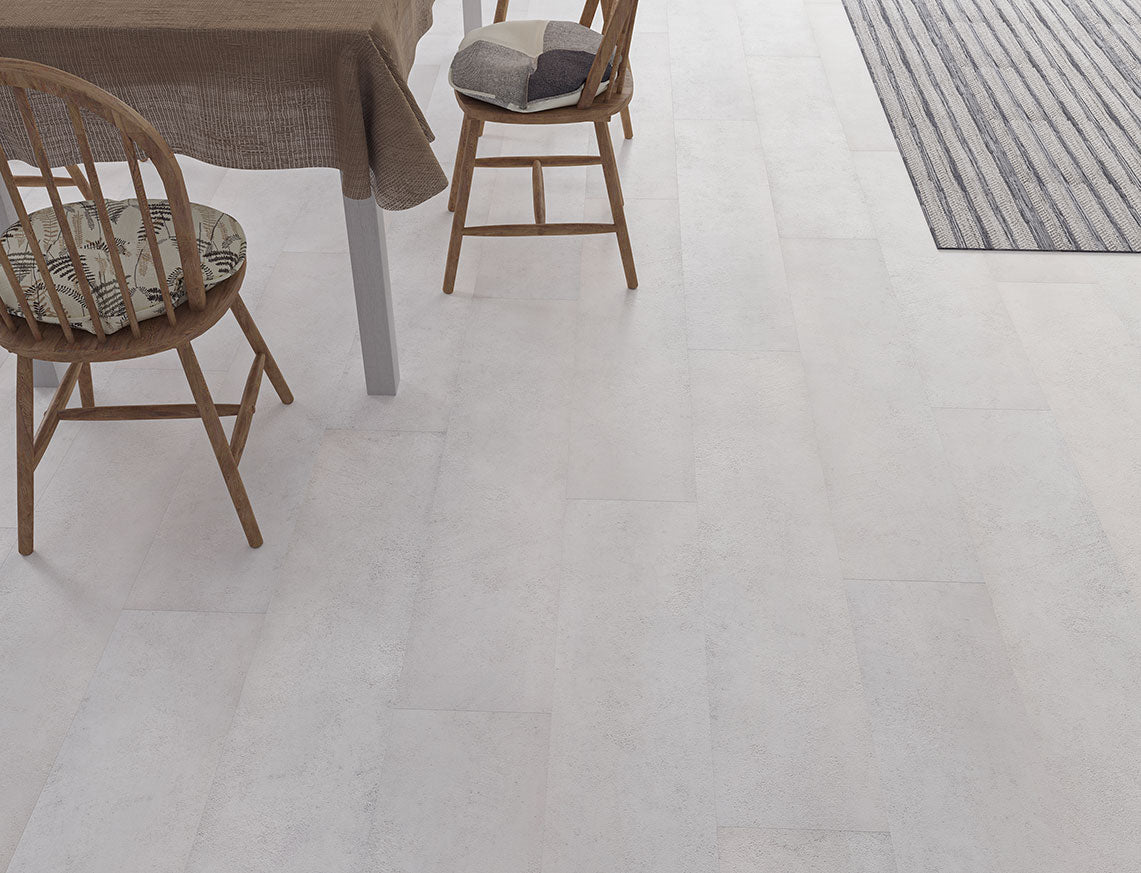
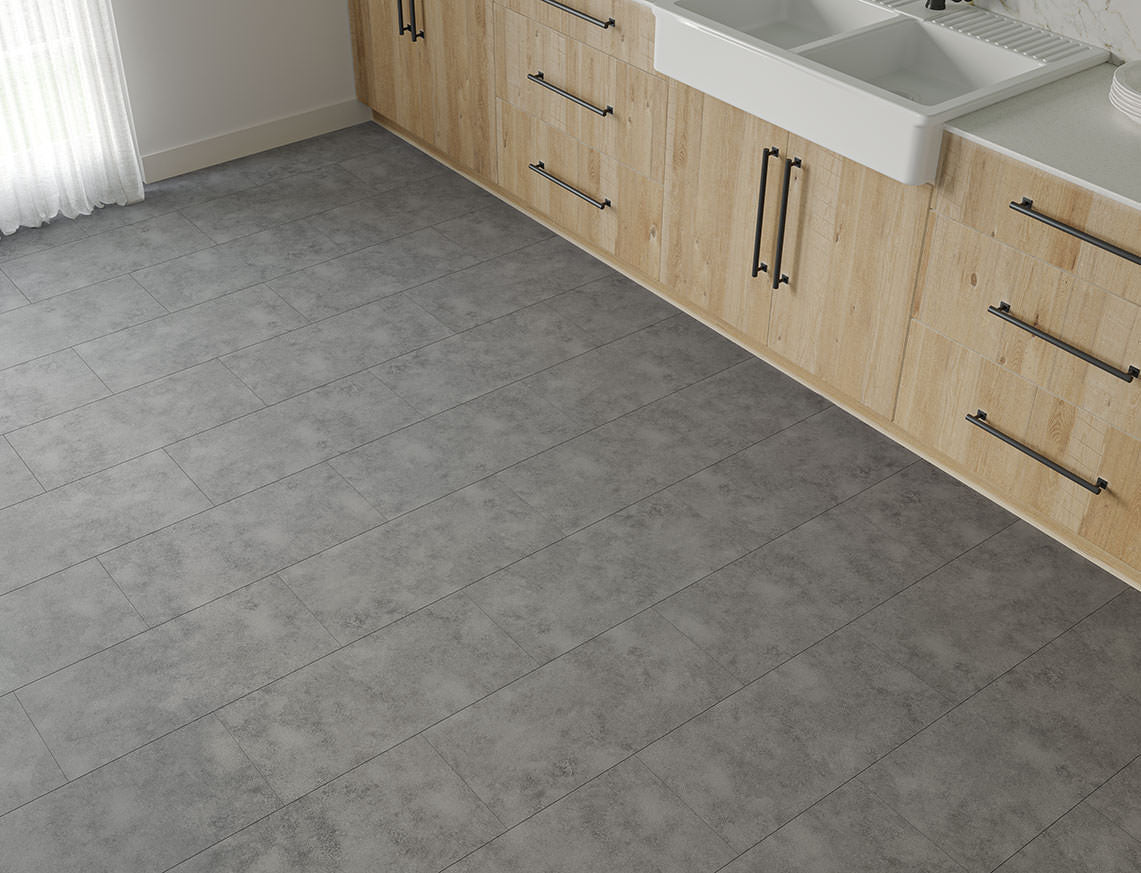
Tile effect flooring is laminate or vinyl printed and embossed to look like stone, marble or ceramic tile, usually supplied in rectangular or square boards with a bevelled edge that mimics a grout line.
The better designs are textured in register, meaning the surface texture follows the printed pattern rather than sitting over it as a generic grain. Up close you can tell it from stone. From standing height, in a fitted room, most people cannot.
Tile effect flooring or real tiles?
This is the decision most people are actually weighing up, so it is worth being straight about where each one wins.
Tile effect flooring
Ceramic or stone tiles
Underfoot
Warm, slight give
Cold and hard
Fitting
Click system, often DIY
Adhesive, grout, tradesman
Grout
None to clean
Needs sealing and scrubbing
Dropped crockery
Usually survives
Usually does not
Subfloor weight
Light
Heavy, may need reinforcing
Lifespan
Long, but replaced not restored
Decades if laid well
Real tile still wins on outright longevity and on genuine wet areas like a shower floor. For a kitchen, hallway or utility, tile effect flooring costs less to buy, far less to fit, and is considerably more pleasant to stand on while you cook.
Laminate or vinyl?
This is the important choice on this page, and it comes down almost entirely to water.
Tile effect laminate
Ten of the fourteen designs, and the widest choice of looks: marbled whites, silver and grey stone, granite, and the two patterned Victorian designs. A hard, scratch-resistant surface that stands up well to a busy kitchen. Suitable for kitchens, hallways and living space, but not for a bathroom or utility where standing water is likely. Browse laminate flooring.
Tile effect SPC and LVT vinyl
Four designs, and the ones to choose for a bathroom, en suite or utility. Fully waterproof, warmer and quieter underfoot than laminate, and the closest of the two to the feel of a real tile. Browse SPC and LVT vinyl.
Buying for a bathroom?
Choose one of the SPC or LVT vinyl designs. Tile effect laminate looks the part but has a fibreboard core, and standing water will eventually swell it. Room suitability is listed in the specification on every product page, so check it before you order.
Choosing a look
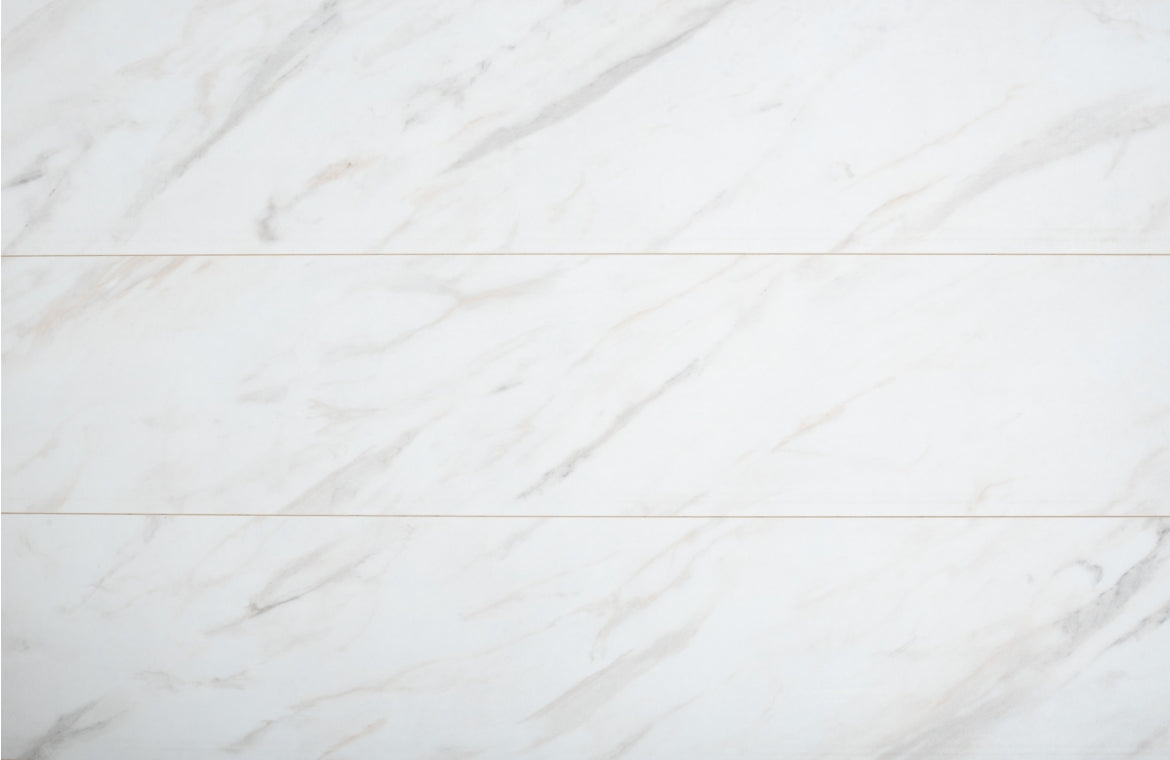
Marble effect
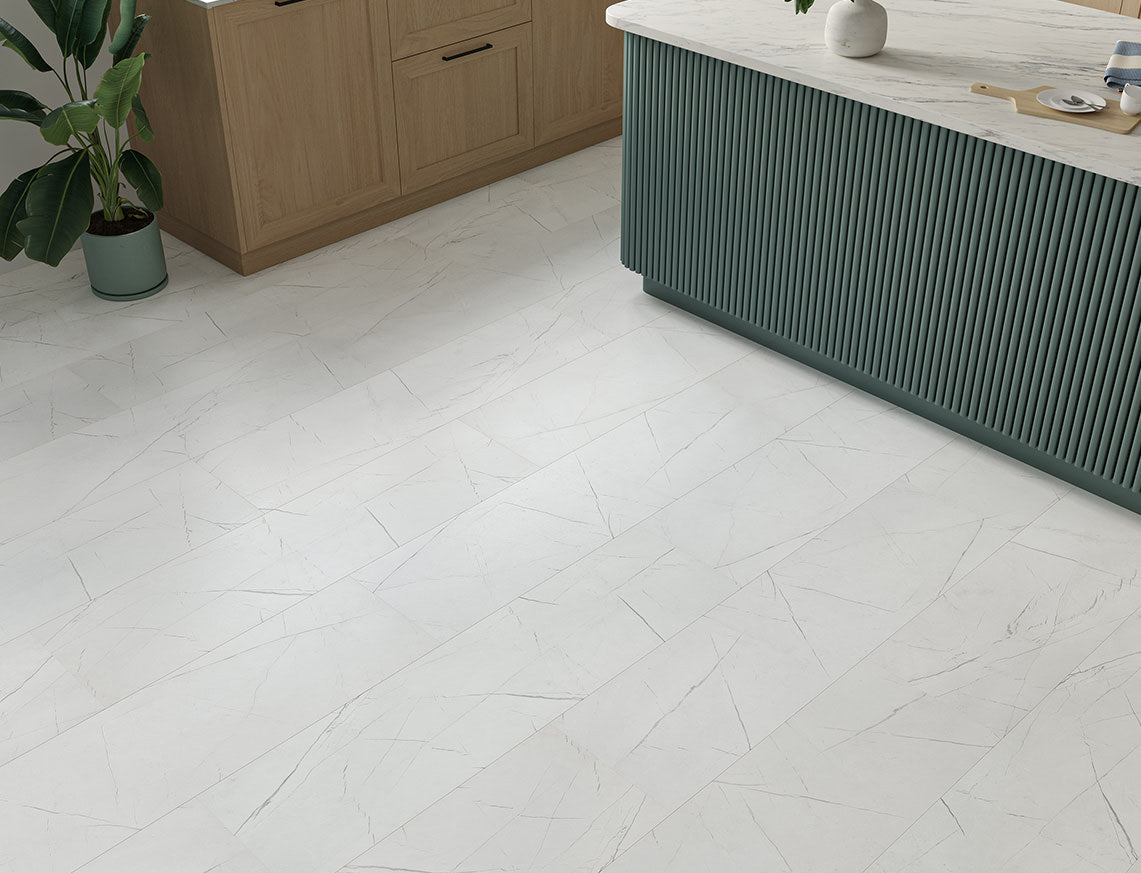
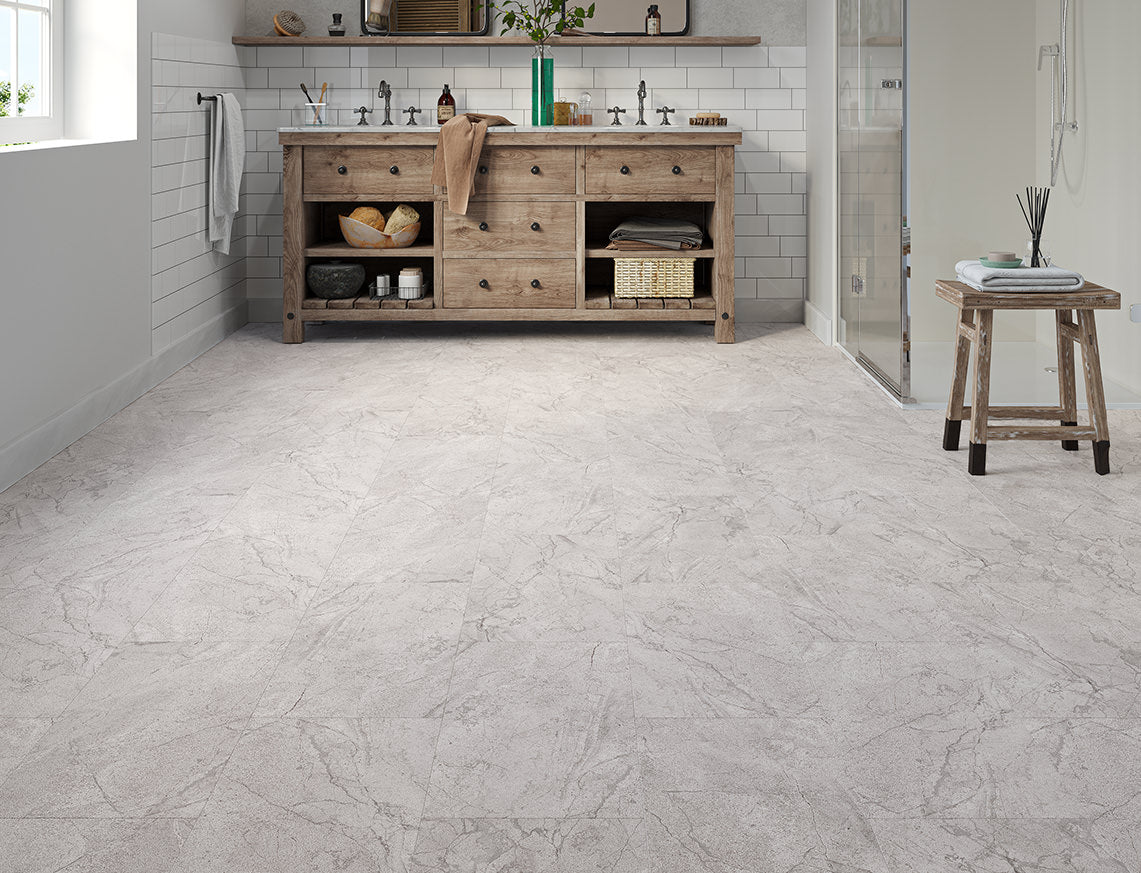
Pale whites with soft veining. The brightest option and the one that makes a small kitchen or hallway feel larger. Veining varies board to board, so lay a few out before fixing anything down.
Stone and granite effect
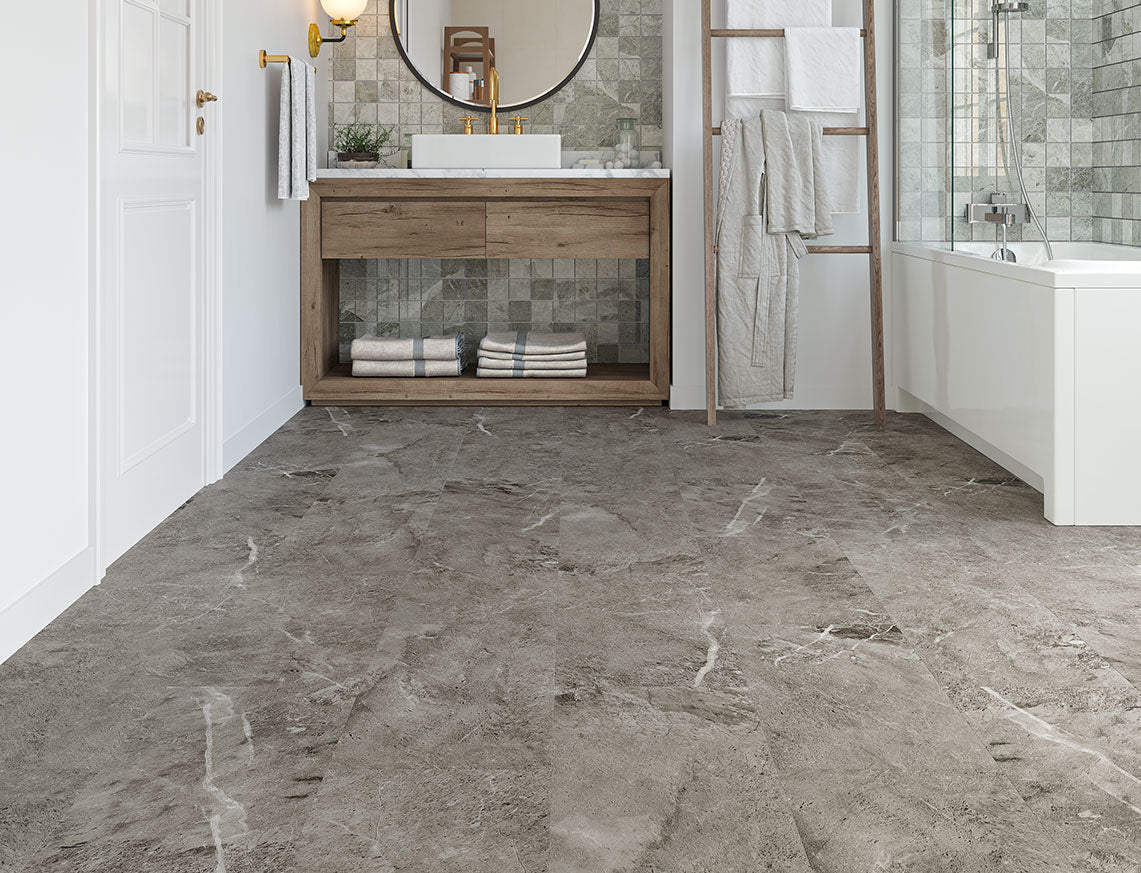
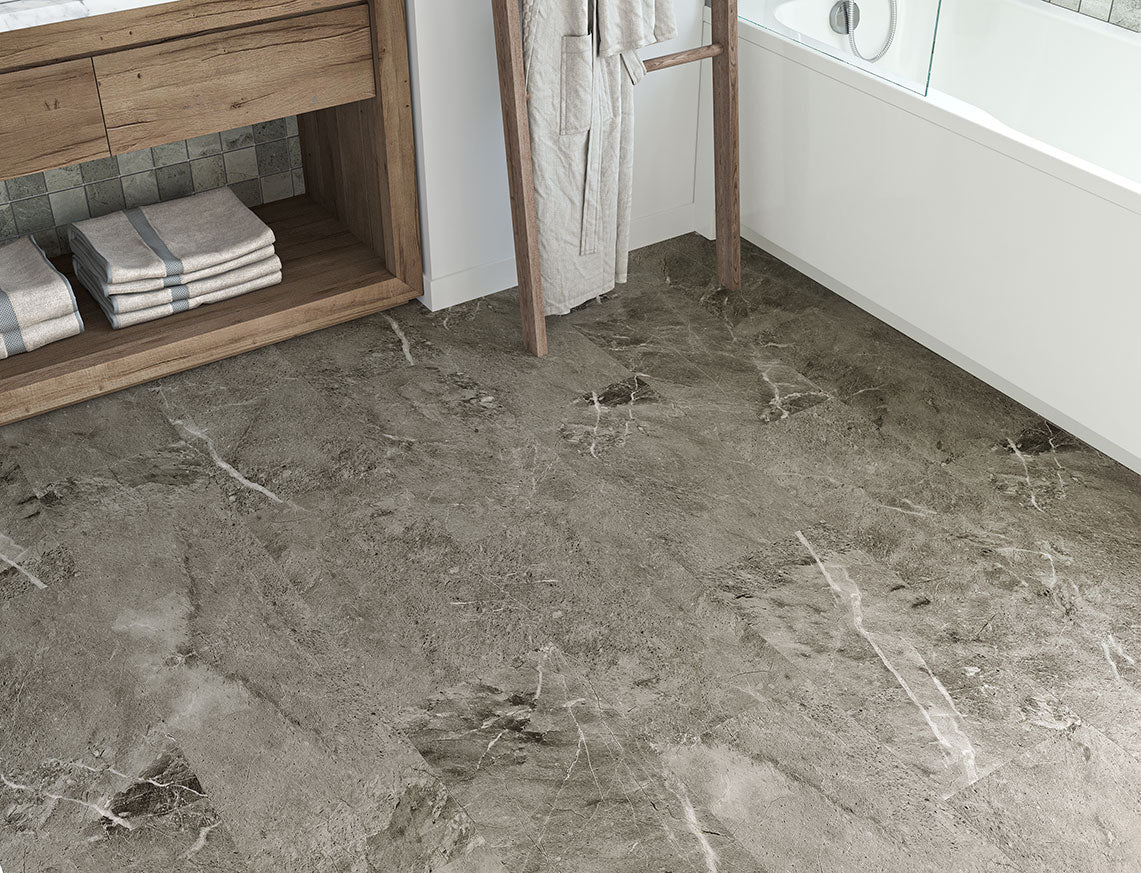
The largest group, in light greys, weathered naturals and speckled granites. The most forgiving choice in a busy house, since a mottled surface hides dust and footmarks far better than a plain one.
Terrazzo and charcoal
Flecked terrazzo and deep charcoal greys for a more contemporary room. Dark floors show dust and pale footprints more readily, so they suit a room with good natural light and a household without a large dog.
Victorian and patterned
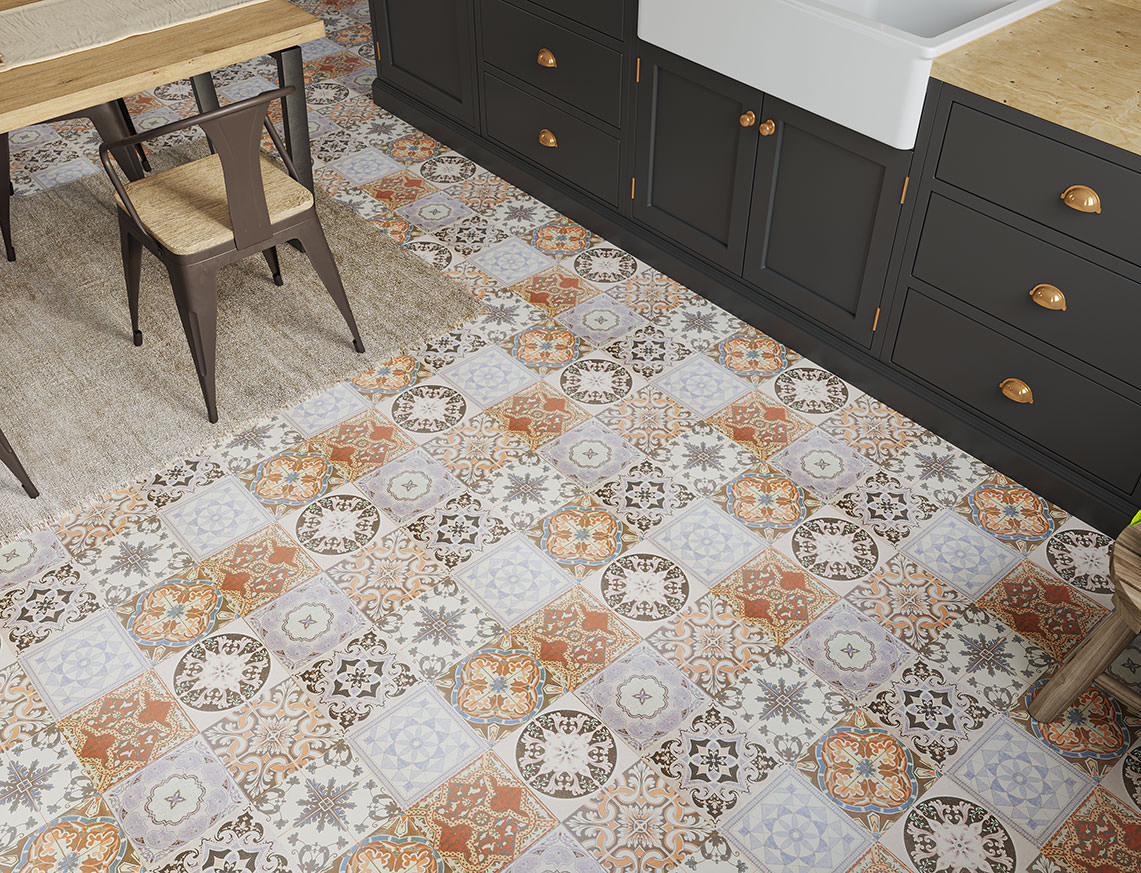
Two designs reproducing the encaustic geometric tiles found in Victorian hallways and porches. A strong pattern that works best in a defined space such as a hall or cloakroom rather than running through an open-plan floor.
Fitting tile effect flooring
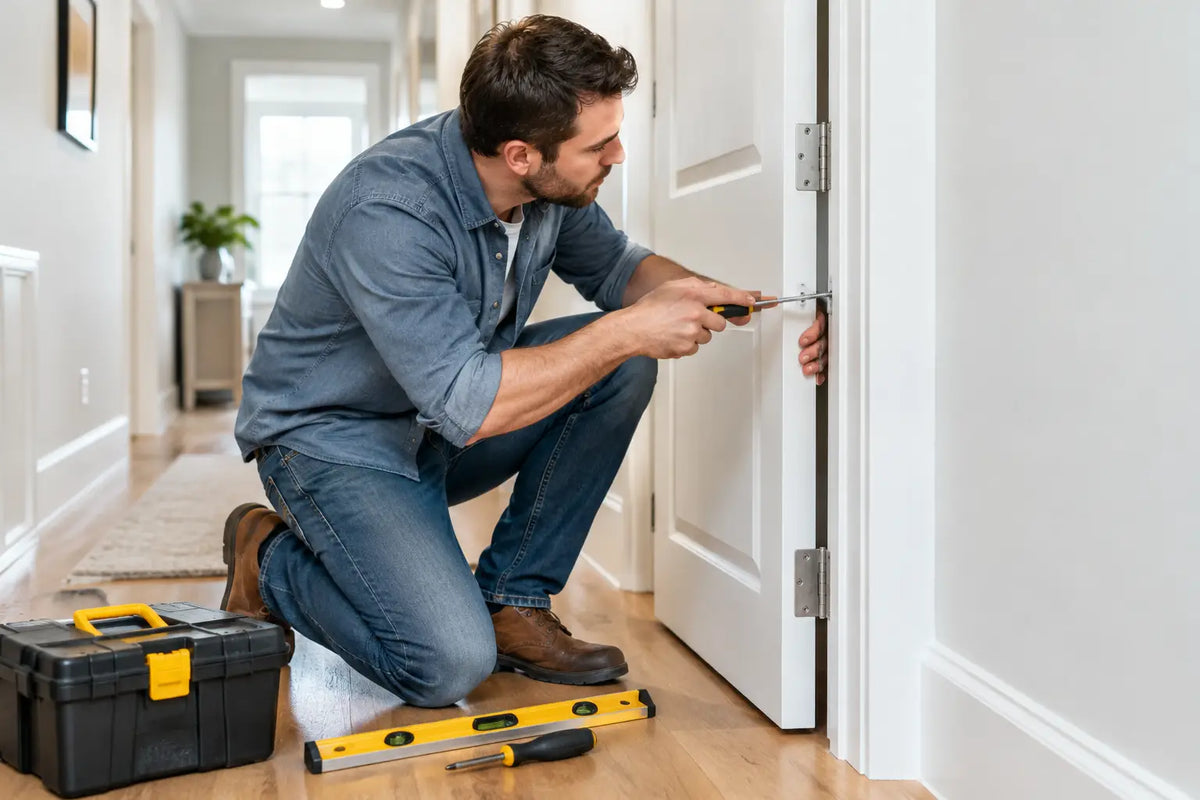
Every design here uses a click system, which puts it within reach of a careful DIY fitter. The subfloor needs to be flat and dry, an expansion gap has to be left at every wall, and the first row must be set out square, since a tile pattern shows any drift far more plainly than a wood grain would.
Set the boards out so you are not left with a narrow sliver of tile against the most visible wall. Measure the room, work out where the pattern lands, and shift the starting line to balance the cuts at each side. Our fitting guides cover subfloor preparation, acclimatisation and expansion gaps.
How much will you need?
Allow 10% for cuts on a straightforward rectangular room. Add a little more if the room has an awkward shape, or if you have chosen one of the patterned Victorian designs, where cut boards are less likely to be reusable elsewhere.
Order the full quantity in one go, since shade and pattern vary slightly between production batches and a mismatched board is obvious on a tile layout.
Tile effect flooring: frequently asked questions
Is tile effect flooring waterproof?
The SPC and LVT vinyl designs are fully waterproof. Tile effect laminate is water resistant on the surface but has a fibreboard core, so it is not suitable for a bathroom or anywhere standing water is likely. Check the room suitability on the product page.
Can I use tile effect flooring in a bathroom?
Yes, provided you choose a vinyl design rather than a laminate one. Four of our fourteen tile effect floors are SPC or LVT vinyl and are rated for bathrooms and utilities.
Does tile effect flooring look realistic?
In a fitted room, at standing height, it is convincing. The designs are textured so the surface follows the printed pattern, and bevelled edges create the impression of a grout line. Order a free sample and look at it on your own floor in daylight.
Is tile effect flooring warmer than real tiles?
Considerably. Laminate and vinyl do not draw heat from your feet the way stone and ceramic do, which is the single most common reason people choose it for a kitchen.
Can it be used with underfloor heating?
Generally yes, since none of these are solid timber. Suitability and maximum surface temperature are stated in the specification on every product page.
Can I fit tile effect flooring myself?
Yes. All of these use click systems, so no adhesive or grout is involved. The setting out matters more than with a wood-look floor, because a tile pattern makes any drift visible.
Does it need grout?
No. The grout line is created by a bevelled edge on each board, so there is nothing to seal, scrub or re-do in a few years.
How much extra should I order?
10% on a simple rectangular room, and a little more for an awkward shape or a patterned Victorian design.