
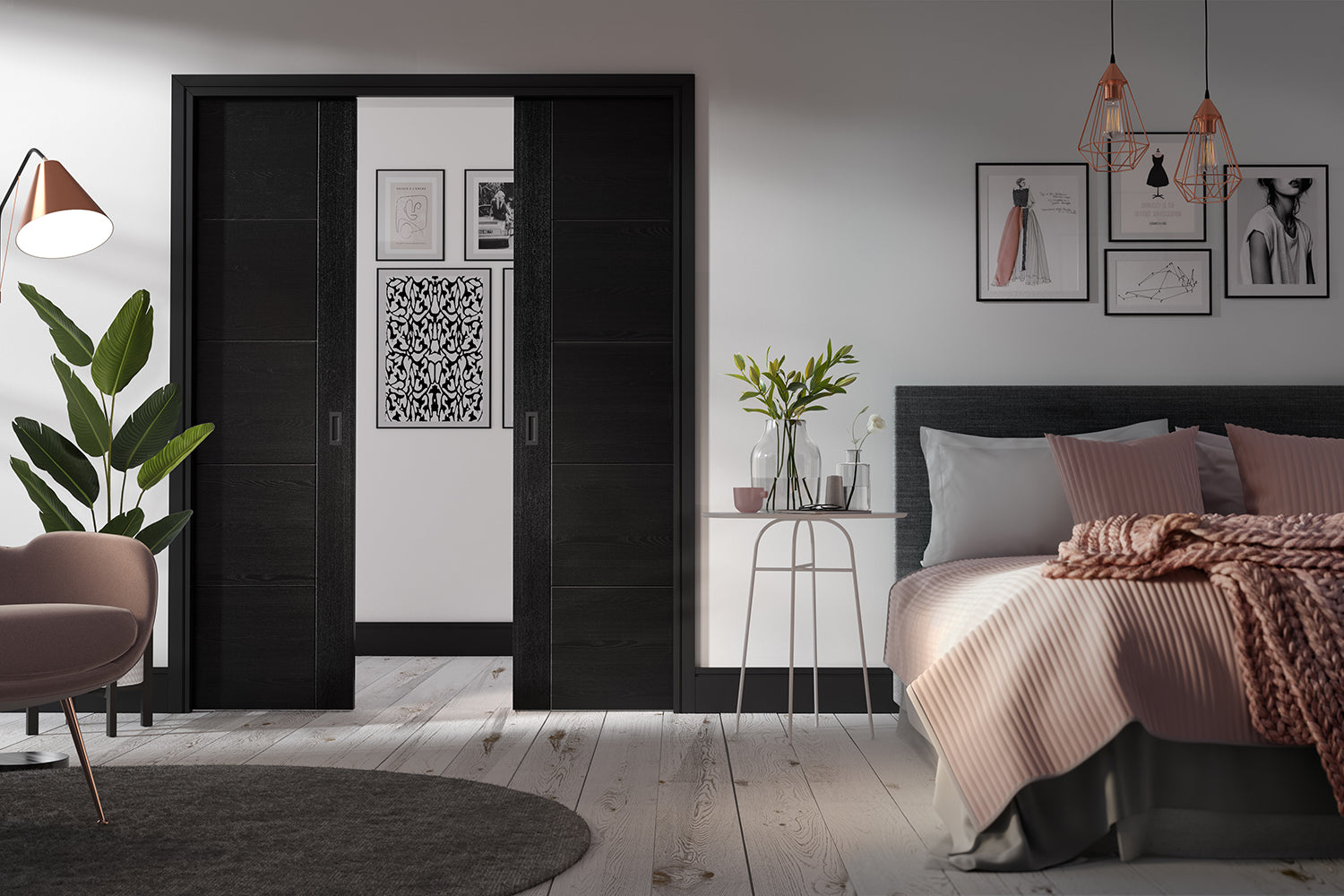
When planning a home renovation, extension or new-build project, every square metre matters. Homeowners often focus on furniture layouts, storage solutions and room sizes, but one design element that can significantly impact usable space is the type of door you choose.
For decades, traditional hinged doors have been the standard option in UK homes. However, pocket doors have grown in popularity thanks to their sleek appearance and space-saving benefits. By sliding neatly into a concealed wall cavity, pocket doors eliminate the need for a door swing and can transform how a room functions.
But do pocket doors genuinely save more space than traditional doors, and are they always the better choice?
In this guide, we'll compare pocket doors vs hinged doors, examining space efficiency, installation requirements, practicality, design flexibility and cost to help you decide which option is right for your property.
Understanding Pocket Doors


A pocket door is a sliding door that disappears into a cavity built within the wall when opened.
Unlike traditional doors, pocket doors do not swing inwards or outwards. Instead, they glide along a concealed track system and slide into the wall structure.
Pocket doors are commonly used in:
- En-suite bathrooms
- Utility rooms
- Cloakrooms
- Walk-in wardrobes
- Home offices
- Apartments
- Open-plan living spaces
Their primary advantage is simple: they remove the need for door swing clearance.
Understanding Traditional Hinged Doors
A hinged door is attached to a frame using hinges and swings open into or out of a room.
They remain the most common door type throughout the UK due to their:
- Simplicity
- Reliability
- Cost-effectiveness
- Wide availability
- Ease of installation
Traditional hinged doors are available in countless styles, including:
- Oak doors
- White primed doors
- Glazed doors
- Fire doors
- Panelled doors
- Contemporary flush doors
While they are familiar and versatile, they require dedicated clearance space to operate properly.
Which Door Saves More Space?
The simple answer is:
Pocket doors save more usable floor space than traditional hinged doors.
The reason comes down to door swing.
A standard internal door typically requires approximately 0.8 to 1 square metre of clear floor area to open fully.
That space cannot be occupied by:
- Furniture
- Cabinets
- Shelving
- Appliances
- Decorative items
Pocket doors eliminate this requirement.
How Much Space Can Pocket Doors Save?
Let's consider a typical internal door measuring 762mm (30 inches).
When opened, a hinged door creates a swing arc that occupies valuable floor space.
By removing the swing area, a pocket door can:
- Improve furniture placement
- Increase usable wall space
- Create more flexible room layouts
- Enhance movement through smaller rooms
This can be particularly valuable in:
- Small bathrooms
- Compact bedrooms
- Studio apartments
- Utility rooms
- Narrow hallways
In some cases, the recovered floor space can make a room feel significantly larger without changing its actual dimensions.
Why Space Matters in Modern Homes


Modern homes often place greater emphasis on efficiency and flexibility.
Property prices continue to rise, and homeowners increasingly seek ways to maximise every available square metre.
A poorly positioned hinged door can create:
- Dead space
- Furniture restrictions
- Awkward room layouts
- Reduced storage opportunities
Pocket doors help address these challenges by freeing up previously unusable areas.
Pocket Doors in Small Bathrooms
Bathrooms are one of the most popular applications for pocket doors.
Traditional bathroom doors often create layout limitations because of:
- Toilets
- Basins
- Shower enclosures
- Storage units
A pocket door removes the swing arc and allows greater flexibility when arranging fixtures.
Benefits include:
- Easier movement
- Improved accessibility
- More storage options
- Better use of compact spaces
For en-suites and cloakrooms, the difference can be particularly noticeable.
Pocket Doors in Bedrooms
Bedrooms can also benefit from pocket door systems.
This is especially true where:
- Built-in wardrobes are installed
- Floor space is limited
- Furniture placement is restricted
Removing the swing area can create room for:
- Wardrobes
- Chest of drawers
- Bedside units
- Desk spaces
This additional flexibility can improve both functionality and aesthetics.
When Hinged Doors May Be the Better Option
Although pocket doors save more space, they are not always the best solution.
Traditional hinged doors offer several advantages.
Better Acoustic Performance
Standard hinged doors generally provide better sound insulation.
This can be important in:
- Bedrooms
- Home offices
- Studies
Simpler Installation
Hinged doors are easier and less expensive to install.
Greater Product Choice
There is a wider selection of:
- Fire doors
- Glazed doors
- Traditional styles
- Security-rated doors
Easier Maintenance
Pocket door mechanisms may require occasional adjustment or maintenance.
Installation Considerations
Pocket Door Installation
Pocket doors require:
- A pocket frame system
- Sufficient wall depth
- Structural planning
- Track installation
Installation is typically easier during:
- New-build projects
- Major renovations
- Stud wall construction
Retrofitting a pocket door into an existing wall can involve significant work.
Hinged Door Installation
Traditional doors require:
- Door frame
- Hinges
- Ironmongery
Installation is generally quicker and less disruptive.
For simple door replacements, hinged doors remain the easiest option.
Cost Comparison
One factor that often influences decisions is budget.
Traditional Hinged Doors
Generally offer:
- Lower material costs
- Lower installation costs
- Greater availability
Pocket Doors
Usually involves:
- Pocket frame systems
- Additional labour
- Wall modifications
- Specialist installation
Although more expensive initially, many homeowners consider the space-saving benefits worthwhile.
Design and Aesthetics


Pocket doors are often associated with contemporary and minimalist interiors.
Benefits include:
- Clean sightlines
- Reduced visual clutter
- Seamless transitions between rooms
- Modern architectural appeal
However, traditional doors continue to offer exceptional design flexibility.
Available options include:
- Victorian styles
- Shaker doors
- Cottage doors
- Contemporary flush doors
- Industrial-inspired designs
Both door types can enhance interior design when specified correctly.
What About Fire Doors?
Fire safety introduces additional considerations.
Traditional fire door sets are widely available and commonly used in:
- Homes
- Apartments
- Commercial buildings
Pocket doors can be fire-rated, but only when:
- The complete system is tested
- Certification is provided
- Installation follows manufacturer's requirements
For many projects, hinged fire door sets remain the simplest compliance solution.
Accessibility Benefits
Pocket doors can improve accessibility by:
- Reducing obstruction
- Providing wider clear openings
- Improving manoeuvrability
This can be beneficial for:
- Older residents
- Wheelchair users
- Multi-generational households
They are frequently specified in accessible living environments.
Pocket Doors vs Hinged Doors: Quick Comparison
| Feature | Pocket Doors | Hinged Doors |
|---|---|---|
| Space Saving | Excellent | Moderate |
| Installation Cost | Higher | Lower |
| Ease of Installation | More Complex | Simpler |
| Product Availability | Limited | Extensive |
| Acoustic Performance | Good | Better |
| Fire Door Availability | Limited | Extensive |
| Maintenance | Moderate | Low |
| Design Appeal | Contemporary | Traditional & Modern |
| Accessibility | Excellent | Good |
Who Should Choose Pocket Doors?
Pocket doors are ideal for:
- Small homes
- Apartments
- En-suites
- Compact bathrooms
- Modern renovations
- Open-plan living spaces
They work best when space efficiency is a priority.
Who Should Choose Hinged Doors?
Traditional hinged doors remain the better choice for:
- Simple refurbishments
- Budget-conscious projects
- Fire door applications
- Period properties
- Projects requiring maximum acoustic performance
They continue to offer excellent versatility and long-term reliability.
Final Verdict: Which Saves More Space?
If your primary goal is to maximise usable floor space, pocket doors are the clear winner. By eliminating the need for door swing clearance, they free up valuable room for furniture, storage and improved circulation, making them particularly effective in smaller homes and compact rooms.
However, space savings should not be the only consideration. Traditional hinged doors remain more affordable, easier to install and available in a much wider range of styles and performance specifications.
For homeowners undertaking a major renovation or designing a new home, pocket doors can deliver a sleek, space-efficient solution that transforms how rooms function. For straightforward replacements or projects where simplicity and cost are priorities, traditional hinged doors remain an excellent and practical choice.
Ultimately, the right option depends on your available space, budget, design goals and performance requirements, but when it comes to saving space alone, pocket doors come out on top.
For more information about our interior or exterior doors or door accessories, give us a call at 01603 622261 and speak to a member of our expert team today or Email us at sales@doorsuppliesonline.co.uk. We look forward to hearing from you.