
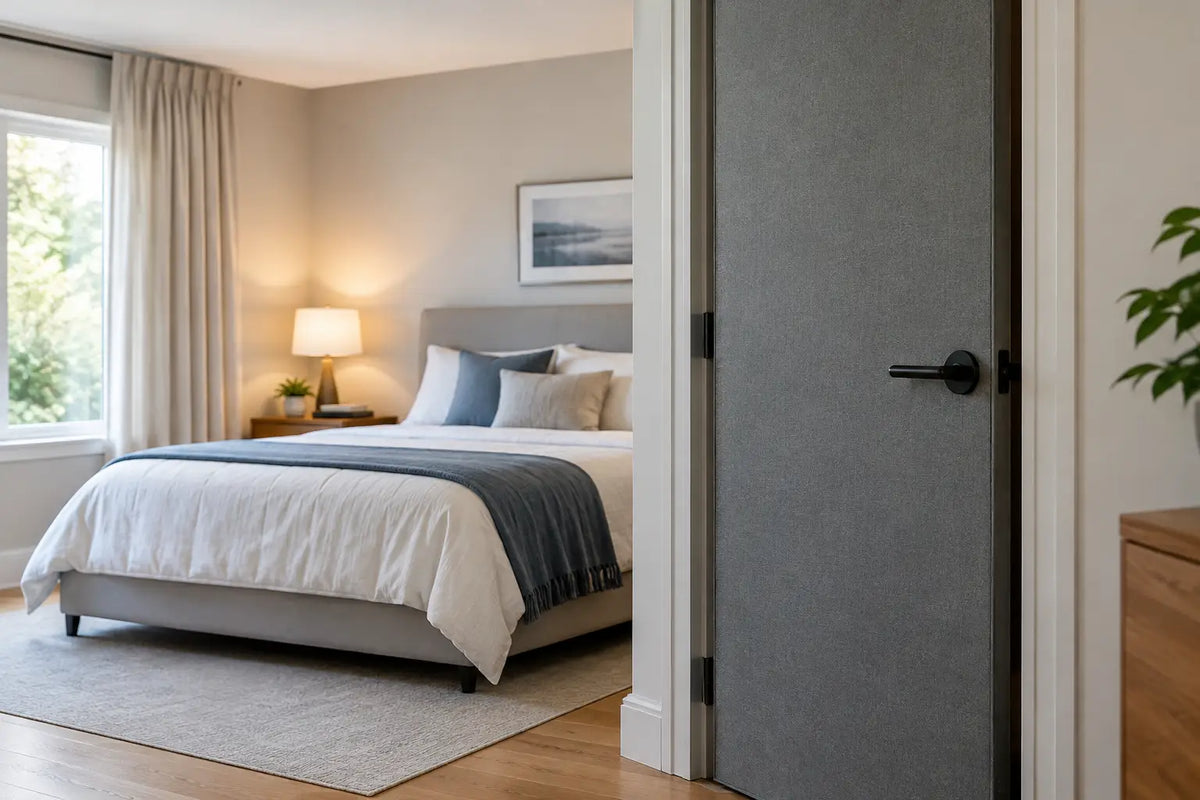
A bedroom door can look solid yet still allow conversations, television noise and footsteps to travel easily between rooms. The best acoustic bedroom doors help reduce sound transmission, creating a quieter and more comfortable sleeping environment. However, effective bedroom soundproofing depends on more than the door itself. Gaps around the frame, an unsealed threshold and poorly insulated walls can all reduce acoustic performance.
Choosing the right soundproof bedroom door depends on your noise reduction requirements, property type and budget. For an existing home, a solid-core internal door combined with quality perimeter seals can provide a practical improvement in sound insulation. For renovations, conversions and new builds where noise control is a priority, an independently tested acoustic doorset with a declared sound reduction rating is often a better choice.
Understanding the differences between solid-core doors, acoustic door seals and purpose-designed acoustic doorsets will help you choose a bedroom door that balances sound insulation, style and cost. By considering the complete door assembly, including the frame, seals and threshold, you can achieve more effective noise reduction and create a quieter bedroom.
What makes a bedroom door acoustic?
Sound is airborne vibration. It finds the easiest route through a partition, which is why the narrow gap beneath an internal door can matter more than a decorative panel detail. A heavier, denser door leaf generally blocks more airborne sound than a hollow-core door, while seals stop sound passing around its edges.
Purpose-made acoustic doors are tested as complete assemblies. Their performance is normally expressed as an Rw rating in decibels, with a higher figure indicating greater sound reduction under laboratory conditions. A door rated around 29 to 32 Rw can be a worthwhile step up from a basic internal door. For homes next to noisy communal areas, home cinemas, studies or plant rooms, specifications of 35 Rw, 40 Rw or above may be appropriate.
Those figures are useful for comparison, not a promise of silence. Site conditions make a substantial difference. A 35 Rw door fitted poorly into a lightweight stud wall with unsealed service penetrations will not provide the same experience as the test result suggests.
The best bedroom acoustic doors by project type
There is no single best choice for every property. The right option depends on the noise source, the existing opening and whether fire performance is also required.
Solid-core internal doors for everyday privacy
For most bedroom upgrades, a solid-core flush or panelled internal door is the sensible starting point. Compared with a lightweight hollow-core construction, it adds mass and feels more substantial in daily use. It can noticeably reduce speech and general household noise when paired with perimeter seals and a drop seal at the bottom.
Solid-core doors are available in popular finishes including primed, white moulded, oak, black and contemporary grooved designs, so improving privacy does not have to compromise the interior scheme. They are also generally easier to source in standard sizes and can suit replacement projects where the existing frame is sound.
This route is good value, but it is not the same as buying a tested acoustic door. If the aim is simply to make a family bathroom, landing or living room less audible from the bedroom, it is often enough. If a resident works shifts or the room sits beside a communal corridor, move up to a certified acoustic solution.
Tested acoustic doorsets for higher noise control
An acoustic doorset combines the door leaf, frame, seals, hinges, latch and threshold detail as a tested package. This is the most dependable way to specify sound reduction because the components are designed to work together.
A pre-assembled or pre-hung doorset can also reduce installation variables. The frame is correctly matched to the leaf, seal positions are known and the required clearances are easier for the installer to achieve. For developers, landlords and contractors fitting several doors, that consistency can be more valuable than saving money on individual components.
Check the declared rating, test evidence and the exact configuration supplied. Glazing, letter plates, ventilation grilles and different ironmongery can affect acoustic performance. A bedroom acoustic doorset should be specified for its intended use rather than chosen solely by appearance.
Fire-rated acoustic doors for flats and conversions
Where a bedroom door forms part of a fire-resisting route, acoustic performance must be considered alongside fire safety. FD30 and FD60 doors are designed to resist fire for 30 or 60 minutes when installed as part of a compatible fire door assembly. They are not automatically acoustic doors, although many fire-rated doorsets can offer both ratings.
This is particularly relevant in flats, HMOs, loft conversions and multi-occupancy properties. Do not add seals, hinges, closers, locks or glazing details to a fire door without checking that they are compatible with the tested specification. Intumescent strips, smoke seals and self-closing devices may be required by the door's certification or the building's fire strategy.
For projects with compliance requirements, a fire and acoustic doorset is usually the clearest specification route. It brings the necessary performance into one coordinated product rather than asking a joiner to assemble separate parts on site.
Ratings, seals and gaps: the details that decide performance
The difference between an ordinary door and a quieter bedroom is often found around the edge of the leaf. Acoustic drop seals are especially effective because they lower automatically when the door closes, sealing the gap to the floor without dragging across carpet or flooring. They are usually preferable to a fixed brush strip for sound control.
Compression seals or acoustic perimeter seals fitted to the frame close the gaps at the head and jambs. The door must compress them evenly when shut, so alignment matters. A warped leaf, loose latch or badly packed frame can leave small openings that noticeably reduce performance.
Consider the threshold before ordering. A raised threshold can help provide a continuous seal, but may be inconvenient in a bedroom and can create an accessibility issue. Drop seals offer a neater answer in many domestic settings. Where there is thick carpet, confirm that the seal can reach the finished floor without excessive compression.
Ironmongery should be chosen with the same care. A correctly sized latch and keep help pull the door firmly against the seals. Three suitable hinges are common on heavier internal doors, while very heavy acoustic or fire-rated leaves may require more hinges or a specific hinge grade. Always follow the door manufacturer's fitting instructions.
Do not overlook the wall and adjoining routes
A bedroom door only controls sound passing through the doorway. If sound is travelling through a thin partition, ceiling void, adjoining stud wall or poorly sealed sockets, replacing the door alone has limits. This is why the expected improvement should be realistic.
Before specifying a premium door, stand in the bedroom while another person speaks in the hall. Listen around the frame, beneath the leaf and through the wall itself. If the noise is strongest at the door edges, sealing and upgrading the door is likely to help. If the whole wall seems to transmit voices, consider acoustic insulation, additional boarding or professional advice on the partition build-up.
Ventilation also needs attention. Bedrooms need adequate airflow, and an undercut beneath the door is sometimes used to support it. Removing that gap with an acoustic seal may mean the room's ventilation arrangement needs to be reviewed. Never compromise required ventilation or fire safety simply to improve sound control.
Measuring and ordering a bedroom acoustic door
Measure the structural opening or existing door and frame accurately, then establish whether you are ordering a door leaf, a frame and leaf, or a complete doorset. Standard internal door sizes can make a replacement straightforward, but acoustic leaves may be thicker and heavier than a conventional internal door. Check that the frame depth, hinge positions and surrounding wall can accommodate the chosen product.
Allow for finished floor levels, especially where new carpet, engineered wood or tile is still to be fitted. It is much easier to specify the correct bottom clearance before installation than to trim a performance door afterwards. Excessive trimming can affect both the construction and any certification.
For a doorset, confirm handing, opening direction, wall thickness, finish, required hardware preparation and whether the product is pre-assembled. For a door leaf upgrade, make sure the existing frame is square, securely fixed and deep enough for the seals. A specialist supplier such as Door Supplies Online can help narrow the choice between standard solid-core doors, fire doors and more technical doorset specifications.
A practical specification for most homes
For a typical family home, a solid-core bedroom door with quality perimeter seals and an automatic drop seal offers the strongest balance of privacy, appearance and cost. Choose a finish that suits the rest of the internal doors, fit suitable hinges and latching hardware, and ask an experienced joiner to set the gaps correctly.
Where the bedroom adjoins a busy hallway, shared stairwell or living space, a tested acoustic doorset is a better investment. The quietest result rarely comes from the heaviest leaf alone. It comes from treating the doorway as a complete assembly, fitted accurately and matched to the wall around it.
For more information about our interior or exterior doors or door accessories, give us a call at 01603 622261 and speak to a member of our expert team today, or email us at sales@doorsuppliesonline.co.uk. We look forward to hearing from you.