
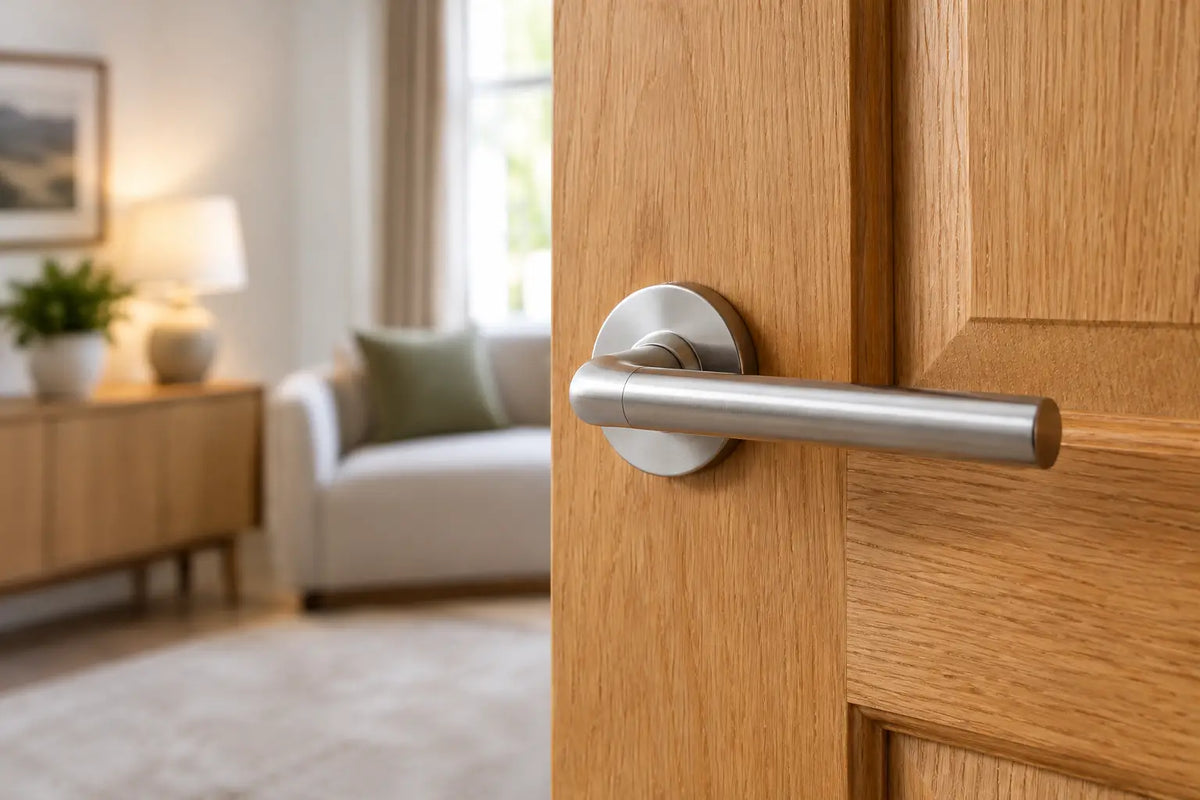
Oak doors have a natural warmth and distinctive grain that make them a popular choice for both traditional and contemporary interiors. However, choosing the right hardware is just as important as selecting the door itself. The best door handles for oak doors should complement the timber's natural colour and grain while providing a comfortable grip, reliable everyday operation and compatibility with the door's specification.
The finish you choose can significantly influence the overall appearance of your oak door. For pale, unfinished or white-oiled oak doors, matt black door handles create a striking contemporary contrast that works particularly well in modern interiors. On richer, honey-toned or stained oak doors, satin brass, antique brass and bronze handles enhance the natural warmth of the timber and introduce a more traditional or premium appearance.
Polished chrome and satin chrome door handles are also versatile options, offering a clean, understated finish that suits many modern homes. However, their cooler metallic appearance works best when coordinated with other fixtures and fittings throughout the room.
When choosing handles for oak internal doors, consider more than colour and style. Lever handles, backplate designs, rose handles and different finishes each offer distinct practical and aesthetic benefits. You should also check the door's thickness, latch requirements and ironmongery compatibility before purchasing.
Whether you are updating existing oak doors or completing a new interior project, the right door handles will complement the natural beauty of the timber and create a consistent, well-finished look throughout your home.
Choose the Handle Style Before the Finish
The first decision is usually the handle type. Lever-on-rose handles are the most flexible option for modern internal oak doors. The rose is compact, so it keeps attention on the door’s grain and works particularly well with flush, shaker and contemporary cottage-style designs. They are also easy to coordinate with separate bathroom turns, key escutcheons and pull handles.
Lever-on-backplate handles suit more traditional oak doors, especially panelled designs. A longer backplate gives the ironmongery greater visual weight and can suit period properties, farmhouse interiors and darker stained oak. It is also useful when replacing existing handles, as the backplate may cover previous fixing marks or colour variation in the timber.
Knobs can look excellent on lighter internal doors, cupboards and occasional rooms, but they are less practical for frequently used passage doors. A lever handle is generally easier for children, older occupants and anyone carrying shopping, laundry or tools. For most homes, it offers the best combination of appearance and everyday usability.
Best Door Handles for Oak Doors by Finish
There is no single finish that works with every oak door. The right choice depends on the oak’s colour, the door style, surrounding joinery and the wider scheme. Looking at a small finish sample against the door in natural daylight is worthwhile, particularly where oak has a pronounced grain or a strong golden tone.
Matt black for modern contrast
Matt black and black nickel handles are among the strongest choices for modern oak doors. They create definition without competing with the grain, and work well with black-framed glazing, black light fittings or dark stair spindles. A black lever-on-rose handle is particularly effective on vertical-groove, ladder-style and minimalist oak doors.
The trade-off is that black can look too stark against very orange or heavily varnished oak. In that setting, choose a softer black finish or balance it with black hinges and matching door furniture so it appears as part of a considered scheme rather than an isolated detail.
Satin brass and antique brass for warmth
Satin brass has a softer sheen than polished brass and gives oak a refined, contemporary feel. It works especially well with white-oiled, natural and mid-toned oak, as well as warm neutral paint colours. Antique brass is more characterful, with a darker, aged appearance that suits traditional panelled doors and heritage-inspired interiors.
Brass is an excellent choice where the aim is warmth rather than contrast. However, avoid mixing several brass tones without a clear plan. Satin brass, polished brass and antique brass can all look different under the same lighting. Select a matching range for handles, hinges, latches, locks and bathroom turns wherever possible.
Satin nickel and chrome for a lighter scheme
Satin nickel is a dependable option for oak doors in homes with stainless steel appliances, grey finishes or cooler neutral décor. Its low-reflective surface is forgiving of fingerprints and does not distract from the door. Polished chrome gives a brighter, more reflective result and can suit contemporary homes, but it may feel less sympathetic to rustic or character-grade oak.
If you are fitting several internal doors, satin nickel is often the safer long-term option. It is understated, widely available and easy to coordinate with standard hinges and locks.
Bronze, pewter and aged finishes for character
Bronze, dark bronze, pewter and forged-effect finishes bring depth to oak. They suit cottage-style doors, reclaimed timber, exposed beams and properties with a more traditional architectural feel. These finishes are usually less uniform than chrome or nickel, which is part of their appeal.
Check the product description carefully, though. Some dark finishes are plated and smooth, while others are deliberately textured or hand-finished. The choice should reflect the door and the setting. A heavily textured handle can overwhelm a clean-lined oak door, while a very sleek handle can look out of place on a rustic ledged-and-braced design.
Match the Handle to the Door Construction
An oak-faced internal door, a solid engineered oak door and a traditional solid oak door do not all accept fittings in exactly the same way. Check the manufacturer’s guidance before drilling, particularly for doors with glazed panels, routed details or a veneered surface.
For most internal doors, a standard sprung lever handle and tubular latch will be suitable. A sprung handle supports its own lever mechanism, reducing reliance on the latch spring and helping the handle return neatly after use. This is useful on heavier oak doors, where a poor-quality latch or unsprung handle can soon feel loose or droop.
Consider the lever length as well as the design. A generous lever is easier to operate, but needs clearance from the frame, glazing beads and nearby walls. On narrow-stile doors, ensure the rose or backplate will fit safely within the available timber without encroaching on a panel or glass aperture.
Door thickness matters too. Internal oak doors are commonly 35mm or 40mm thick, while external doors and fire doors may be thicker. Confirm that the handle spindle, bolt-through fixings and latch are suitable for the actual door thickness, not simply the nominal product category.
Fire Doors Need Certified Compatible Ironmongery
If the oak door is an FD30 or FD60 fire door, appearance comes after compliance. Handles, hinges, latches, locks and closers must be suitable for the door’s fire rating and installed in line with the door manufacturer’s instructions. Do not assume that a standard internal handle set is appropriate simply because it looks the same.
A fire door needs a positive latching action, so the latch must engage correctly with the strike plate every time. Where a door is smoke-rated, the complete doorset specification may also require smoke seals and specific gaps around the leaf. Drilling or altering a fire door without checking the permitted ironmongery positions can compromise its performance.
For communal areas, flats, commercial settings or projects subject to building control, specify tested and compatible components from the outset. A pre-assembled fire door set can simplify this process where the frame, leaf and key components are designed to work together.
Do Not Overlook Hinges, Latches and Privacy Hardware
A handle never looks fully finished if the remaining ironmongery clashes. For black handles, black hinges and a black latch faceplate create a coordinated result. For brass, consider whether matching hinges are available, or whether a discreet satin brass and stainless steel combination is more practical. On oak, even small differences in metal tone are noticeable.
Bathroom and WC doors need a privacy turn and release rather than a keyed lock in most domestic settings. Choose a separate turn that matches the handle rose or backplate. Bedrooms may use a simple latch, a key lock or a privacy lock depending on the property and the level of privacy required.
Also think about the latch sound. A quality latch with a smooth action makes a noticeable difference on a substantial oak door. It is a small component, but one that gets used every day.
A Practical Specification Checklist
Before ordering, confirm these details across every door in the project:
- Door type, thickness and handing where relevant.
- Handle style, finish and whether it is sprung.
- Latch, lock or bathroom privacy function required.
- Compatible hinges, strike plates, escutcheons and turns.
- Fire rating and tested ironmongery requirements for FD30 or FD60 doors.
- Fixing method and clearances around glazing, panels and frames.
Ordering all ironmongery from the same finish family is the simplest way to keep a renovation or new build consistent. It also helps avoid delays when a joiner is ready to fit the doors but the correct latch or privacy turn has not arrived.
The right handle should make an oak door feel complete, not merely fitted. Start with how the door will be used, then choose a finish that supports the timber and a specification that suits the door itself. If you are unsure between two finishes, place them against the actual oak sample first - natural timber and room lighting will make the final decision far easier.
For more information about our interior or exterior doors or door accessories, give us a call at 01603 622261 and speak to a member of our expert team today, or email us at sales@doorsuppliesonline.co.uk. We look forward to hearing from you.