
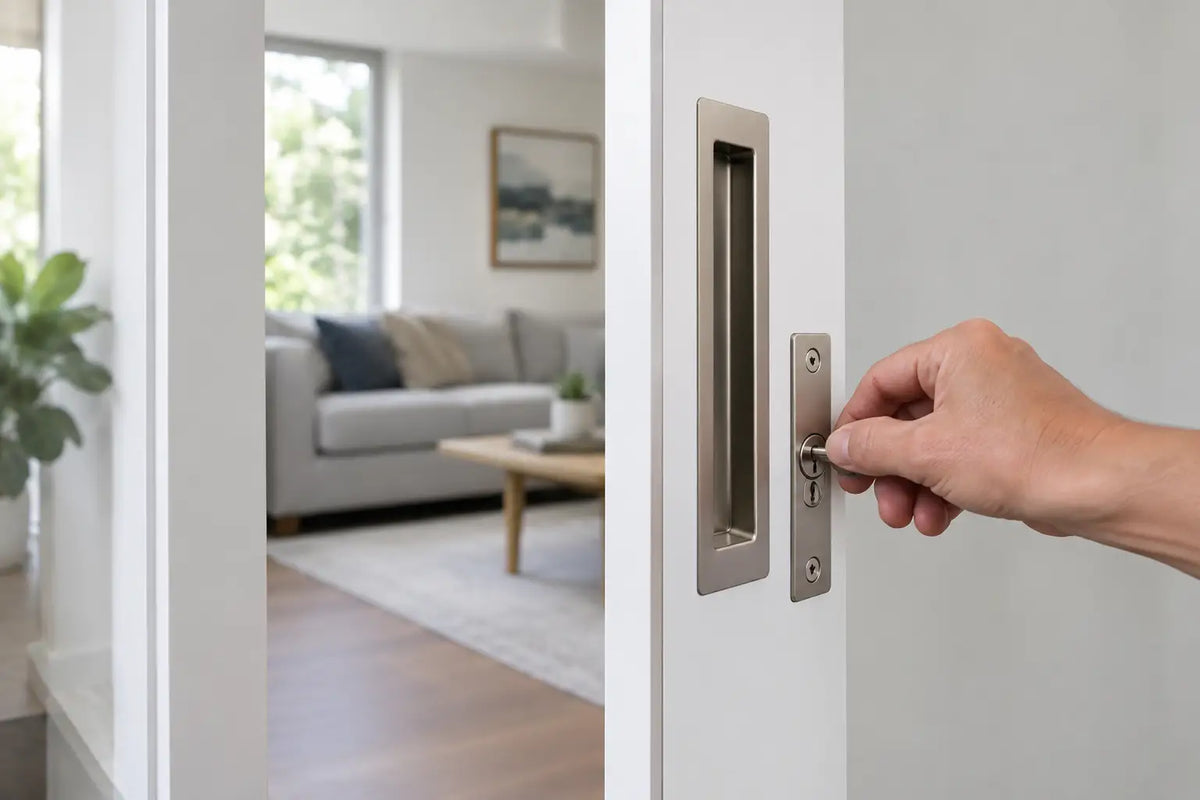
A pocket door is an excellent space-saving solution, but it still needs to provide the privacy and security expected of a conventional internal door. So, can pocket doors be locked? Yes. With the right hardware, pocket doors can be fitted with locks for bathrooms, bedrooms, home offices and other internal spaces. The best option depends on your requirements, whether you need a simple bathroom privacy lock, a key-operated lock for a study or rental property, or a more secure locking solution for a specific application.
Unlike traditional hinged doors, pocket doors slide into a wall cavity or pocket door cassette rather than closing against a conventional door frame and keep. This means they require specialist locking hardware designed specifically for sliding doors. Standard tubular latches and lever handles are generally unsuitable, as they can prevent the door from sliding fully into the wall.
Purpose-made pocket door locks and privacy handles are designed to fit flush within the door, allowing it to slide smoothly into its pocket while maintaining a neat, unobtrusive appearance. From bathroom privacy locks to key-operated pocket door mechanisms, choosing compatible hardware ensures your pocket door remains practical, secure, and easy to operate.
Can Pocket Doors Be Locked Securely?
They can, although it helps to be realistic about the level of security. Most internal pocket door locks are intended for privacy and access control, not for protecting an external entrance or a high-value room. The lock commonly operates a hook bolt, which throws into a keep fitted to the closing jamb. As the bolt hooks into place rather than simply pushing straight across, it resists the door being pulled open.
For an en-suite, WC, changing room or bedroom, a privacy lock is usually the correct specification. It gives the occupant a turn-and-release lock on the inside and an emergency-release facility on the outside. This is the familiar arrangement used on standard bathroom doors, adapted for sliding doors.
A key-locking pocket door set is more appropriate where controlled access matters, such as a home office, consulting room, cupboard containing personal items, or a landlord-managed room. These sets may use a euro-profile cylinder, a key-and-turn cylinder, or a traditional key-operated lock depending on the design. Choose the locking format before ordering handles, as the escutcheons and lock case must be compatible.
A lock will only be as good as the door, jamb and installation behind it. Lightweight hollow-core doors and poorly fixed closing jambs can be forced more easily than solid-core doors installed accurately within a quality pocket door system. For most internal settings, however, a correctly fitted hook lock provides dependable day-to-day privacy.
The Main Types of Pocket Door Lock
Privacy lock with emergency release
This is the most popular choice for bathrooms and en-suites. The inside thumbturn locks the door, while the external side has a coin-release or similar emergency release. It avoids the risk of someone becoming trapped if they are unwell, while still giving clear privacy when the room is occupied.
Look for a sliding door privacy lock rather than trying to adapt a lock intended for a hinged door. The case needs to suit the door edge and the bolt needs to engage properly with a dedicated strike plate or keep on the closing jamb.
Keyed hook lock
A keyed sliding door lock uses a hook bolt operated by a key or cylinder. It is useful for studies, store rooms, treatment rooms and other spaces where you want more than an occupied/vacant indicator. Some versions lock from both sides with a key, while others have a thumbturn internally for quicker exit.
Think about who needs access before selecting the cylinder. A key and turn arrangement can be practical in a home, while keyed alike cylinders may make sense across several rooms in a managed property. For higher-use commercial applications, select hardware rated for the expected duty and make sure the door leaf and pocket system are suitable for the weight.
Passage set with pull handles
Not every pocket door needs a lock. A passage set has flush pulls and, often, an edge pull to retrieve the door when it has slid fully into the pocket. This is a clean choice for kitchens, lounges, utility rooms and open-plan areas where the door is mainly used to divide sound, cooking odours or visual clutter.
Flush pulls are essential where the door enters the cassette. Proud handles can catch on the pocket frame, damage the finish and prevent the door from opening fully.
Choose Hardware to Suit the Door and System
The lock is only one part of the specification. A complete pocket door hardware arrangement normally includes a lock case, a matching pull handle or flush pull, a keep, finger pulls or edge pulls, and any required cylinder, thumbturn or emergency-release component. Buying these items as a compatible set reduces the risk of incorrect cut-outs or mismatched finishes.
Check the door thickness first. Many internal doors are 35mm or 44mm thick, but lock cases and pull sets have minimum and maximum thickness ranges. A lock intended for a 44mm door may not fit neatly into a slimmer leaf, while a deep lock case can leave too little material at the edge of the door.
The closing jamb also matters. It needs enough solid fixing behind it to hold the keep securely and withstand repeated locking. Pocket door kits are often supplied with a closing post or jamb arrangement, but the final detail varies by system and wall construction. Follow the pocket system manufacturer's fitting guidance rather than cutting the lock recess before the cassette, door and jamb positions are confirmed.
Finish is the design decision that customers notice most. Satin stainless steel and satin nickel work well in contemporary homes; polished chrome remains a popular bright finish; black hardware creates a stronger modern contrast; and antique brass or bronze can suit more characterful interiors. Match the lock pulls with nearby hinges, lever handles, sockets and cabinetry where possible. Although pocket doors do not use hinges, coordinated ironmongery gives the room a considered finish.
Fitting a Lock to a Pocket Door
A lock can be fitted to a new pocket door or, in some cases, retrofitted to an existing installation. New builds and renovations are simpler because the door leaf can be machined on a bench before hanging. Retrofitting is possible, but access around the door edge and closing jamb can be limited, particularly once architraves and decoration are complete.
Start by confirming the handing and closing direction. The lock must be installed on the meeting edge that reaches the closing jamb, and the hook bolt must face the correct way to engage with the keep. Product drawings will show the required centres, cut-out sizes and edge preparation.
The lock body is recessed into the door edge, with flush pulls or escutcheons fitted to both faces. Careful marking is essential. A misaligned keep can make the hook bolt scrape, fail to engage or leave the door under tension. Before final fixing, test the door travel through its full opening and closing movement, then test the lock several times with the door naturally positioned against the jamb.
Do not overlook the final few millimetres of travel. A pocket door that does not close squarely because of an incorrectly adjusted track, warped leaf or loose guide may never lock consistently. Adjust the door height and alignment first, then position the keep to suit the final closed position.
Fire Doors and Pocket Doors Need Separate Consideration
If the opening requires fire resistance, do not assume a standard pocket door system and ordinary lock can be used. Fire door assemblies are tested as complete systems, and the cassette, door leaf, seals, frame detail, hardware and installation method all affect performance.
A conventional internal pocket door should not be substituted for an FD30 or FD60 doorset simply because it has a hook lock. Where fire compartmentation is required, specify a tested and certified sliding fire door or pocket door solution and use only the compatible ironmongery identified for that system. Fire-rated doors also need correct installation, including the specified seals and gaps, to meet their intended performance.
This is particularly relevant for flats, loft conversions, shared properties, commercial premises and work where Building Regulations or a project specification apply. If there is any doubt, confirm the requirement with the building control body, fire consultant, contractor or system manufacturer before ordering.
Common Problems to Avoid
The most frequent mistake is choosing handles before choosing the lock. A beautiful pair of flush pulls may not accommodate the lock case, cylinder or thumbturn you need. Select the operating function first, then buy matching furniture.
Another issue is forgetting retrieval. If a pocket door slides completely into its wall cavity, you need an edge pull or a recessed finger pull that allows it to be drawn back out. Some locks incorporate this feature, while other arrangements need a separate edge pull.
Finally, avoid treating a privacy lock as a security lock. For a bathroom, it is exactly the right product. For a room requiring controlled access, choose a key-operated hook lock and pair it with a solid, well-installed door and jamb.
The best pocket door lock is the one that suits how the room is actually used: easy emergency release for a family bathroom, a key lock for a private workspace, or simple flush pulls where the door only needs to slide quietly out of sight. Getting that decision right before the door is machined makes the installation cleaner, the hardware more reliable and the finished space far easier to live with.
For more information about our interior or exterior doors or door accessories, give us a call at 01603 622261 and speak to a member of our expert team today, or email us at sales@doorsuppliesonline.co.uk. We look forward to hearing from you.