
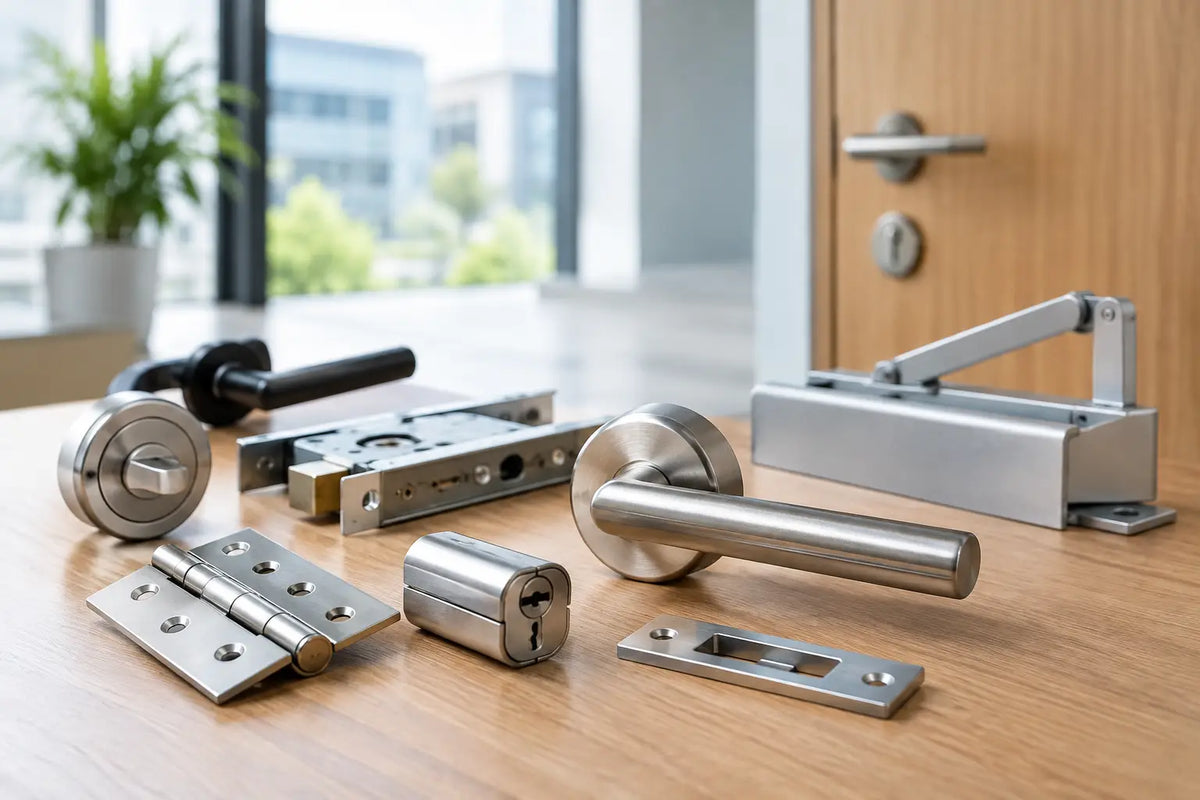
A commercial door that sticks, slams shut or fails to latch properly is more than an everyday inconvenience. It can disrupt workplace operations, compromise building security and, where fire doors are involved, create serious fire safety and compliance concerns. This commercial ironmongery guide explains how to choose and specify the right door hardware to ensure a reliable, secure and fully functional installation.
Commercial door ironmongery includes all the hardware and accessories needed to operate, secure and maintain a door. Common components include hinges, lever handles, locks, cylinders, door closers, pull handles, panic hardware, kick plates, signage and access-control systems. Although each component serves a specific purpose, they must work together as part of a properly specified door assembly.
Choosing the right commercial ironmongery involves considering the door's material, weight, frequency of use, location and security requirements. For example, heavily used doors in offices, schools, hospitals and commercial buildings may require durable hinges, robust locking mechanisms and adjustable door closers designed for frequent operation. Fire doors also require compatible, appropriately tested and certified hardware to maintain their intended fire performance.
Selecting individual products based on appearance or price alone is rarely enough. A premium lever handle cannot compensate for undersized hinges, an unsuitable lock or a poorly adjusted door closer. By understanding the different types of commercial door hardware and ironmongery, you can specify components that work together to deliver lasting performance, accessibility, security and safety across your building.
Start with the door's purpose
The right specification begins with how the door will be used. A lightly used internal office door needs different hardware from a busy school corridor, a communal entrance or a plant-room fire door. Consider traffic levels, door weight, security, accessibility, exposure to moisture and the direction of escape before selecting a finish or style.
For example, a solid-core commercial door may require three heavy-duty ball-bearing hinges, while a particularly tall or heavy doorset may need four. A glazed door can also place different demands on hinges and closers because weight distribution matters. The door manufacturer’s instructions and the hardware manufacturer’s load data should always take priority over rule-of-thumb sizing.
Function also determines whether a latch, sashlock, deadlock, bathroom lock or roller catch is appropriate. On a meeting room door, a lever handle on rose with a latch may be all that is required. A store cupboard may need key control, while a communal flat entrance could require a more detailed security and fire specification.
Commercial ironmongery guide to fire doors
Fire door hardware is where compatible specification matters most. An FD30 or FD60 door is only part of a tested or assessed doorset. Drilling extra holes, fitting unsuitable hinges or installing a closer with the wrong power can undermine its fire performance.
Use ironmongery that is suitable for the stated fire rating and supported by relevant test evidence or third-party certification. Check the door manufacturer’s fitting instructions as well as the hardware details. These documents may set limits for hinge positions, intumescent protection, lock cases, latches, viewers, letter plates and other cut-outs.
A fire door normally needs a self-closing device so that it returns to the frame and latches fully after use. The closer must be matched to the size, weight and location of the leaf, then adjusted on site for a controlled close. If it shuts too quickly, it can be difficult to use and may cause damage. If it shuts too slowly or does not overcome the latch, the door may be left ajar.
Hinges are equally critical. Fire doors commonly use steel ball-bearing hinges, with the quantity, grade and fixing method confirmed for the particular doorset. Decorative hinges may suit domestic internal doors, but a commercial fire doorset needs proven load capacity, durability and fire suitability.
Do not treat intumescent protection as an optional extra. Depending on the product and test evidence, intumescent pads or hinge protection may be required behind hinges, locks, closers and other ironmongery that interrupts the door leaf or frame. It is a specification decision, not an on-site guess.
Match standards to the application
Standards provide a useful way to compare products, but they do not replace project-specific requirements. Hinges are commonly assessed to BS EN 1935, controlled door-closing devices to BS EN 1154, mechanically operated locks to BS EN 12209 and lever furniture to BS EN 1906. These classifications indicate performance characteristics such as use, durability, door mass, corrosion resistance and fire performance.
Escape hardware needs even closer attention. Doors on escape routes must allow people to leave quickly and safely. BS EN 179 emergency exit devices are generally intended for situations where occupants know the building and its escape arrangements, such as staff-only areas. BS EN 1125 panic exit devices, including push bars, are generally used where the public may be present and familiarity cannot be assumed.
The correct choice depends on the building’s fire strategy, risk assessment, occupancy and the advice of the responsible designer or fire-safety professional. Do not select panic hardware purely because it appears more substantial, or specify a keyed lock on an escape door without confirming the means of egress.
Choose hinges and closers as a pair
Hinges and closers carry most of the mechanical load in a commercial door. They should be selected together, alongside the door leaf, frame and any seals. A closer powerful enough to control a heavy leaf can make a narrow door hard to open if the opening forces are not considered. Conversely, a lighter closer may struggle against air pressure, seals or a latch.
Door closers are available in several formats. Overhead surface-mounted closers are familiar, accessible for adjustment and often a practical commercial choice. Concealed closers offer a cleaner appearance but may involve more preparation and need careful confirmation for fire-door use. Floor springs and pivot systems can suit large glazed or high-traffic entrance doors, although they involve a different installation detail and maintenance plan.
Where accessibility is a priority, specify adjustable closing and latching speeds, and ensure the installer can set them correctly once the building is occupied. Hold-open devices should only be used where they are appropriate to the fire strategy. On fire doors, linked electromagnetic hold-open systems can release on activation of the fire alarm, whereas a simple wedge is never an acceptable substitute.
Specify security without spoiling usability
Commercial security is rarely achieved by a lock alone. A secure external door may need a suitable lockcase, cylinder, security escutcheon, reinforced strike plate, hinges with security features and an access-control solution that works with the building’s daily operation.
Cylinder choice deserves particular care on outward-opening external doors and communal entrances. The cylinder should be sized correctly to the door thickness and hardware, avoiding excessive projection that can make it vulnerable to attack. For master-keyed properties, agree the key hierarchy early. Retrofitting a complicated key plan after doors have been installed creates avoidable cost and delay.
On internal doors, simpler can be better. If a door only needs privacy, a bathroom turn and release may be more appropriate than a keyed lock. For cleaners’ cupboards, service risers or restricted offices, identify who needs access and whether lost keys would create a management issue. Mechanical digital locks or electronic access control can reduce key handling, but they also require a clear maintenance and emergency override plan.
Finish, durability and maintenance
Finish affects both appearance and service life. Satin stainless steel is a dependable choice for high-use commercial interiors because it coordinates easily and is relatively forgiving of fingerprints. Polished stainless steel creates a sharper look but shows marks more readily. Black hardware can give contemporary schemes a strong visual identity, yet quality matters: lower-grade coated finishes can show wear quickly on heavily used doors.
For wet rooms, coastal locations or externally exposed entrances, corrosion resistance should take precedence over a purely decorative finish. Match the material and grade to the environment, including cleaning chemicals used by the facilities team. A handle that looks right on day one but pits or discolours after a year is not good value.
Consistency also matters across a development. Coordinating lever handles, hinges, door closers, escutcheons, signage and kick plates creates a professional finish and makes replacements easier to source. It is usually worth agreeing one or two core finishes rather than specifying a different style for every room type.
Order as a complete door set
The most reliable way to buy commercial ironmongery is to create a door-by-door schedule. Record the door number, handing, leaf size and weight, fire rating, room use, security level, closer, hinges, lock, handles, signage and any access-control requirement. This removes ambiguity for installers and reduces the chance of incompatible items arriving on site.
Allow for the less obvious components too: correct screws, intumescent kits where required, keeps, floor or wall stops, finger protection, kick plates and signage. These are small details, but missing one can hold up handover. For larger schemes, pre-assembled or pre-hung doorsets can reduce site work and give greater confidence that the door, frame, seals and core hardware have been considered together.
Door Supplies Online can help simplify the buying stage with a specialist range covering commercial doors, fire doors and coordinating architectural ironmongery. Bring together the door specification first, then choose hardware that supports it. That approach produces doors that look considered, operate reliably and remain easier to maintain long after the project is signed off.
For more information about our interior or exterior doors or door accessories, give us a call at 01603 622261 and speak to a member of our expert team today, or email us at sales@doorsuppliesonline.co.uk. We look forward to hearing from you.