
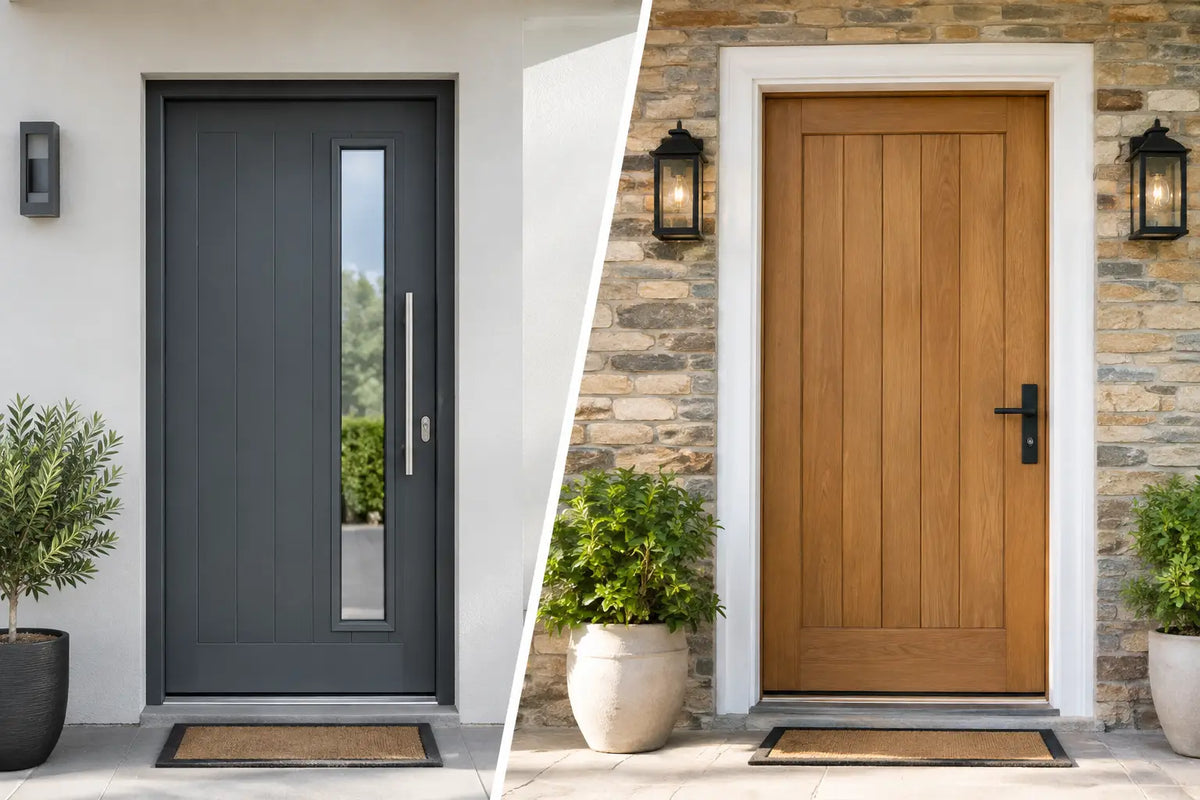
Choosing a new front door involves more than finding a style that complements your brickwork. Your entrance door needs to keep out rain and draughts, provide reliable security and withstand daily use without creating unnprotective finish.ecessary maintenance. That is why the composite vs timber doors debate deserves more consideration than simply choosing a colour or finish from a brochure.
For many UK homes, both composite doors and timber doors can be excellent choices. The right option depends on the age and style of your property, how exposed the entrance is to the weather, your preferred level of maintenance and whether you prioritise traditional character or low-maintenance performance.
In this guide, we compare composite and timber front doors, looking at durability, security, insulation, maintenance, appearance and cost to help you choose the right door for your home.
Composite vs timber doors: the key difference
A composite door is made from several materials rather than one solid timber construction. Depending on the design and manufacturer, its structure may include a reinforced frame, insulating core, GRP skin and secure multi-point locking. The aim is to combine strength, thermal efficiency and a durable weather-resistant finish in one external door system.
A timber door is made from wood, although that does not always mean a single solid plank. Quality external timber doors may be engineered to improve stability, using layers or sections of timber designed to reduce movement. They are commonly available in softwood, hardwood and oak, with painted, stained or unfinished options depending on the required look and level of site finishing.
The distinction matters because the two doors age differently. Composite is built for consistency and minimal upkeep. Timber is valued for natural grain, detail and the ability to repair, refinish and adapt its appearance over time.
Appearance and suitability for your property
Timber has an advantage where authenticity matters. A well-made oak or painted timber entrance door can complement period terraces, cottages, Victorian homes and traditional rural properties in a way that is difficult to replicate exactly. Timber also offers scope for bespoke sizing, panel arrangements, glazing, mouldings and colour matching, which can be particularly useful on renovation and conservation-led projects.
That said, composite doors are no longer limited to a generic suburban look. Modern designs cover traditional panelled styles, cottage-style doors, contemporary grooves, side panels and glazed designs. Woodgrain finishes can be convincing from a distance, while smooth finishes, black hardware and contemporary glazing suit newer homes well.
The deciding factor is usually proximity. If you want the warmth, texture and small variations of real wood at close range, timber is the clear choice. If you want a crisp, repeatable finish that remains consistent with very little intervention, composite is often more practical.
Weather resistance and maintenance
This is the category where composite doors usually appeal most strongly. Their outer skins are designed to cope with rain, UV exposure and everyday knocks. Routine care generally involves washing the surface with mild soapy water, checking hinges and keeping drainage areas clear. A good-quality composite door should not need regular painting or staining to retain its protective finish.
Timber needs a more active maintenance plan. Painted and stained finishes protect the wood from moisture and sunlight, but coatings eventually require inspection and renewal. How frequently will depend on the timber species, finish, quality of installation and how exposed the entrance is. A south-facing door or one without a porch canopy may need attention sooner than a sheltered doorway.
This does not make timber a poor weather choice. Properly specified, factory-finished and maintained timber doors can give many years of service. However, neglect is less forgiving. If the coating breaks down, moisture can enter the timber, leading to movement, swelling or surface deterioration. For landlords, busy households and exposed coastal or urban sites, the reduced upkeep of composite can be a major advantage.
Thermal performance and draught control
An external door is only as effective as the complete installation. The leaf, frame, seals, threshold and fitting quality all affect air leakage and comfort. A poorly fitted high-specification door can still let in draughts, while a properly installed door set will perform far more reliably.
Composite doors typically have an insulated core and perimeter seals that support good thermal performance. This makes them a strong option when replacing an older, ill-fitting entrance door. Their stable construction can also help maintain consistent gaps around the frame through changing seasons.
Timber is naturally insulating, and a well-built external timber door with suitable seals and glazing can also perform very well. The important point is to compare the performance information for the specific product, rather than assuming every composite door will outperform every timber door. Check the stated U-value where supplied, the glazing specification and whether the door is supplied as a coordinated door set.
Security, locks and compliance
Security should be assessed as a complete package, not as a material label. A secure entrance door needs a strong frame, suitable hinges, correctly fitted hardware and a locking arrangement appropriate to the property. Composite door systems commonly include multi-point locks as standard, which makes specification straightforward for many domestic replacements.
Timber doors can also provide high levels of security when paired with the right lock, keeps and reinforced hardware. For both materials, check what is included rather than assuming the handle shown in a product image is the final security specification.
Where a project has a specific requirement, such as a PAS24-rated entrance door, communal flat entrance door, fire-rated door or an insurance-led security standard, select a tested and certificated doorset designed for that purpose. Do not attempt to create a compliance-rated assembly by mixing a standard door, frame and hardware without confirming the full specification. Fire safety, smoke control and security performance depend on tested components working together.
Cost: purchase price versus lifetime value
Composite doors often offer a predictable all-in route. The initial price can include the slab, frame, threshold, seals, glazing and locking system, although specifications vary. Installation costs remain separate unless you are buying through a fitting service, but the product itself is usually a clearly defined package.
Timber doors can start at a competitive price for simple designs, but the final budget may need to include a frame, weather bars, glazing, ironmongery, locks, finishing materials and labour. Bespoke work, hardwood and detailed joinery will increase the cost further. This is often justified where the property needs a particular size or architectural style that off-the-shelf composite options cannot match.
Over the longer term, composite can be better value for buyers who want minimal maintenance. Timber can be better value when repairability and longevity are priorities. Scratches, dents and worn coatings on timber can often be sanded, filled and refinished. A deeply damaged composite surface is generally harder to repair invisibly.
When composite is the better choice
Choose composite if you want a secure, insulated and low-maintenance front door with a broad range of colours and glazing styles. It is especially well suited to busy family homes, rental properties, modern developments and entrances exposed to rain and wind.
It is also a sensible choice when speed and specification certainty matter. A pre-configured composite door set reduces the number of separate components to source and helps make sure the door, frame, seals and locking system are intended to work together.
When timber is the better choice
Choose timber when the character of real wood is central to the project. It is often the right answer for heritage-style properties, homes with existing timber sash windows, bespoke openings and renovation work where matching original details matters.
Timber also gives more freedom for a future change of direction. A painted door can be repainted in a new shade, while stained timber can be refreshed to bring back its grain. That flexibility has real value for homeowners who expect to stay in the property and are willing to maintain it properly.
Specify the whole entrance, not just the door
Before ordering, measure the structural opening carefully and decide whether you need a door slab, frame and associated ironmongery, or a complete pre-assembled door set. Consider the handing, outward or inward opening, threshold type, letterplate position, glazing privacy and any side panels. If the door opens onto an exposed elevation, discuss the need for a canopy, weathering details and a durable finish.
Door Supplies Online can help make this comparison more practical by narrowing the specification around style, performance, budget and the complete set of components required. The best entrance door is the one that suits the building, performs properly in its location and remains a door you are happy to come home to year after year.
For more information about our interior or exterior doors or door accessories, give us a call at 01603 622261 and speak to a member of our expert team today, or email us at sales@doorsuppliesonline.co.uk. We look forward to hearing from you.