
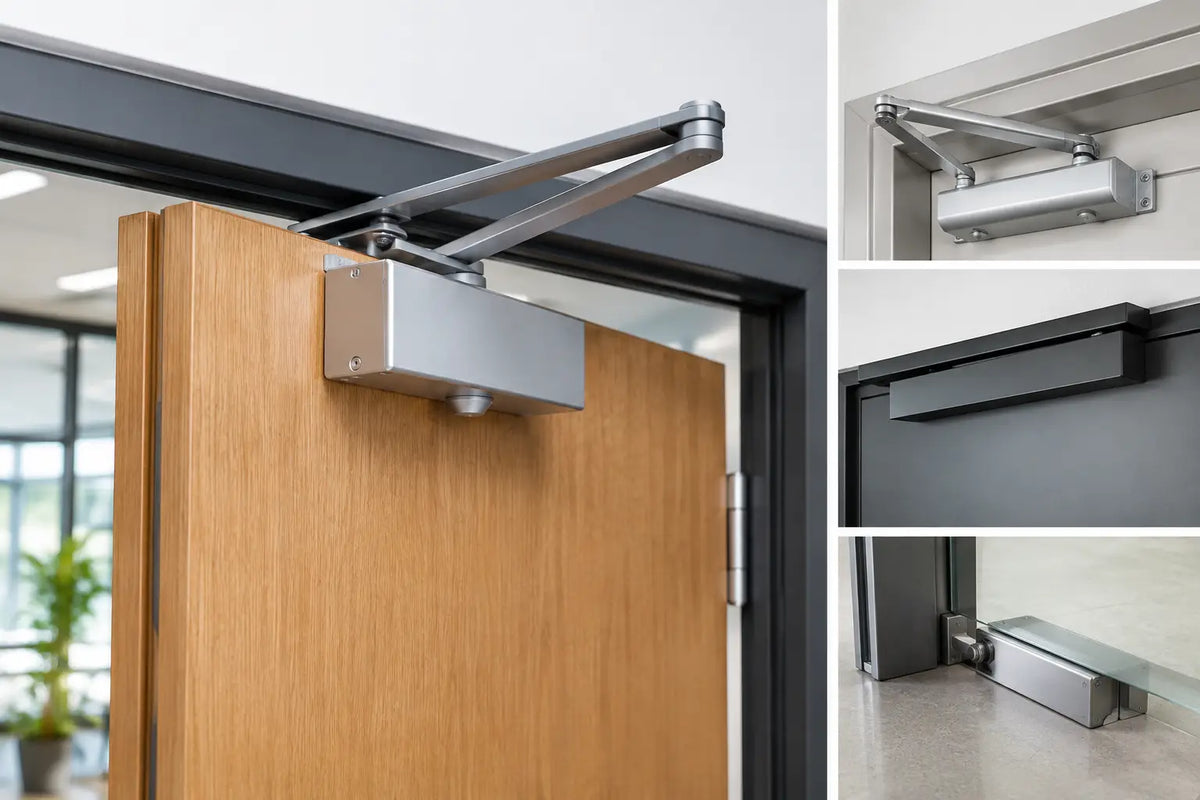
A door that slams shut, drifts open or fails to latch properly is more than an everyday annoyance. It can damage door frames, compromise privacy, allow cold draughts and, in the case of a fire door, affect an essential safety function. This door closer review explores the main types of door closers, their features and practical differences to help you choose the right door closing mechanism for your door, location and level of use. Whether you are fitting hardware to a residential entrance, a busy commercial doorway or a fire-rated door, selecting the correct closer is essential for reliable operation, controlled closing and long-term performance.
What a door closer needs to do
At its simplest, a door closer returns an opened door to its closed position in a controlled manner. The best choice balances enough closing force to overcome hinges, seals, latches and air pressure with a closing action that is not uncomfortable or hazardous for users.
That balance changes from one project to another. A lightweight internal cottage-style door on a quiet landing has very different requirements from a heavy solid-core FD30 fire door in a communal corridor. Door width, weight, material, hinge condition, latch type, exposure to wind and frequency of use all affect the specification.
For a replacement, inspect the existing closer before ordering. Its body position, arm arrangement and fixing holes may point towards a like-for-like product. That can save time, but it should not override the need for the correct power rating and fire-door suitability.
Door closer review: the main types compared
Overhead surface-mounted closers
Overhead closers are the familiar rectangular units fixed to the door or frame, connected by an arm. They are the most versatile and widely specified option for timber, aluminium and steel doors. They are also generally the most straightforward type to maintain, adjust and replace.
A standard rack-and-pinion closer is a sensible all-round choice for many residential and commercial applications. It is available in several fixing arrangements, including regular arm, parallel arm and transom mounting. The correct arrangement depends on the direction of opening, frame detail and whether you need to keep the arm within the reveal.
Parallel arm closers are popular in corridors, schools, offices and public-facing areas because the arm sits closer to the face of the door when closed. This reduces projection into the opening and offers a neater, more tamper-resistant appearance. The trade-off is that the geometry can require a more powerful unit than an equivalent regular-arm installation.
For most projects, an overhead closer is the strongest value option. It is visible, which may not suit a design-led interior, but that visibility makes inspection easy and helps ensure the closing action is not overlooked.
Cam-action closers
Cam-action closers use a different internal mechanism to reduce opening resistance. They are useful where accessibility and ease of operation matter, such as accommodation, healthcare settings and busy workplace doors. Users feel less initial resistance when pushing the door open, while the closer still provides a controlled return.
They cost more than a basic overhead unit and must still be specified correctly for the door weight and fire-door application. Do not assume that a light opening feel means the closer lacks power. Look at the manufacturer's tested performance and installation instructions, particularly where seals, smoke control or fire resistance are involved.
Concealed closers
Concealed closers are installed into the top of the door and frame, leaving very little visible hardware when the door is shut. They are a strong choice for high-end internal joinery, hotel-style schemes and contemporary homes where clean lines matter.
The limitation is preparation. The door and frame must be machined accurately, and the available timber section needs to accommodate the closer body without weakening the door. Retrofitting one into an existing fire door is rarely a casual alteration: fire performance can be affected by the size and location of the recess. Always check the doorset evidence and permitted ironmongery details before cutting.
A concealed closer may look better, but it is not automatically the better specification. Access for adjustment and future replacement is more restricted, and the fitting cost can outweigh the visual benefit on a straightforward renovation.
Floor springs and pivot systems
Floor springs are normally used with heavy, wide or glazed doors, particularly in retail, office and entrance settings. The mechanism is set into the floor and works with pivots, creating a premium, unobtrusive finish and allowing certain doors to swing in both directions.
They are not usually the first choice for a domestic replacement. Installation involves forming a floor pocket, setting the unit precisely and coordinating the pivot positions. Waterproofing and drainage also matter at external entrances. Where correctly specified, however, a floor spring gives excellent control for substantial doors that would be unsuitable for a light-duty closer.
Strength ratings: why EN power size matters
Many closers are classified to BS EN 1154, using power sizes from EN 1 to EN 7. In broad terms, a higher number indicates a unit capable of controlling a larger or heavier door. Some closers have a fixed size, while others are adjustable across a range, such as EN 2-4 or EN 3-5.
It is tempting to select the highest power available to make sure the door shuts. That often creates the wrong result. An overpowered closer can make a door difficult to open and cause it to slam, while an underpowered closer may stall against seals or fail to engage the latch.
Start with the door's width and mass, then consider the practical resistance in the opening. A thick acoustic seal, rising threshold, strong latch or negative air pressure can all demand more closing force. External doors face wind loading, but a standard door closer is not a cure for an exposed entrance that is repeatedly caught by gusts. The door, hinges, restrictor and entrance design all need to work together.
Where a door is part of an accessible route, opening forces and user comfort need particular attention. A low-resistance cam-action solution, suitable handles and correct adjustment can make a substantial difference without compromising the required closing performance.
Fire doors: closer selection is not optional
A fire door only performs as intended when it closes fully into its frame. That makes the closer a core part of the doorset, not an optional finishing item. For FD30 and FD60 doors, choose a closer that is approved for the relevant fire rating and install it in line with the door, closer and ironmongery manufacturers' instructions.
Check whether the closer is suitable for the door's test evidence, including its fixing position and any intumescent protection required. The closer must also have enough power to shut the door against the latch and seals. A door that rests just short of the latch might appear closed, but it is not functioning correctly.
Hold-open wedges, hooks and improvised retainers should never be used on fire doors. If a door genuinely needs to remain open for daily operation, specify a compliant hold-open or free-swing arrangement designed for the application. These products release the door to close when triggered by the fire alarm system or local detection, depending on the system.
Fire-door installations benefit from a full check after fitting. Open the door to different angles, then watch it close. It should move smoothly, avoid slamming, overcome the latch and sit correctly against the frame. Recheck after seals, flooring and ironmongery are completed, as each can alter the closing action.
Adjustments that make a closer work properly
Most quality hydraulic closers allow adjustment of closing speed and latch action. Closing speed controls the main travel from the open position, while latch action governs the final few degrees needed to engage the latch. Some units also offer backcheck, which resists the door being flung open and can protect walls, handles and hinges.
Small adjustments are usually enough. Turning a valve too far can cause oil loss and permanently damage the closer, so follow the product instructions and adjust gradually. Never use the closer body or arm as a door stop. Fit a suitable stop or restrictor where the opening needs limiting.
Before blaming the closer, check the basics. Loose hinges, a warped door, a poorly aligned keep, excessive seal pressure or a dragging threshold can stop even a correctly selected unit from latching. Correcting those faults is often a better fix than increasing the closing force.
Choosing the right finish and specification
Finish matters where the closer is visible. Satin stainless steel, polished brass, antique brass, black and white options can coordinate with lever handles, hinges, locks and door furniture. On a commercial project, however, dependable operation and a readily available replacement should take priority over a decorative match.
Also consider the complete ironmongery package. A heavier fire door may need appropriately rated hinges, a compatible latch or lockcase, intumescent protection and a closer selected as part of the tested assembly. For a new build or larger refurbishment, a pre-assembled doorset can reduce the risk of mismatched components and site alterations.
Door Supplies Online offers closers and supporting ironmongery across domestic, commercial and fire-door applications, making it easier to match practical performance with the finish and door type required.
The right closer should disappear into daily use: the door opens without a struggle, closes without drama and latches every time. Specify it with the same care as the door itself, and it will protect the finish, improve day-to-day comfort and support the performance the opening was designed to deliver.
For more information about our interior or exterior doors or door accessories, give us a call at 01603 622261 and speak to a member of our expert team today, or email us at sales@doorsuppliesonline.co.uk. We look forward to hearing from you.