
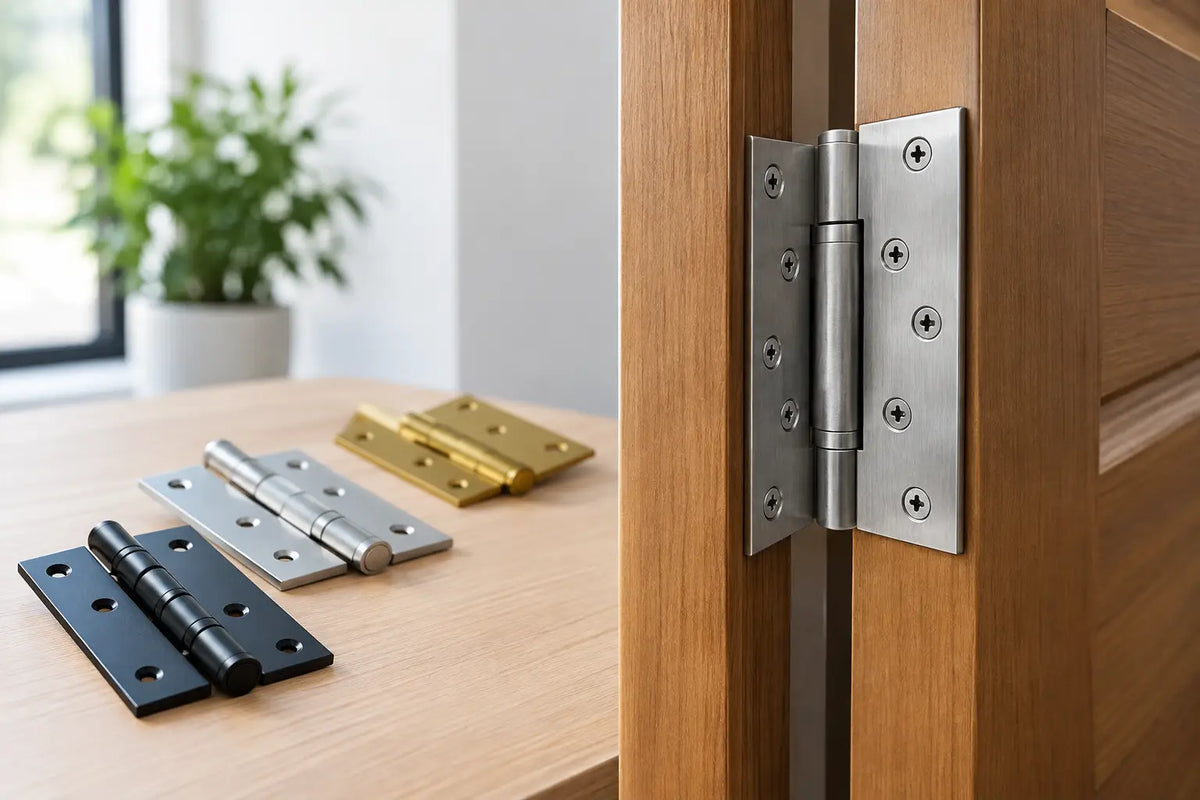
A heavy oak door that sags within weeks, catches on its frame or pulls screws from the jamb is rarely a door problem. It is usually a hinge specification problem. The right heavy-duty door hinges must carry the door's weight, suit its usage and fixing material, and, on fire doors, maintain the tested performance of the whole assembly.
Choosing hinges on appearance alone can be costly. Standard hinges may look fine when the door is first hung, but they often lack the load capacity for a solid core, hardwood, glazed or oversized door. The result is premature wear, poor alignment and a door that no longer closes properly.
Start with the door weight, not the hinge finish
The most useful figure is the actual weight of the door leaf. A hollow-core internal door can be relatively light, while a solid oak, fire-rated or glazed door may be considerably heavier than it appears. Add the weight of glazing, decorative panels, acoustic cores and door furniture where relevant.
Next, consider the door height and width. A tall door creates more leverage at the hinge positions, while a wider door places greater strain on the fixings each time it is opened. A 44mm fire door or a substantial external door therefore needs a more considered hinge arrangement than a standard 35mm internal door.
Hinge manufacturers publish load capacities based on a particular number of hinges, a stated door size and a specified fixing method. Treat these figures as a system rating, not a rough indication. If a hinge is rated for a door only when three hinges are used, fitting two does not provide a margin of safety.
For particularly heavy leaves, confirm the required weight capacity before ordering. It is sensible to allow a practical margin rather than selecting hinges that only just meet the calculated door weight. This is especially relevant for frequently used entrance doors, communal areas, commercial rooms and busy family homes.
How many heavy door hinges are needed?
Three hinges are the usual starting point for heavier internal, external and fire doors. They spread the load over more fixing points and reduce pressure on the top hinge, which takes the greatest share of the door’s weight. On tall, very heavy or high-traffic doors, four hinges may be the right specification.
The correct number depends on the hinge manufacturer’s data and the door set requirements. Do not assume that adding an extra hinge always solves an under-specified installation. The hinge size, grade, screw type, frame material and the strength of the door’s hinge stile all matter.
Hinge positioning is equally important. The top hinge is normally set close to the top of the door, the bottom hinge close to the bottom, and a third hinge is positioned to support the upper section of the leaf. Accurate recessing and consistent gaps are essential. A hinge sitting proud of the timber, or a mortice cut too deeply, can affect alignment and cause binding.
Choose the right hinge design
Butt hinges are the familiar choice for most hinged internal and external doors. For heavy applications, ball-bearing butt hinges are often preferable to plain-bearing versions. Their bearings reduce friction through the opening cycle, helping a substantial door move more smoothly and limiting wear over time.
Grade 13 ball-bearing hinges are commonly specified for fire doors and demanding applications, provided they are suitable for the particular door set and installation. They are available in a range of finishes, so a technical requirement does not mean compromising on the overall scheme. Satin stainless steel, polished chrome, antique brass, matt black and polished brass options can be matched with handles, latches and locks.
Parliament hinges are useful where a door must open wider than a standard butt hinge allows. Their extended knuckle projects the door clear of the architrave or wall, making them a practical choice where a full opening is needed. They must still be selected for the door weight and opening arrangement.
For gates, utility rooms, workshops or more traditional external joinery, tee hinges and hook-and-band hinges can offer both support and character. These are not simply decorative fittings. Their strap length, fixing method and supporting post or frame must be adequate for the door or gate they carry.
Material and finish affect service life
Stainless steel is a dependable choice for many heavy-duty installations because it offers good corrosion resistance and suits modern hardware schemes. It is particularly relevant in kitchens, bathrooms, coastal locations or other areas where moisture is a concern.
Brass and plated finishes can be an excellent design choice indoors, but the base material and manufacturer guidance still matter. A finish should be selected for the environment as well as the look. For exposed external doors, choose hinges designed for exterior use rather than relying on an interior decorative finish to withstand rain and temperature changes.
Match the hinge finish thoughtfully, but do not let it override the specification. A black hinge may complement black door furniture perfectly; it still needs the correct grade, dimensions and corrosion resistance for the job.
Fire doors need compatible, tested hardware
A fire door is a complete assembly, not just a fire-rated leaf. Hinges, latch, closer, frame, seals and installation all contribute to its performance. Where heavy door hinges are being fitted to an FD30 or FD60 door, they must be compatible with the relevant fire door specification.
In many cases, steel ball-bearing hinges are used, with three hinges fitted as a minimum. However, the door manufacturer’s instructions, test evidence and project specification take priority. The hinges may need to meet a particular performance classification, and intumescent hinge pads or protection may be required as part of the tested arrangement.
Never substitute hinges on a fire door simply because they are a similar size or finish. A change that appears minor can affect compliance. This is particularly significant in flats, communal corridors, rental properties, commercial buildings and any project subject to Building Regulations or a fire-risk assessment.
If you are replacing existing fire door hinges, check the leaf label or plug, assess the door condition and follow the manufacturer’s instructions. A fire door that does not close fully and positively is not performing its intended safety function.
Fixings and frames are part of the specification
Even the best hinge cannot compensate for poor screws or weak timber. Use the screws supplied with quality hinges where appropriate, or specified replacements of the correct diameter, length and material. Short screws may only bite into a thin lining, while overtightened screws can strip timber and make a secure installation impossible.
For a heavy door, the hinge screws need sound material to fix into. Check for damaged timber, old oversized screw holes, loose linings and split jambs before hanging the leaf. Repairs may be needed before new hinges are installed. On steel frames, use the fixing method specified for that frame system rather than ordinary timber screws.
Pre-drilling pilot holes helps prevent splitting, particularly in hardwood doors and frames. Keep hinge leaves flush with the surface and make sure screws are fully seated. A proud screw head can foul the hinge movement and create a misleading alignment issue.
Sizing heavy-duty hinges correctly
Hinge dimensions should suit the door thickness, weight and required opening. The leaf of the hinge must be wide enough to sit securely on both the door and frame, while the knuckle needs sufficient clearance to allow the door to open without scraping the frame or architrave.
As a general rule, a heavier or thicker door will usually need a larger hinge, but size alone is not a load rating. Compare the manufacturer’s stated capacity, bearing type and grade alongside the physical dimensions. This is the difference between choosing a hinge that looks substantial and one that has been engineered for the load.
Door Supplies Online offers hinges and ironmongery across practical finishes and technical specifications, making it easier to coordinate the look of a project without overlooking the functional requirements. For fire doors, oversized leaves or unusual frames, take time to check the door manufacturer’s requirements before finalising the hardware.
A correctly specified hinge is largely unnoticed in daily use: the door hangs true, closes cleanly and stays that way. Measure the door, verify the load rating and choose fixings with the same care as the hinge itself - it is the straightforward route to a dependable installation.
For more information about our interior or exterior doors or door accessories, give us a call at 01603 622261 and speak to a member of our expert team today, or email us at sales@doorsuppliesonline.co.uk. We look forward to hearing from you.