
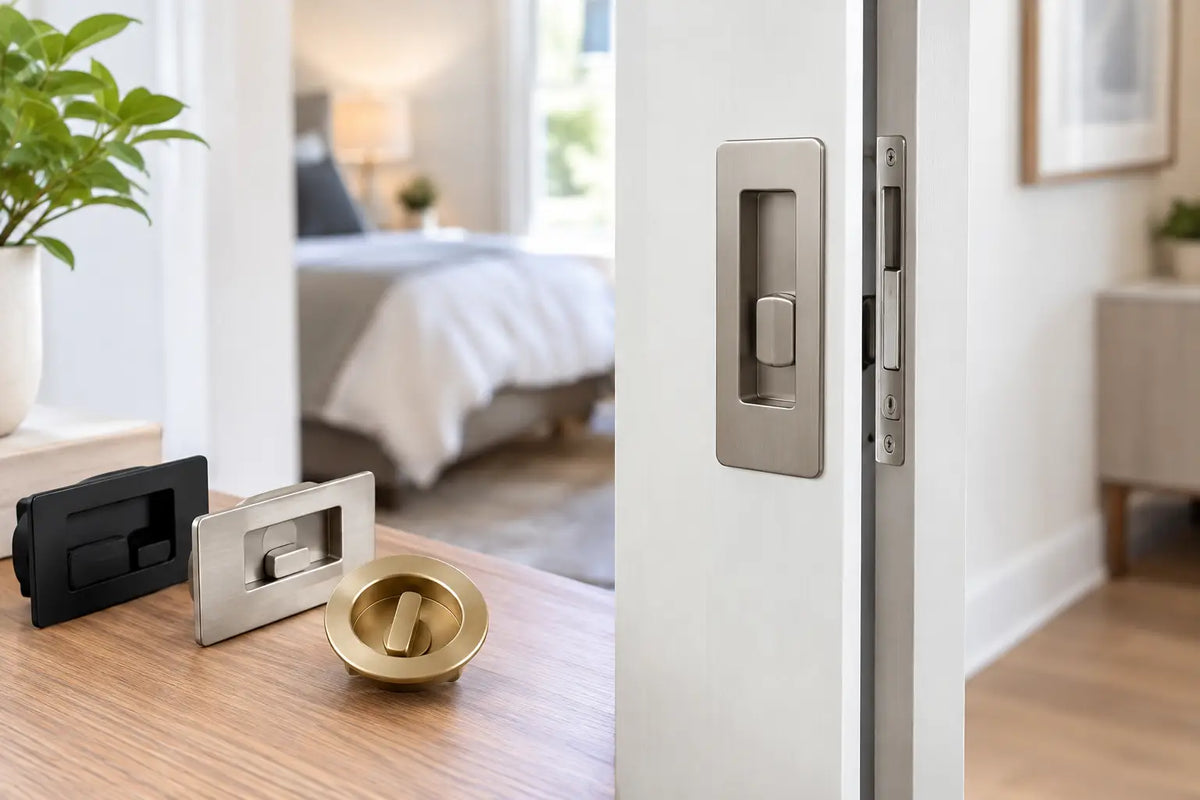
Pocket door locks play an important role in the privacy, security and everyday functionality of sliding doors. Choosing the right pocket door lock allows you to secure bathrooms, en suites, bedrooms and utility rooms while maintaining the clean, space-saving appearance of a pocket door. The right hardware should be easy to operate, compatible with the door thickness and suitable for the intended application. Choosing an unsuitable lock can lead to installation difficulties, poor operation or a mechanism that does not provide the level of privacy required.
Unlike conventional hinged doors, pocket doors slide into a wall cavity or pocket door cassette, meaning they require specialist locking hardware. Standard lever handles and tubular latches are generally unsuitable because their protruding components can prevent the door from sliding completely into the wall. Instead, purpose-made pocket door locks feature recessed handles and mechanisms designed specifically for sliding door systems.
Most pocket door locking mechanisms use a hook bolt that engages with a compatible keep at the closing edge of the door. The lock is operated using a recessed turn, pull or integrated locking mechanism, allowing the door to close securely without compromising its flush appearance.
Whether you are choosing a bathroom privacy lock, an en suite pocket door lock or a locking mechanism for another internal sliding door, understanding the available options will help you select compatible pocket door hardware that combines practicality, privacy and a neat, professional finish.
Why pocket door locks need careful selection
Pocket doors are often chosen where every square metre matters. They work particularly well in en suites, cloakrooms, dressing rooms, kitchens and compact flats, while double pocket doors can create a flexible divide between living areas. Yet the same space-saving design means the lock must sit flush within the door face. A standard mortice sashlock or tubular latch is not suitable.
Before choosing a style, establish whether the door is single or double, its thickness, and whether it has a timber, glazed or composite construction. Most pocket door locks are designed for common internal door thicknesses, but dimensions vary between manufacturers. A lock case that is too deep can weaken a slim door stile or clash with the pocket cassette components.
Also consider how the door will be opened when fully recessed. A locking handle alone may not provide enough grip to draw the door out of the pocket. Many installations use a separate recessed edge pull, sometimes called a finger pull, at the closing edge. This allows the user to pull the door clear before using the main handle or turn.
Types of pocket door locks
The best choice depends on whether the room needs privacy, simple closure or controlled access. It is worth deciding this before ordering the door hardware, as matching a finish later is not always straightforward.
Privacy locks for bathrooms and bedrooms
A privacy lock is the most common option for an en suite, bathroom, WC or changing area. It typically combines a recessed pull handle with a thumbturn on the inside and an emergency coin-release or slotted release on the outside. The hook bolt secures into a keep fitted to the pocket-door jamb.
This arrangement gives privacy without trapping someone inside should assistance be needed. It is practical for family bathrooms, rental properties and guest accommodation. Check which side the thumbturn is supplied for and whether the lock can be reversed during fitting, particularly where doors slide in opposite directions.
Passage handles without a lock
For a pantry, walk-in wardrobe, lounge or open-plan divider, a passage handle may be all that is required. These flush pulls have no locking function and are ideal where the door simply needs to slide easily and sit neatly within the wall.
A non-locking option gives a cleaner appearance and usually involves less door preparation. However, it will not hold the door shut against draughts or prevent it sliding open if there is movement in the property. If positive closure matters, a hook latch or a magnetic closing arrangement may be more suitable.
Key-locking pocket door locks
A key-locking lock is appropriate where access needs to be restricted, such as a home office, store room, treatment room or managed rental property. Options include a key and turn cylinder, a traditional key lock, or a lockable recessed pull with a hook bolt.
Security expectations should be realistic. Internal pocket door locks provide access control, not the security level of an external entrance door. For a higher-risk internal area, specify the door, frame or pocket system and hardware together, rather than expecting a small lock body to provide the entire solution.
Double pocket door locks
Meeting double doors need hardware that brings the leaves together accurately. One leaf may have a flush bolt or coordinated closing arrangement, while the active leaf carries the lock. The exact specification depends on the pocket-door system and whether both leaves need to operate daily.
Avoid selecting two standard single-door locks without checking the meeting detail. The bolt needs a properly positioned keep, and the doors must align when closed. A purpose-designed double-door set prevents an otherwise polished installation from feeling loose or difficult to lock.
Check dimensions before ordering
Pocket door hardware is compact, but fitting it still requires accurate joinery. The product specification should be checked against the door thickness, the case depth, the faceplate size and the required cut-out. Doors with glazed panels or narrow stiles may have limited solid timber available for a lock body.
The backset is particularly important. This is the distance from the door edge to the centre of the operating handle or turn. A sensible backset positions the pull comfortably while leaving enough material at the leading edge for strength. It must also align with the lock keep on the closing jamb.
Think about the closing jamb as well as the door itself. Pocket systems are supplied in different forms, from cassette kits built into a stud partition to pre-assembled systems. The jamb must accept the keep securely and remain stable in use. Fitting a lock after plastering and decorating can be done, but it is far easier to plan the hardware while the pocket system is being installed.
Match the finish to your wider ironmongery
A pocket door can be almost invisible when open, but the handles become a focal point when it is closed. Matching finishes creates a considered result, especially in rooms where the pocket door sits alongside hinged doors, cabinetry or black-framed glazing.
Satin stainless steel and brushed chrome suit contemporary interiors and are forgiving of everyday fingerprints. Polished chrome has a brighter, more reflective look, while matt black works well with modern black hinges, door furniture and internal glazing. Brass and antique bronze finishes bring warmth to traditional schemes, painted shaker doors and period renovations.
Do not choose by colour alone. Compare the shape and size of the recessed pull with neighbouring handles. A square, minimalist pocket-door pull can look out of place beside ornate lever furniture, while a rounded satin pull may soften a modern scheme. Where possible, select all visible door furniture from a coordinated range.
Fire doors and pocket-door locking hardware
A standard pocket door lock should never be assumed suitable for a fire-rated door. Fire-resisting pocket-door assemblies are specialist products, tested as complete systems with the correct door leaf, cassette or frame, seals, closers where required, and approved ironmongery.
If the opening needs FD30 or FD60 performance, check the evidence for the exact door and pocket system being specified. The lock, pull, keep and any intumescent protection may need to be included in the tested configuration. Substituting hardware because it looks similar can compromise the fire-door specification.
This is especially relevant in flats, shared accommodation, commercial premises and projects subject to building-control requirements. Speak to the manufacturer or a qualified project professional before altering a fire door or cutting additional apertures. The need for privacy or key control must be balanced against escape, accessibility and the proven fire performance of the full assembly.
A practical specification checklist
For a straightforward internal installation, confirm these points before placing the order:
- the door thickness and available solid timber at the leading edge;
- whether the door is single, paired or part of a telescopic arrangement;
- the required function: passage, bathroom privacy or key locking;
- the direction the door slides and which side needs the thumbturn or release;
- the finish needed to coordinate with hinges, handles and other ironmongery;
- whether the door or pocket system has any fire, acoustic or accessibility requirement.
This information makes it easier to compare like-for-like products and avoids delays for the joiner on fitting day. For larger refurbishments, ordering the pocket-door system, door leaf, handles and lock together also gives you the best chance of achieving consistent sizing and finish.
A well-chosen pocket door lock should feel natural rather than noticeable: easy to pull, positive to close and appropriate to the room behind it. Start with the door system and function, then choose a finish that belongs with the rest of the scheme. That approach keeps a compact opening practical for daily use and gives the finished room the level of detail it deserves.
For more information about our interior or exterior doors or door accessories, give us a call at 01603 622261 and speak to a member of our expert team today, or email us at sales@doorsuppliesonline.co.uk. We look forward to hearing from you.