
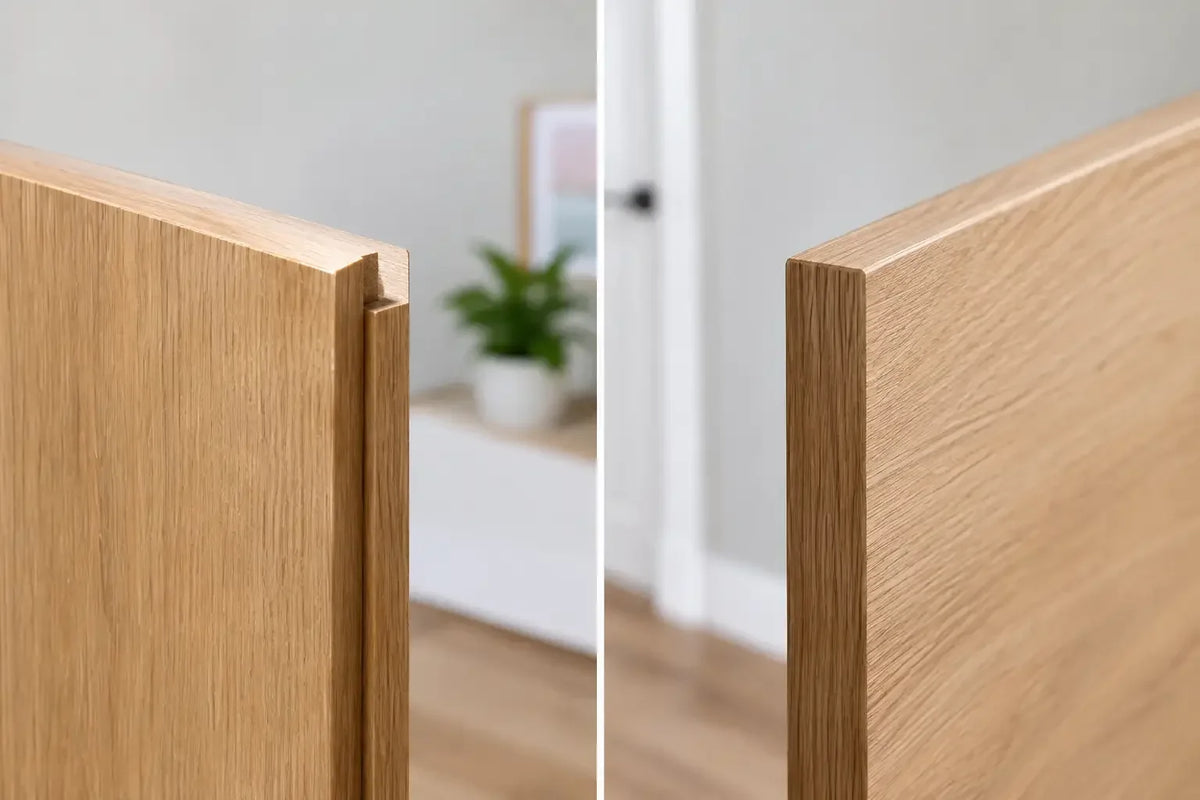
A door may look perfect in a product image but still be unsuitable for the existing frame in your property. One of the most important details to check is the door edge profile. Understanding the difference between rebated doors and square edge doors can help you choose the correct replacement door, ensure it closes properly and make sure the appropriate door ironmongery can be fitted.
When replacing an internal door, it is important to check whether your existing frame is designed for a rebated door or a square edge door. Choosing the correct edge profile helps ensure a proper fit and smooth operation while avoiding unnecessary alterations to the frame.
For properties requiring fire-rated doors, the edge profile can also be an important part of the overall fire door assembly. Always check the manufacturer's installation requirements and certification to ensure the replacement fire door is suitable for the intended application.
What is the difference between rebated and square door edges?
A square-edged door has straight, flat edges. When it closes, its edge sits within the opening and meets the door stop, frame or opposing leaf without an overlapping step. It is the cleanest-looking option, particularly for contemporary internal doors, and it is widely used in modern door sets.
A rebated door has a stepped edge cut into one or more sides. That step overlaps the frame or another door leaf when the door is shut. On a single door, the rebate may work with the frame to reduce the visible gap. On a pair of doors, rebated meeting stiles overlap one another, rather than meeting edge to edge.
This overlap is not merely decorative. It can assist with controlling draughts, light and sound, while also creating a more traditional, substantial look. However, the profile must match the frame, door pair and intended hardware. A rebated leaf cannot simply be treated as a square-edged replacement of the same nominal size.
Rebated versus square door edges in everyday use
The practical difference becomes clear once the door is hung. A square-edged leaf has a consistent edge, so it is generally straightforward to trim, hinge and align within a suitable frame. It creates a neat shadow gap when correctly fitted and works well with modern flush, panelled and glazed internal door designs.
A rebated leaf has more to line up. The step must sit in the correct position against the frame or matching leaf, and the hinge positions, latch location and closing action all need to suit the profile. On double doors, the rebate determines which leaf closes first and which overlaps. That affects handing, locks, flush bolts and astragal arrangements.
Appearance and sightlines
For a minimal interior scheme, square edges usually give the simpler result. The narrow, even lines around the leaf suit contemporary white primed, black, oak and painted doors. They are also a natural choice where doors are fitted in a flush or modern-style frame.
Rebated edges are often preferred where the property has a more traditional character, or where paired doors need a defined overlapping meeting detail. The overlap can make the closed doors appear more solid, but it also creates a visible line that is not suited to every design.
Gaps, draughts and sound
A rebate can help shield the gap around a closed door, but it is not a substitute for properly specified seals. With external doors, weather performance depends on the complete system: the door leaf, frame, threshold, compression seals, drainage detail, glazing and installation quality.
For internal doors, a rebate may reduce light passing through an edge compared with a simple square meeting line. If privacy, acoustic control or smoke resistance is a priority, specify the correct seals and compatible frame detail rather than relying on the edge shape alone.
Choosing edge profiles for external doors
External entrance doors have to cope with wind, rain, temperature changes and regular use. A rebated arrangement can form part of an effective weathering detail because the overlap provides a less direct route for air and water. This is common in traditional timber joinery and certain purpose-designed external door systems.
That does not mean every external door should be rebated. Many high-performance composite, aluminium and steel entrance door systems use square-edged leaves with engineered seals and multi-point locking. Their weather, security and thermal performance comes from the tested construction, not from a single edge profile.
When replacing an external door, avoid choosing by appearance alone. Check whether you are buying a slab door for an existing frame or a complete pre-assembled door set. If the existing frame has a rebate, a square-edged replacement may leave excessive gaps or fail to meet the stop correctly. Equally, a rebated door may not close into a frame designed for a square leaf.
Fire doors: never mix and match profiles
The decision carries more weight with FD30 and FD60 doors. A fire door is a tested assembly, not simply a thicker door leaf. Its rating relies on the compatible leaf, frame, hinges, latch or lock, door closer, seals, glazing where fitted and the controlled gaps around the perimeter.
Both rebated and square-edged fire door arrangements exist, but the permitted configuration is set by the manufacturer’s fire test evidence and installation instructions. Do not assume that adding a rebate, planing one away or pairing an untested leaf with a different frame will retain the stated fire performance.
Intumescent strips and smoke seals must be fitted exactly where the relevant specification requires them. Clearances also matter. A gap that looks harmless can allow smoke or hot gases through too early, while an over-tight fit may prevent the leaf closing fully. Follow the door set data rather than working to a rule of thumb copied from a non-fire internal door.
For communal entrances, flats, commercial corridors and other controlled locations, a pre-assembled fire door set can remove much of the compatibility risk. It provides the leaf, frame and essential components as a matched solution, while still allowing you to select an appropriate finish and ironmongery specification.
How to identify the door edge you need
Start with the existing opening, not the old door’s style. Open the leaf and inspect the closing edge and frame. If there is a clear step that overlaps when shut, you are dealing with a rebated arrangement. If the leaf edge is flat and closes against a stop or seal, it is likely square-edged.
Measure the door leaf height, width and thickness in several places, particularly in older properties where previous trimming may have occurred. Then measure the frame rebate, the depth of any stop and the available clearance. For double doors, establish which leaf is active, whether there are flush bolts and how the leaves meet when closed.
Also check the direction of opening before ordering. Handing can influence lock preparation, hinge positioning, vision panel orientation and the practical use of a rebated pair. A joiner can alter some non-rated timber doors, but each alteration changes the fit and may affect the warranty or fire certification.
Hardware and fitting considerations
Square-edged doors give more flexibility when choosing standard latches, handles and hinges, provided the leaf thickness and frame construction are suitable. The installer still needs to set even margins and ensure the latch engages without pulling the door out of alignment.
With rebated doors, hardware needs a little more planning. On a pair, the overlap may restrict where a lock case or keeps can sit. Flush bolts are often needed to secure the inactive leaf, while the active leaf carries the latch or lock. Hinges must be positioned so the rebate clears correctly throughout the swing.
Do not overlook finishing details. The exposed edge of an unfinished oak or timber door needs sealing as part of the manufacturer’s finishing guidance, particularly where moisture is possible. For painted doors, any site-made alteration should be prepared and finished carefully to avoid exposing vulnerable timber or leaving an uneven line.
Before you place an order
A few checks prevent the most expensive mistakes:
- Confirm whether the existing frame is rebated or designed for a square-edged leaf.
- Measure the leaf, frame and opening separately. They are not interchangeable dimensions.
- Check if the door is single, double, internal, external, fire-rated or part of a security-rated entrance system.
- Establish the opening direction and, for pairs, which leaf is active.
- Match the door to compatible frames, seals, hinges, locks and closers rather than selecting components independently.
If the project involves a fire door, flat entrance door or an external door exposed to the weather, it is usually wiser to specify a complete tested or manufacturer-matched system. For straightforward internal replacements, the priority is often a precise match to the existing frame profile and the finish you want.
Door Supplies Online can help narrow down the practical options, from traditional rebated timber designs to modern square-edged internal doors and complete fire door sets. The right edge detail is a small specification choice, but getting it right is what makes the finished door close cleanly, look considered and perform as intended.
For more information about our interior or exterior doors or door accessories, give us a call at 01603 622261 and speak to a member of our expert team today, or email us at sales@doorsuppliesonline.co.uk. We look forward to hearing from you.