
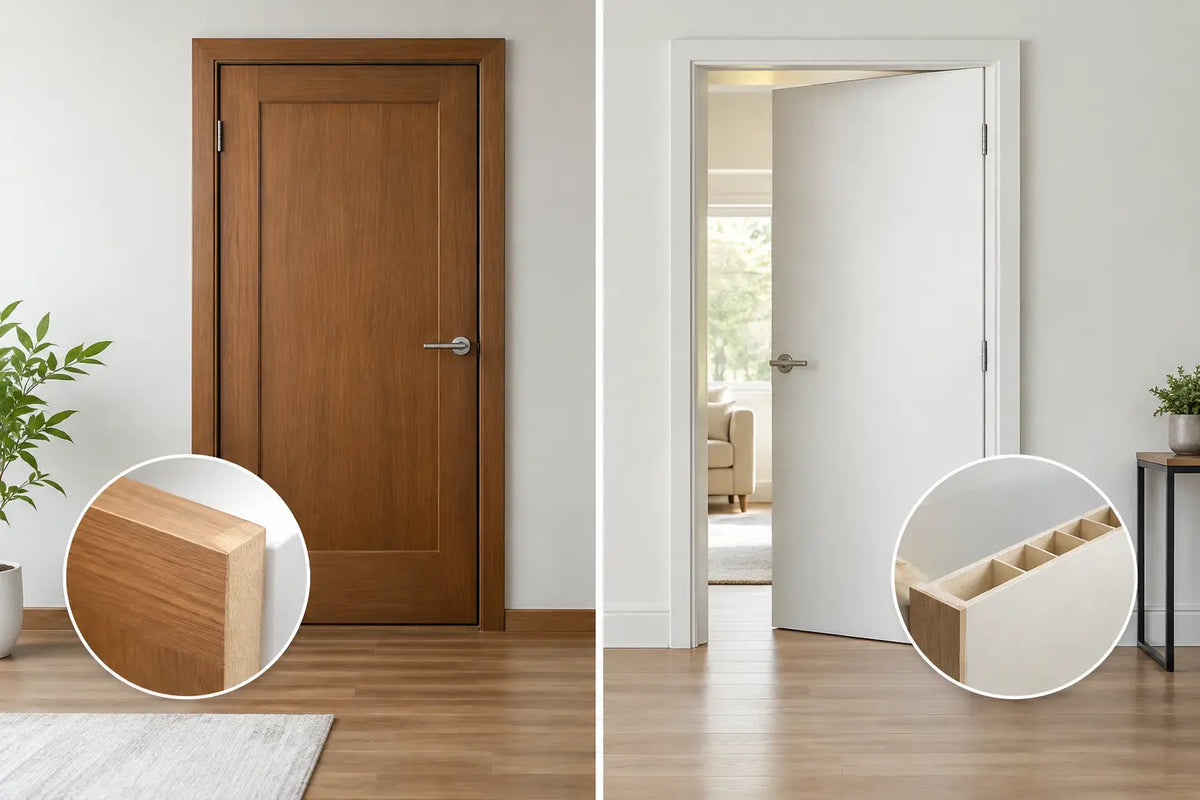
A door can look right in a product image yet feel completely different once it is installed. That is the practical difference between solid core vs hollow core doors: solid core doors offer greater weight, substance and everyday durability, while hollow core doors are designed to be lighter, easier to handle and more cost-effective.
For most UK homes, choosing between solid core and hollow core doors depends less on appearance and more on where the door will be used. A lightweight hollow core door can be a practical choice for a little-used cupboard, utility room or budget-conscious refurbishment. A solid core door is often better suited to rooms where privacy, sound reduction, durability and a more substantial feel are important.
Neither door type is automatically right for every opening. Understanding the differences between solid core and hollow core doors, including their weight, construction, sound insulation, durability and cost, can help you choose the right internal door for each room in your home.
Solid core vs hollow doors: the key difference
A hollow core door has a thin outer skin, commonly faced in moulded hardboard, plywood or MDF, with a lightweight honeycomb or block framework inside. The internal structure keeps the door stable enough for normal domestic use without filling the whole leaf with dense material. This makes it lighter to carry, easier to hang and generally less expensive.
A solid core door has a dense engineered core beneath its decorative finish. Depending on the product, this may be particleboard, chipboard, laminated timber or another composite material. It is not necessarily made from a single piece of natural timber, despite the name. The key point is that the leaf has mass throughout, rather than a largely empty centre.
Many panelled, flush, oak-effect, primed white and glazed door designs are available with different constructions. Do not judge the core from the style alone. Always check the product specification, particularly if you are replacing several doors and want them to feel consistent throughout the property.
Why core construction changes day-to-day use
The most immediate difference is weight. A solid core door feels heavier when opened and closed, with less vibration and a more reassuring close. That can give a renovated house, rental property or new-build project a noticeably higher-quality finish without changing the overall design scheme.
Weight also improves resistance to the knocks of daily life. Solid core doors are generally better suited to busy family homes, hallways, home offices and rooms used by children. They are less likely to sound hollow when tapped and tend to cope better with repeated use over time.
Sound is another major consideration. A solid core leaf will usually reduce more airborne sound than a hollow core leaf, helping to make bedrooms, studies and reception rooms feel more separate. It will not make a room silent, however. Sound can still pass through gaps beneath the door, around the frame, through ventilation routes and across lightweight partitions. For meaningful acoustic performance, the entire doorset needs consideration, including seals, frame quality and fitting tolerances.
Hollow core doors have advantages of their own. Their lower weight is useful where one person is handling doors during a DIY refurbishment, and they place less demand on existing hinges and frames. They also offer an economical way to replace multiple doors in a property where the priority is a neat, coordinated finish rather than enhanced privacy or durability.
Cost, fitting and hardware requirements
Hollow core doors are usually the lower-cost option at the point of purchase. That makes them attractive for landlords refreshing a property, developers working to a tight specification budget, or homeowners updating several low-traffic rooms at once. A lighter door can also reduce the effort involved in installation.
Solid core doors cost more because of the material content and weight, but the price difference should be viewed against expected service life and room use. Fitting a solid core door to a main bedroom, lounge or office can be a sensible upgrade where the door will be operated frequently and occupants value a quieter, more substantial interior.
The heavier the door, the more important the supporting components become. Solid core doors normally need good-quality hinges, securely fixed into a suitable frame. Check the manufacturer’s guidance for the number, type and position of hinges. A heavy door fitted with undersized or poorly fixed hinges can sag, bind on the floor or damage the frame over time.
Latches, handles and privacy locks should also suit the intended use. There is little value in choosing a weighty solid core door only to fit light-duty ironmongery that feels loose after a short period. Coordinating the door, hinges, latch and handles as one specification produces a better result than selecting each item in isolation.
Trimming: check before cutting
Trimming allowances vary considerably between products. This matters especially with hollow core doors, which may have only limited solid timber around the edges for planing and fitting. Cutting too much from the top, bottom or sides can expose the internal core, weaken the leaf and invalidate any manufacturer warranty.
Solid core doors can sometimes offer more flexibility, but they are not automatically suitable for substantial alteration. Factory-finished, veneered, glazed and fire-rated doors all have particular limitations. Confirm the permitted trim amount before cutting, and allow for flooring changes, hinges, clearances and any required undercut for ventilation.
If a door needs significant resizing, a made-to-measure door, a different stock size or a bespoke solution is often the cleaner route. Trying to force a standard door into an unsuitable opening can create problems that are more expensive than choosing the correct product from the outset.
Where hollow core doors make sense
Hollow core doors work well in the right setting. They are particularly practical for cupboards, box rooms, utility areas and properties where several matching internal doors are needed at a controlled cost. A lightweight primed door can also be a straightforward option for decorating to match new skirting boards, architraves and wall colours.
They are not the strongest choice for a room where noise, privacy or heavy use is a priority. They can also feel less refined in a prominent hallway or open-plan ground floor, where occupants regularly handle the door and notice its sound and movement.
A hollow core door should never be selected on the assumption that it provides fire protection. Standard internal hollow core doors are not fire doors. If the opening requires an FD30 or FD60 rating, select a tested and certified fire door system with compatible frame, intumescent protection, hinges, latch and self-closing arrangement where required.
When a solid core door is worth choosing
Solid core doors suit projects where the finish needs to work as hard as the design. Bedrooms benefit from the extra privacy and quieter close. Home offices benefit when calls, meetings or concentrated work are part of everyday life. Lounges and dining rooms can feel more separate from noisy kitchens, hallways or family spaces.
They are also a strong option for rental homes and shared houses, where doors often receive more frequent use. A better-quality internal door can support a more durable overall specification, especially when paired with hardwearing handles and dependable hinges.
For style-led renovations, solid core construction is often available in popular finishes such as unfinished oak, pre-finished oak, black, white primed, shaker and contemporary flush designs. This means buyers do not need to choose between practical construction and the look they want.
Do not confuse solid core with a fire door
This distinction is essential. A solid core door may feel dense and substantial, but it is not automatically rated for fire resistance. A fire door is a tested product assembly with a specific fire rating, such as FD30 or FD60. Its performance depends on the door leaf, frame, intumescent strips, smoke seals where specified, hinges, glazing, latch and installation.
Likewise, a fire-rated door should not be excessively trimmed, altered or fitted with unapproved hardware. If you are replacing a door in a flat entrance, a protected escape route, a loft conversion or a commercial setting, check the applicable requirements before ordering. Where compliance is involved, a pre-assembled fire door set can reduce uncertainty by bringing compatible components together.
Choosing the right door for each room
Rather than using one construction throughout the house by default, match the door to the room. A hollow core door can be a sensible, value-led choice for storage and low-traffic areas. Solid core doors are usually preferable for bedrooms, offices, living spaces and other rooms where occupants will notice sound, weight and durability.
Measure every opening individually, including height, width and frame condition. Then consider finish, glazing, handing, required hardware and whether any door has a fire-safety role. This approach avoids a common mistake: buying a good-looking door first and discovering later that its size, core or specification is unsuitable.
The right internal door should do more than fill an opening. Choose the core construction around how the room is used, specify the correct components alongside it, and the finished door will look considered and perform properly for years.
For more information about our interior or exterior doors or door accessories, give us a call at 01603 622261 and speak to a member of our expert team today, or email us at sales@doorsuppliesonline.co.uk. We look forward to hearing from you.