
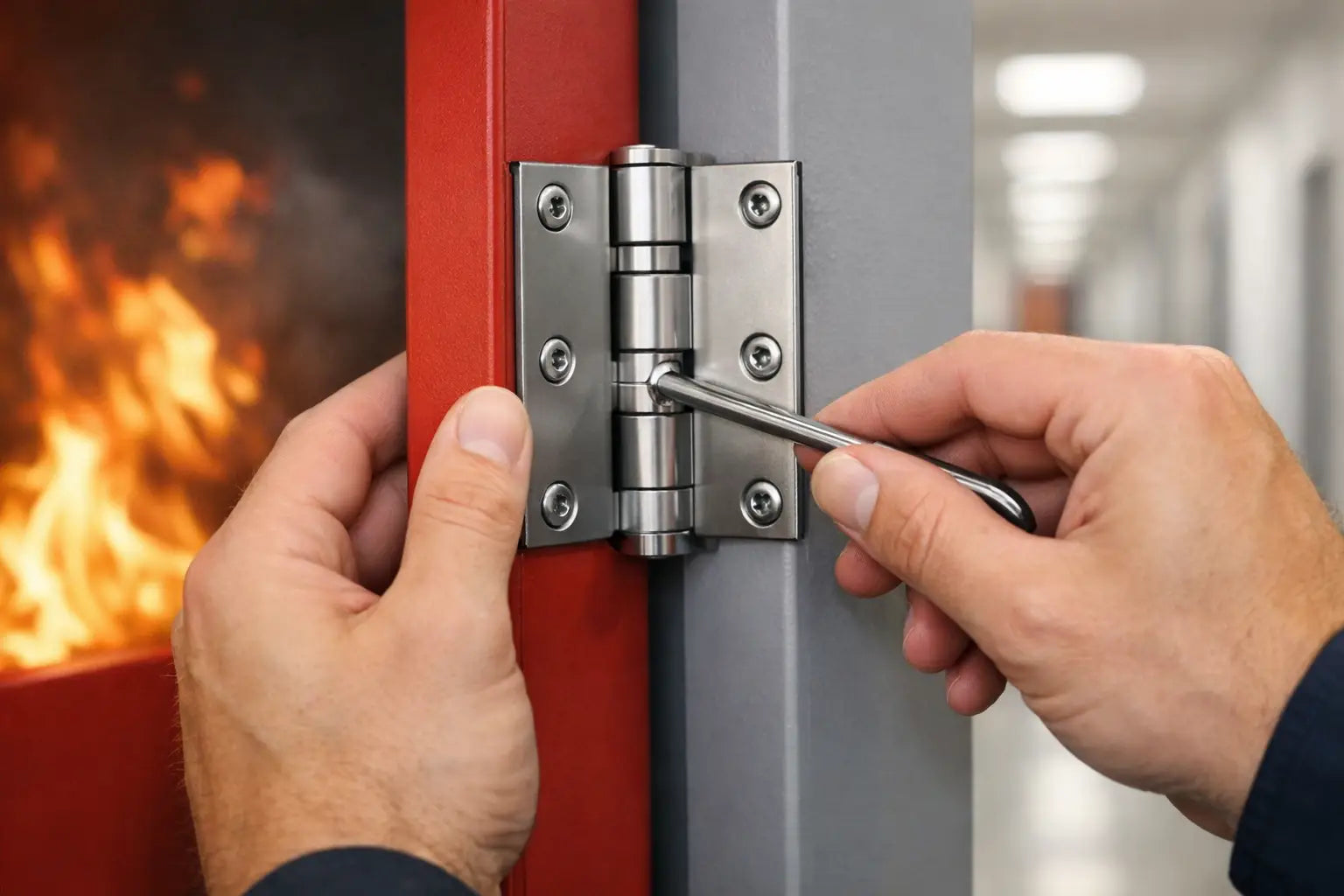
A fire door that drags on the threshold, catches on the frame or fails to close completely is more than an everyday inconvenience; it can compromise the door's ability to perform in the event of a fire. Knowing how to adjust fire door hinges correctly can help restore the required clearances, smooth operation and reliable self-closing action, but the process is very different from adjusting a standard internal door. A fire door is a certified, fire-tested assembly, and incorrect adjustments, such as excessive trimming, repositioning hinges without approval or replacing fire-rated screws and ironmongery with unsuitable alternatives, can invalidate its certification, reduce its fire resistance and affect compliance with UK Building Regulations.
For homeowners, landlords, facilities managers and trade professionals, the objective is to maintain the performance of the complete fire door set rather than simply making the door easier to operate. Properly adjusted fire door hinges should allow the door to achieve consistent gaps, close smoothly under the action of the self-closing device and latch securely every time without sticking or binding. Any adjustment should preserve the integrity of the door leaf, frame, intumescent seals, smoke seals and fire-rated ironmongery, ensuring the complete assembly continues to perform as tested.
What adjusting fire hinges actually involves
Most traditional fire door butt hinges do not have a built-in adjustment mechanism. Unlike some concealed hinges, they cannot be turned with an Allen key to move the door sideways or upwards. In practice, adjusting fire hinges usually means checking the hinge fixings, correcting minor movement in the frame or leaf, and ensuring the hinges are properly seated.
Many fire doors use three steel butt hinges, commonly specified to the required fire rating and suitable for the weight of the door. The hinges should be fitted with the correct number and type of screws and fixed firmly into sound timber. A loose screw can allow the door to drop by a few millimetres, which is enough to cause rubbing at the latch side and leave excessive gaps elsewhere.
Before touching the hinges, establish whether the problem is genuinely hinge-related. Seasonal movement, a loose frame, swollen timber, a worn threshold or a poorly adjusted overhead closer can all make a door appear to have dropped. Correct diagnosis avoids altering a fire door unnecessarily.
Start with the door gaps and closing action
Open and close the door slowly, then look at the gap around all four sides. The gap should be even and within the manufacturer’s stated tolerance. As a general guide, many timber fire door sets are installed with a gap of around 3mm at the sides and head, with the threshold detail determined by the fire door design, smoke seals and relevant specification. Do not assume one dimension suits every door set.
Pay particular attention to the latch side. The door must close against the stops cleanly and engage the latch from any open position. If it needs a push to overcome friction or springs back open after contacting the stop, the fire separation may be compromised in an emergency.
A simple inspection will often reveal the cause:
- Polished timber or paint damage at the head usually indicates the door has dropped or the frame has moved.
- A widening gap at the top of the latch side can point to loose hinges or screw holes that no longer hold securely.
- Rubbing along the hinge edge may indicate a distorted frame, incorrect hinge recesses or an incompatible door leaf.
- A door that closes but fails to latch may be affected by closer strength, latch alignment, seals or warped timber rather than hinge position alone.
Check that intumescent strips and any smoke seals are continuous, secure and free from heavy paint build-up. They must not be cut through, removed or compressed excessively to disguise a poor fit.
How to make minor fire hinge adjustments safely
For a minor sagging issue, begin by tightening every hinge screw with the door supported. Do not over-tighten, as this can damage timber fibres and make the fixing weaker. If a screw turns without biting, it is not providing a reliable fixing and needs professional attention. Simply fitting a larger random screw is not a suitable fire door repair.
Check that the hinges sit flush in their recesses and that the hinge knuckles line up vertically. A hinge leaf sitting proud can alter the gap and place stress on the door. Equally, hinge recesses that have been cut too deeply may require a correctly specified repair, not a stack of improvised packers.
Where the door has settled slightly, a competent installer may re-secure the hinges using compatible fixings or carry out a limited, appropriate adjustment to the frame or leaf. The method depends on the door set construction, rating and installation instructions. FD30 and FD60 doors, veneered leaves, laminated finishes and pre-finished doors each have different limitations on trimming and repair.
Never remove material from the hinge edge as a first response to a door that catches. This can reduce the gap between the hinge and the edge of the leaf, affect the strength of the fixing area and invalidate the tested arrangement. It also tends to solve one problem while creating a new uneven gap around the door.
Do not overlook the door closer
A self-closing fire door relies on its closer as much as its hinges. Once the hinges are secure and the leaf moves freely, test the closer from several opening positions. The door should close fully, overcome the resistance of seals and latch without being slammed.
If the closer is too weak, the door may stop short of the frame. If it is too powerful, it can cause excessive wear, make the door difficult to use and encourage people to prop it open. Adjust closer speed and latching action only in line with the closer manufacturer’s instructions. The force required can vary with the weight of the door, the seals fitted, air pressure in the building and the location of the door.
A hold-open device should only be used where it is electrically linked to the fire alarm system or otherwise designed and installed for that purpose. A wedge, bin or hook may seem harmless during a busy working day, but it defeats the purpose of a self-closing fire door.
When the hinges need replacing
Replace fire door hinges where there is corrosion, visible wear, distorted knuckles, persistent play, missing screws or a hinge that has pulled away from the leaf or frame. The replacement should match the fire rating, size, load capacity and material specification required for the door set. Standard lightweight internal-door hinges are not an acceptable substitute.
For many timber fire doors, steel ball-bearing hinges rated for fire door use are a common choice because they support repeated use and heavier door leaves. However, the correct product is not chosen by appearance alone. The number of hinges, their dimensions, fixing detail and compatibility with intumescent hinge pads or protection all depend on the tested or specified door assembly.
If the existing hinges are marked with a performance classification, retain that information before ordering replacements. On a commercial project, check the fire door schedule, architectural ironmongery schedule and the manufacturer’s installation data. This matters especially for FD60 doors, high-traffic communal doors and doors fitted with access control, panic hardware or automatic closers.
Fire hinge adjustments that need a competent specialist
Some faults should not be treated as a maintenance job. Call a competent fire door professional if the leaf is warped, the frame is loose, the door has been excessively trimmed, the hinge screws have repeatedly failed, or the gaps are too large around several edges. The same applies where the door is marked as a certificated fire door and the necessary product data is unavailable.
In flats, shared corridors, schools, care settings, offices and other higher-risk buildings, repairs should be recorded as part of the responsible person’s fire safety arrangements. The door may be one element in a wider fire strategy, so the installer needs to consider signage, smoke seals, glazing, locks, closers and the condition of the surrounding frame, not hinges in isolation.
Pre-assembled fire door sets can reduce uncertainty on new installations because the leaf, frame, seals and hardware preparation are designed to work together. They still require correct fitting on site, but they avoid many of the compatibility decisions involved in building a set from separate components.
Choosing the right route for your door
A loose hinge screw on an otherwise sound domestic FD30 door may be a modest repair. A door that is dragging because the frame has moved, the closer is mis-set and the leaf no longer latches is a different proposition. The cost of a proper assessment is small beside the risk of leaving a fire door that cannot close when it is needed.
When sourcing replacement hinges or planning a new fire door installation, identify the door’s rating, size, weight, usage level and hardware specification first. Door Supplies Online can help make that product selection clearer, but installation and adjustment must always follow the individual manufacturer’s instructions and the requirements of the building.
A correctly fitted fire door should feel ordinary to use: it opens smoothly, closes under control and latches every time. That quiet, dependable action is the result worth protecting whenever hinges need attention.
For more information about our interior or exterior doors or door accessories, give us a call at 01603 622261 and speak to a member of our expert team today, or email us at sales@doorsuppliesonline.co.uk. We look forward to hearing from you.