
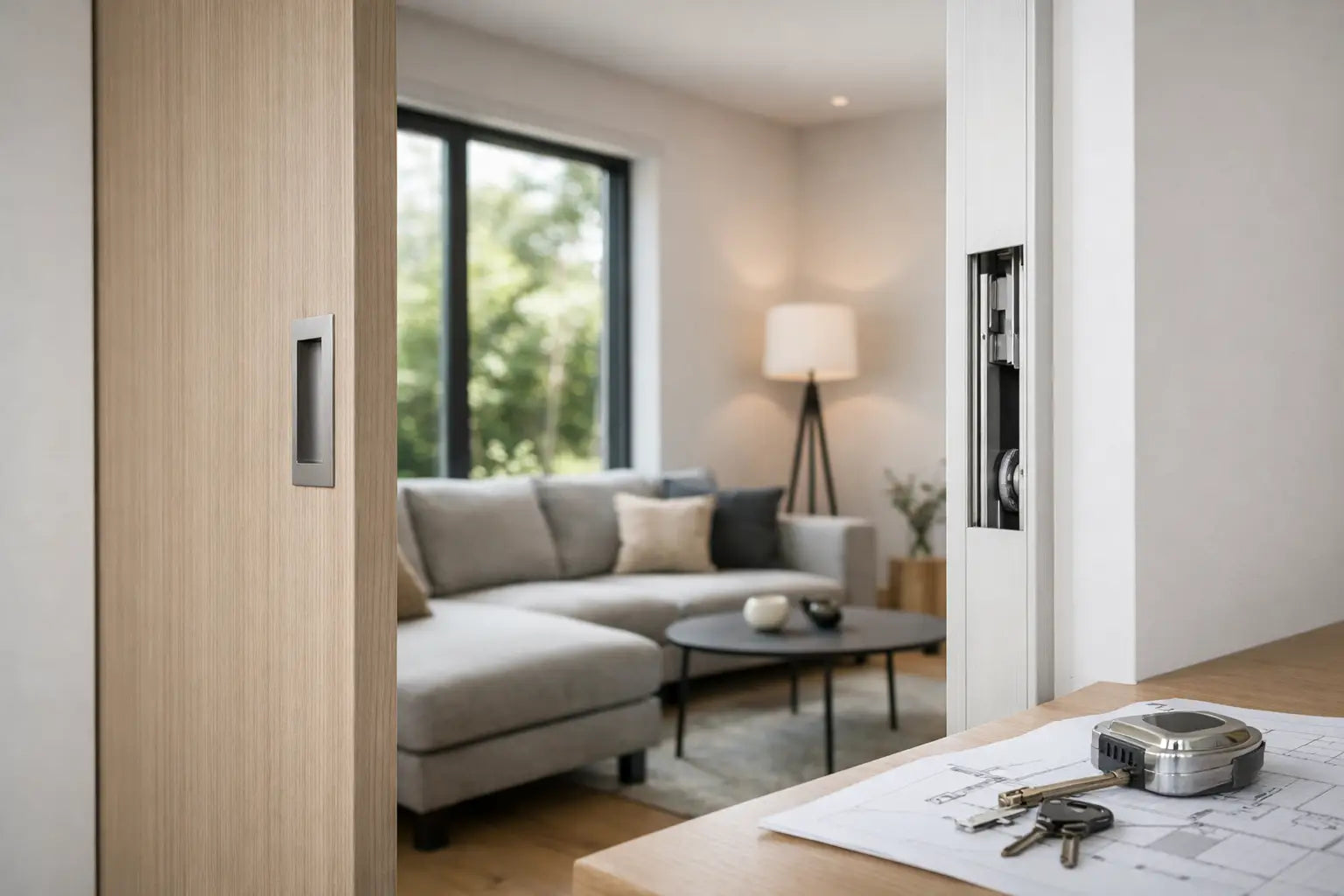
A traditional hinged door can require up to a square metre of clear floor space to accommodate its swing. In compact bathrooms, en-suites, kitchens, loft conversions and open-plan living areas, that is valuable space many homeowners and developers cannot afford to lose. Pocket door systems provide an effective solution by allowing the door to slide neatly into a concealed wall cassette, creating a clean, unobstructed opening while maximising usable floor space.
Although they appear simple, pocket sliding door systems involve far more than fitting a door to a track. Every component, including the pocket door frame, wall construction, door weight, sliding mechanism, running gear and final finish, must work together to ensure smooth, reliable operation. Where building regulations apply, selecting a fire-rated pocket door system is equally important to maintain the required level of fire protection.
What makes the best pocket door systems?
The right system depends first on the wall and the purpose of the room. A lightweight single-pocket kit may be ideal for a standard internal door between a lounge and dining area. A wider opening, heavy solid-core door, double doors or a commercial setting calls for a more substantial system with a higher stated load capacity.
Look beyond the finished door. The cassette or metal frame has to remain straight while the surrounding partition is constructed, then support years of opening and closing without the door catching or rattling. Quality systems use rigid uprights, reliable track components and adjustable hangers, allowing the door to be set level after fitting. This adjustment is particularly valuable in renovation work, where existing floors and openings are rarely perfectly true.
The running action matters as much as the frame. Good roller gear should carry the door quietly and consistently, without a jerky start or a tendency to roll back. Soft-close mechanisms are worthwhile in bedrooms, bathrooms and family homes because they slow the final movement and prevent the door from striking the pocket. They do add cost and require compatible hardware, so they should be selected as part of the system rather than treated as an afterthought.
A dependable kit should also state its maximum door weight, compatible door thickness and finished opening dimensions clearly. These figures are not minor details. A system designed for a light hollow-core door should not be asked to carry a heavy glazed or solid oak leaf simply because the opening sizes appear to match.
Start with the wall, not the door design
A pocket door needs an empty space equal to the width of the door leaf, plus the structure around it. For a 762mm door, for example, the wall must accommodate a pocket of that width alongside the clear opening. The final overall width is therefore considerably greater than the doorway alone.
This is why early planning is essential. The pocket cannot contain plumbing, sockets, switches, pipework or structural posts. In a timber stud wall, the cassette normally forms the core of the partition. In masonry, a new non-load-bearing lining wall may be built to create the pocket. Neither approach should be improvised after the electrics have been installed.
Wall thickness also affects the choice. Some systems are intended for slimmer stud partitions and standard internal doors, while others create a more substantial wall to take thicker doors or enhanced acoustic construction. Check the manufacturer’s required finished wall thickness, including plasterboard, before ordering frames, architraves or door linings.
For renovation projects, assess the route into the room too. A full-sized door leaf still needs to be carried through the property and lifted into the track. That can influence whether a single large leaf or a pair of smaller meeting doors is the more practical option.
Match the system to the door leaf
Pocket systems can work with painted, primed, oak, walnut-effect, glazed and panelled internal doors, provided the leaf stays within the hardware specification. However, appearance should not override construction. A heavier leaf gives a more substantial feel and can improve sound reduction, but it needs a suitable frame and rollers.
Solid-core doors are a strong choice where privacy and durability matter, such as home offices, bedrooms and busy rental properties. Lighter hollow-core doors can suit occasional-use rooms, but their performance will depend on the quality of the leaf and the surrounding partition. For bathrooms and utility areas, consider the room’s humidity and choose a door finish appropriate to the environment.
Glazed pocket doors bring borrowed light into halls, kitchens and internal rooms without sacrificing the open feel. They may be heavier than expected, particularly with safety glass, so confirm the complete door weight rather than estimating it from the style. A glazed door also needs careful handling during installation and a system that offers a smooth, controlled close.
Do not forget the pull. Once a door is fully inside the wall, a standard handle cannot retrieve it. Most installations need a recessed flush pull, plus an edge pull that flips or slides out when the door is fully open. Privacy locks are available for bathrooms and bedrooms, but they must be specified for sliding-door use and coordinated with the door thickness.
Single, double and telescopic pocket doors
A single pocket door is the most common arrangement. It is practical for doorways between small rooms, cloakrooms, en-suites and utility spaces, and it gives the cleanest possible opening on one side of the wall.
Double pocket doors are effective for wider openings between living spaces. The leaves can slide into pockets on opposite sides, allowing a room to be opened up for everyday use or closed off for work, guests or warmth. They need more wall width, more precise set-out and matching hardware, but the visual result is often worth it.
Telescopic systems allow two or more door leaves to slide into the same pocket. They are useful where a wide opening is wanted but there is only room for a pocket on one side. This is a specialist arrangement, with more moving parts and a greater need for accurate installation. It is best specified where the space saving genuinely justifies the added complexity.
Fire-rated pocket doors require a tested approach
Fire performance is the point at which a standard pocket door kit and a fire-rated pocket doorset must never be confused. If an opening forms part of a required fire-resisting route, such as between a dwelling and an integral garage, or within a building subject to fire-door requirements, the complete assembly must be appropriate for the application.
An FD30 or FD60 leaf alone does not create a compliant pocket door installation. The cassette, door leaf, seals, closing arrangement, ironmongery and installation details need to form a tested or assessed system. Intumescent seals may be incorporated within the frame or designed into the relevant assembly, and self-closing requirements can apply depending on the building and location.
Always check the project specification and seek useful professional advice where Building Regulations, lease conditions, insurers or fire-risk assessments apply. For developers, landlords and commercial buyers, the evidence supplied with the system is as important as its finish. Door Supplies Online can help buyers identify specialist pocket-door and fire-door options, but the installation must follow the manufacturer’s instructions exactly.
Installation details that protect the finish
Pocket doors reward accurate joinery. The cassette must be plumb, level and firmly fixed before boards are fitted. If it twists under pressure from the partition, the track can be misaligned and the door may scrape or fail to close evenly. Follow the system’s specified stud positions and board-fixing zones rather than driving screws wherever they are convenient.
Leave the running gear accessible in the way the manufacturer intends. Many systems allow hanger adjustment from the head of the opening after installation, which is useful as a building settles or floor finishes are added. Fit final flooring with the required clearance beneath the door in mind. Too little clearance causes rubbing; too much can reduce privacy and sound control.
Architraves, closing jambs and brush seals should be selected to suit the system, not forced into place afterwards. The visible details are what make a pocket door look intentional rather than like a compromise. A properly finished pull, aligned reveal and controlled close make a major difference to the final impression.
A practical buying checklist
Before choosing between the best pocket door systems, confirm these points with the drawings, installer or joiner:
- the clear opening size and total wall width available for the pocket;
- the finished wall thickness, construction type and position of services;
- the exact door leaf size, thickness, material and total weight;
- whether soft-close, privacy locking, synchronisation or double-door operation is required;
- whether the opening has an FD30, FD60, acoustic or other performance requirement.
It is also sensible to order the compatible pull handles, edge pulls and locking hardware at the same time as the system. Pocket doors use dedicated ironmongery, and waiting until the door is hung can delay the final fit-out.
A pocket door should be chosen as part of the wall, not as a late-stage replacement for a hinged door. Measure the available structure carefully, select a system with capacity for the chosen leaf and treat fire-rated applications as complete assemblies. That approach gives you a quieter, cleaner opening and space that can be used properly every day.
For more information about our interior or exterior doors or door accessories, give us a call at 01603 622261 and speak to a member of our expert team today, or email us at sales@doorsuppliesonline.co.uk. We look forward to hearing from you.