
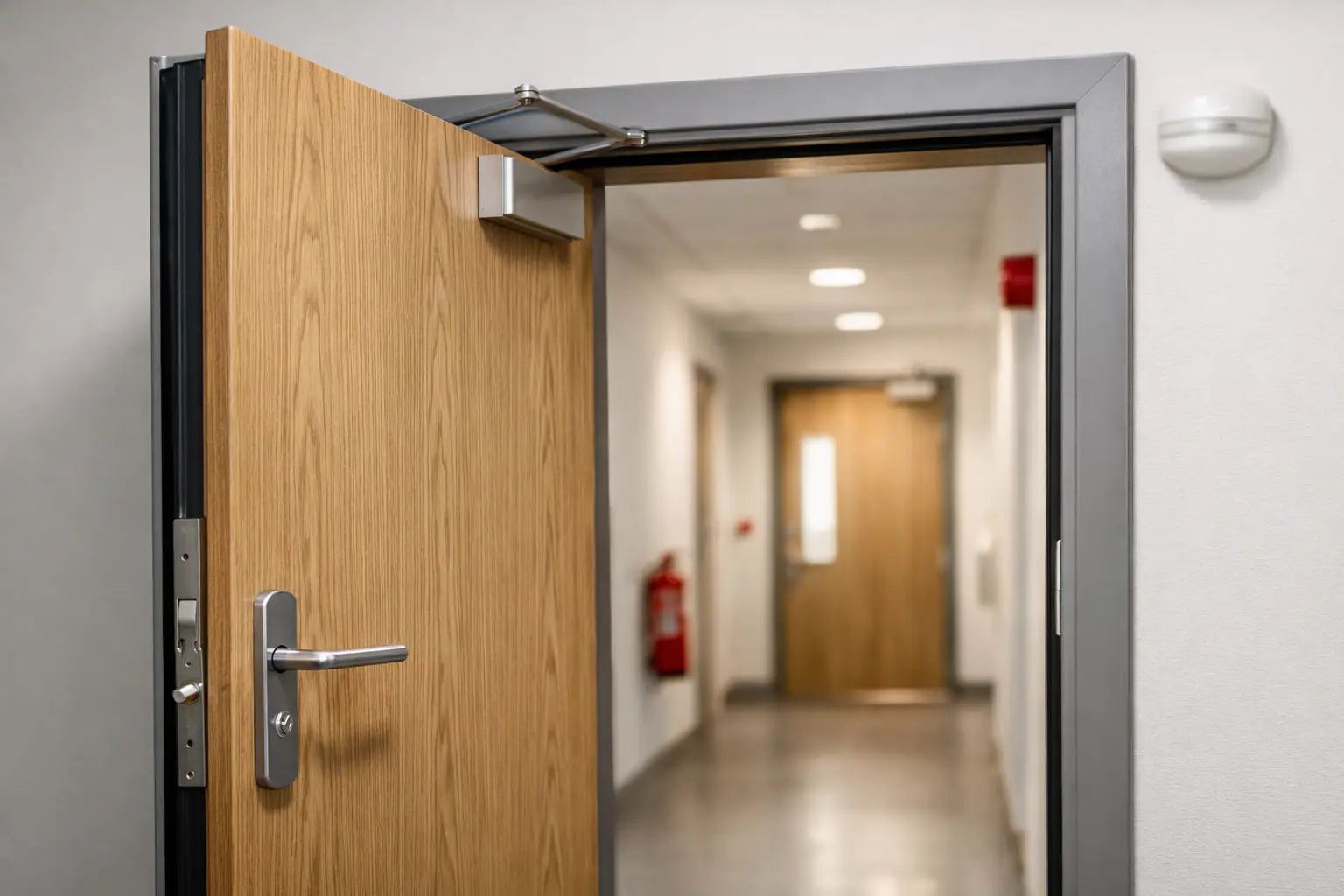
A fire door leaf may look similar to a standard internal door, but its ability to protect lives and property depends on much more than the door itself. Do fire doors require frames? In almost every case, yes. A fire door must be installed within a compatible fire door frame or lining as part of a tested fire-resisting doorset or door assembly. The door frame, intumescent seals, smoke seals, hinges, locks, glazing, self-closing device and fire-rated ironmongery all work together to achieve the certified FD30 or FD60 fire rating. Without the correct frame and properly specified components, even a certified fire door leaf may fail to deliver its intended level of fire protection.
For homeowners, landlords, developers and trade professionals, this question most commonly arises when replacing a fire door in an existing opening. Reusing the original frame may seem like a cost-effective solution, but it is not always the best choice. The existing fire door frame must be structurally sound, correctly sized and compatible with the new fire-rated door leaf. It must also comply with the door manufacturer's installation instructions or be supported by appropriate fire test evidence or certification. If the frame has been damaged, altered or is unsuitable for the new door, replacing it is often the safest and most compliant option.
Do fire doors need frames to be fire rated?
A fire door needs a compatible fire-resisting frame or lining, but that does not always mean every frame carries the same prominent FD30 or FD60 label as the door leaf. What matters is that the complete installation has evidence that it can achieve the required fire performance.
A fire door assembly includes the door leaf, frame or lining, architraves where specified, intumescent seals, hinges, latch, closer, glazing and any other items fitted into or around the door. These parts work together during a fire. The leaf slows the spread of flames and heat, while the frame holds it securely in place and the seals close the gaps as temperatures rise.
A standard internal lining may be too light, damaged or incorrectly sized for a fire door. If the lining distorts, burns through, allows the leaf to fall away or leaves excessive gaps around the perimeter, the fire resistance of the door is compromised. This is why a fire-rated door should never be treated as a standalone product.
Can you fit a fire door in an existing frame?
Possibly, but it depends on the condition, material and dimensions of the frame, as well as the specification of the replacement door. An existing timber frame can sometimes be retained when it is substantial enough, securely fixed to the surrounding wall and compatible with the fire door manufacturer’s requirements.
Before ordering a replacement fire door leaf, check the frame carefully. It should be free from significant splits, rot, movement, loose fixings or previous alterations that weaken it. The door stop must also be suitable and securely fixed. On many fire-door installations, the stop is an essential part of the system that prevents the door leaf from pushing through the opening under fire exposure.
The gap between the door and frame is equally important. Fire-door guidance commonly specifies close, controlled clearances, often around 2-4mm at the sides and head, with a limited gap at the threshold depending on the tested detail. A joiner should follow the manufacturer’s instructions for the particular door, seals and threshold arrangement rather than relying on a generic rule of thumb.
If the existing lining is oversized, uneven or badly worn, fitting a new FD30 door leaf may involve excessive planing or large gaps. Either can affect certification and performance. In that situation, replacing the lining or choosing a pre-assembled fire door set is usually the more dependable option.
Timber, steel and composite frames
Timber frames are common in homes, flats and many commercial interiors. They can be suitable for FD30 and FD60 applications when they are the correct section size, species or density, and installed in line with the tested specification. A softwood lining is not automatically unsuitable, but it must meet the requirements of the door system.
Steel frames are frequently used in commercial buildings, communal corridors and higher-traffic areas. They offer excellent durability and can be supplied as part of a rated doorset. However, steel frames still require the correct intumescent seals, hinges, fixings and wall interface. The material alone does not guarantee compliance.
Composite, MDF or engineered linings should be assessed with particular care. Some are designed and tested for use with fire doors, while others are intended only for standard internal doors. Always use the product documentation to confirm suitability.
Why the frame affects FD30 and FD60 performance
FD30 doors are designed to provide 30 minutes of fire resistance, while FD60 doors are designed for 60 minutes. The rating is based on a test of a particular construction, not simply the thickness or weight of a door leaf.
During a fire, the leaf expands and the intumescent strips fitted to the door edge or frame expand to seal the perimeter. The frame must remain stable enough to support this action. It also needs to be fixed correctly to the wall, with the appropriate packing, fire-stopping and fixings. A poorly installed frame can create concealed gaps around the opening, allowing smoke and fire to bypass the door.
Where smoke protection is required, look for an FD30S or FD60S specification. The “S” indicates that the door assembly has smoke-control performance when fitted with the specified seals. This is particularly relevant for escape routes, communal areas and locations identified in the building’s fire strategy.
A door leaf marked FD30 is therefore not automatically an FD30 installation once it is hung. Cutting it down beyond permitted limits, fitting an unapproved letter plate, changing the glazing or installing it in an unsuitable frame can all invalidate the intended rating.
Frames, seals and ironmongery must be specified together
The right frame is only one part of the job. Fire-door ironmongery must be suitable for the rating and weight of the leaf. In practice, this usually means using the correct number and grade of fire-rated hinges, a compatible latch or lock, and a door closer where required.
Fire doors protecting communal corridors, stairwells, flats, plant rooms or commercial escape routes will often need a self-closing device. The closer must shut the door fully onto the latch from any opening position, without being wedged open. Whether a closer is required in a particular domestic setting depends on the building layout, the door’s purpose and the applicable Building Regulations or fire-risk assessment.
Intumescent strips are another common point of failure. They must be the correct type, size and position for the tested door assembly. Some systems use strips in the frame, while others use strips in the door edge. Do not add, remove or relocate them simply because another door appears to have a different arrangement.
The same care applies to hinges, handles, locks, viewers, air grilles and letter plates. Every cut-out removes material from the door or frame. If an item is not approved for use with that fire-door specification, it may create a weak point precisely where protection is needed.
When a pre-assembled fire door set makes sense
For a new opening, a major refurbishment or a project where compliance confidence is a priority, a pre-assembled fire door set can be the simplest route. These sets are supplied with a matched leaf and frame, and may include seals, hinges, closer preparation and other compatible components depending on the specification.
This reduces the risk of mixing a certified door leaf with an untested lining, incorrect seals or unsuitable hardware. It can also save fitting time on site, particularly where several doors are required across a development, rental property or conversion.
A doorset is not a substitute for careful installation. The installer must still fit it into the structural opening exactly as specified, including the correct gaps, fixings and perimeter fire-stopping. But it gives buyers a clearer starting point because the key parts have been selected to work together.
For replacement projects, a separate FD30 or FD60 door leaf may be the better-value choice where the existing frame is confirmed as suitable. For higher-risk areas, complex specifications or uncertain existing linings, a complete set is often the more practical investment.
What to check before buying a fire door and frame
Start by identifying why the door is required. A fire door between an integral garage and a house, a flat entrance door, a communal corridor door and a commercial plant-room door can all have different performance, smoke-control, security and acoustic requirements.
Then measure the opening and the existing frame accurately. Record the width, height, depth of the lining, door-stop dimensions, hinge positions and available floor clearance. Check whether the door needs to be left- or right-handed, whether it must be self-closing and whether glazing, a lock, a viewer or a threshold seal is required.
Most importantly, keep the specification evidence together. Product labels, test reports, certification documents and installation instructions should be retained, especially for rental, commercial and multi-occupancy properties. If the work is subject to Building Control, a fire-risk assessment or a project specification, confirm the required standard before ordering.
Door Supplies Online can help simplify the buying process with FD30 and FD60 door options, compatible frames, fire-door hardware and pre-assembled fire door sets. Matching the right products at the outset is far easier than trying to correct an unsuitable installation later.
A fire door is there to buy people time to escape and to limit damage while emergency services respond. Treat the frame as part of that protection, not as an optional extra, and make sure the full assembly is specified and fitted for the job it has to do.
For more information about our interior or exterior doors or door accessories, give us a call at 01603 622261 and speak to a member of our expert team today, or email us at sales@doorsuppliesonline.co.uk. We look forward to hearing from you.