
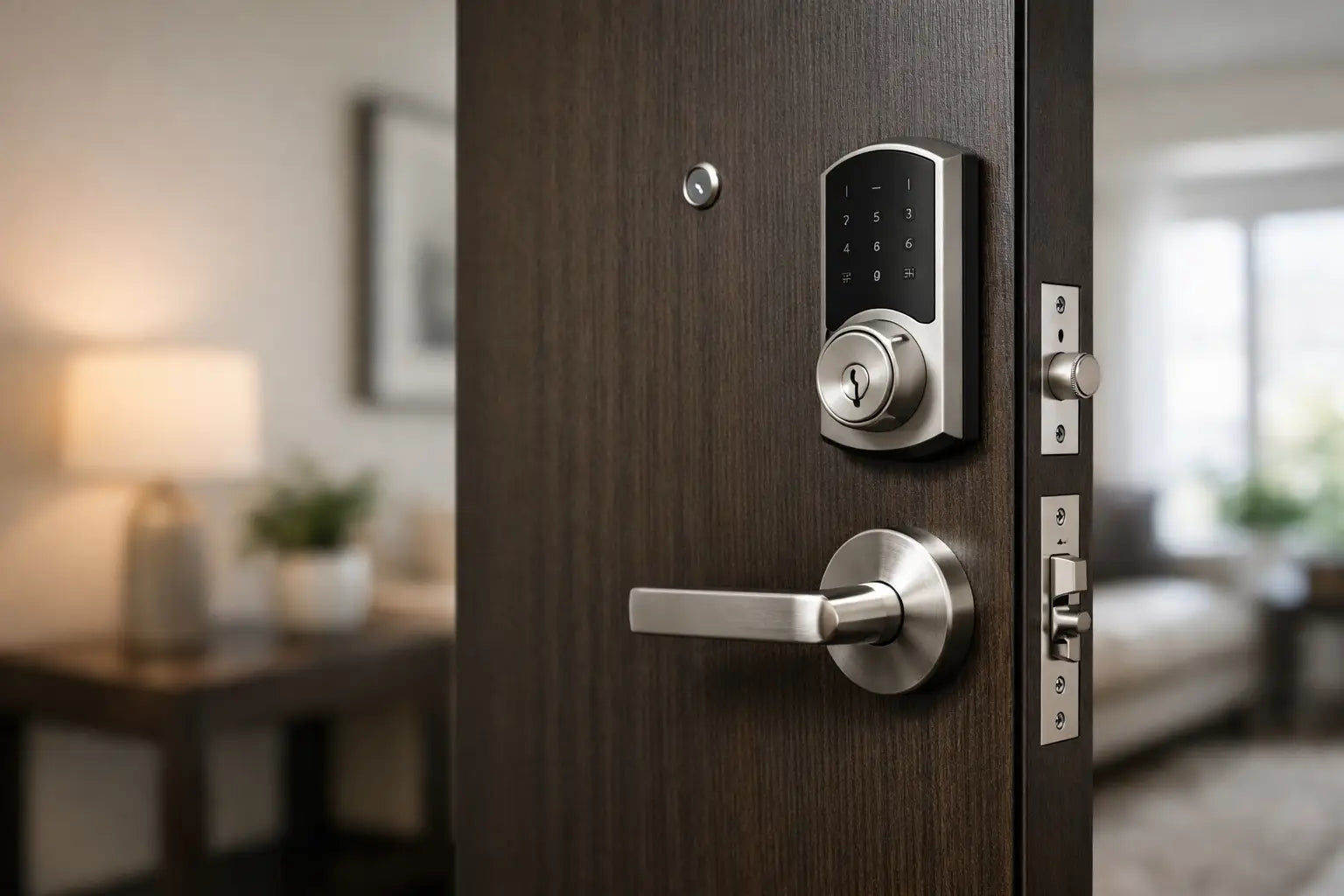
A tired flat entrance door can make an otherwise well-finished property feel dated, while a poorly specified replacement can create more serious issues than appearance alone. A flat entrance door upgrade needs to balance the look of the hallway with security, acoustic performance, thermal efficiency and fire safety, where required.
For leaseholders, landlords and property developers, choosing the right apartment entrance door starts with performance rather than finish. The door leaf, frame, hinges, seals, locking hardware and other components need to work together as a complete entrance door system. Where fire performance is required, the complete doorset should be appropriately tested and specified for the intended application.
Before choosing a replacement flat entrance door, check the existing opening, required performance levels and any building or project requirements. Taking this approach helps ensure the finished door not only complements the property but also provides the security, fire protection, acoustic performance and durability expected from a modern apartment entrance.
Start with the door's role in the building
Not every flat door performs the same job. A door opening from a private flat into a shared corridor, stairwell or communal lobby may be a fire door and often needs to protect the escape route in the event of a fire. A door between rooms within a flat, by contrast, is usually selected primarily for privacy, sound reduction and interior style, unless plans or building requirements state otherwise.
This distinction affects almost every purchase decision. An internal oak door with black handles may be ideal for a bedroom or living room, but it is not a substitute for a rated flat entrance door. Where the existing flat entrance door is fire-resisting, replacing only the leaf without checking the frame, seals, hinges, closer and glazing can compromise its performance.
Before ordering, establish whether the door opens onto a communal area, whether the building has specific management requirements and whether the existing door carries a fire rating label or plug. If there is any doubt, consult the managing agent, freeholder, building control body or a competent fire door professional. This is especially relevant in purpose-built blocks, converted properties and higher-risk buildings.
Choosing the right flat entrance door upgrade
For flat entrance doors, FD30 is a common requirement. An FD30 fire door is designed to resist fire for 30 minutes when correctly installed as a complete assembly. Some projects may require FD60 doors, while certain flat entrance specifications also call for PAS24 security performance. The correct rating is determined by the building design and relevant requirements, not by personal preference or budget alone.
A fire door should be approached as a system. The leaf, frame, intumescent strips, smoke seals where specified, hinges, latch, lock, letterplate, spyhole and self-closing device all need to be suitable for the door assembly. Pre-assembled fire door sets can simplify this process because the door and frame are supplied as a coordinated unit, helping reduce uncertainty on site. They are particularly useful for landlords and developers replacing multiple entrance doors to a consistent specification.
There is a practical trade-off here. A door slab may offer more flexibility where an existing frame is known to be sound and suitable, but it places greater responsibility on accurate specification and installation. A pre-hung or pre-assembled set can cost more initially, yet may save time, reduce fitting complications and provide a clearer route to a consistent finish.
Security is more than the lock
A secure flat entrance relies on the entire construction, not a single high-security cylinder. Look at the strength of the leaf and frame, hinge security, locking points, cylinder protection and how the door closes into the frame. A viewer or digital door viewer can be useful where occupants want to identify callers without opening the door, provided the chosen item is compatible with the door's fire performance where applicable.
For doors opening into communal corridors, avoid assuming that a chain, surface bolt or additional lock is acceptable. It may interfere with the required self-closing action or with the door's tested specification. Any additional hardware should be checked carefully before fitting.
Match the finish to the wider interior
Safety-led specification does not mean settling for a plain or institutional-looking entrance. Modern flat doors are available in finishes that work with contemporary and traditional schemes, including oak, walnut-effect, painted colours, black details and subtle panelled designs. A flush or shaker-style face can suit a clean, modern flat, while a more detailed panelled finish may complement period conversions and traditional communal spaces.
Think about what residents see from both sides. The hallway face may need to align with a building-wide finish schedule, while the interior face should sit comfortably with flooring, skirting, architraves and furniture. In managed blocks, a uniform corridor-side appearance is often required even where owners can choose a different internal finish.
If the flat has narrow halls and limited natural light, lighter finishes can make the entrance feel more open. Dark doors, particularly black or deep stained timber, create a stronger architectural statement but show dust, fingerprints and scuffs more readily. This is not necessarily a reason to avoid them, but it is worth considering in busy rental properties and family homes.
Glazing, letterplates and other details
Glazed panels can bring light into an internal hallway, but they need careful consideration on flat entrance doors. Any vision panel in a fire-resisting door must use suitable fire-rated glazing and be part of an appropriate specification. Standard decorative glass is not enough.
Letterplates are another common weak point. If post is delivered through the entrance door, choose a fire-rated letterplate that is compatible with the required door rating. Some buildings use communal post boxes instead, which removes the need for a letterplate and can support both security and fire performance.
Small details have a large visual effect. Lever handles, escutcheons, door viewers, numerals and knockers should share a finish where possible. Satin stainless steel remains practical for high-use communal settings, while matt black, polished chrome and antique brass can give a more design-led result. Make sure the chosen handle and latch arrangement works with the door thickness, lock case and any fire-door requirements.
Do not overlook sound and comfort
Flat living brings closer neighbours, shared corridors and more everyday noise. A solid-core door generally provides a more substantial feel and better sound reduction than a lightweight hollow-core alternative. For an entrance door, perimeter seals and a correctly adjusted drop seal can help reduce draughts, corridor noise and cooking smells travelling into the flat.
Acoustic performance depends heavily on fitting. A high-quality door with visible gaps around the edges will not perform as intended. The threshold, frame condition and closing action all matter. If the door has a closer, it should shut fully from any open position without slamming excessively. A closer that is too weak can leave the door ajar; one that is too forceful can make daily use difficult for children, older residents and people with limited mobility.
For internal room doors, the priorities may differ. Solid, panelled or glazed doors can be selected around the need for privacy, light and airflow. Pocket door systems are useful where a hinged door would obstruct a tight hallway or compact en-suite, although they require suitable wall construction and should be planned before finishes are complete.
Measure, specify and fit with care
Accurate measuring prevents expensive delays. Record the structural opening, frame dimensions, wall thickness, handing, swing direction and floor finish levels. Check whether the existing frame is square and whether it has signs of movement, rot or previous alteration. In older flats, openings are often irregular, making made-to-measure doors or bespoke frames a sensible option rather than forcing a standard size to fit.
For fire doors, installation quality is central to performance. Gaps, packing, fixings, seals and ironmongery must be installed in line with the door set specification. A capable joiner may be ideal for general internal door fitting, but flat entrance fire doors should be fitted by someone with demonstrable knowledge of fire door installation and the relevant product instructions.
Avoid mixing components because they happen to fit. An untested closer, unsuitable hinges or incorrect intumescent seals can undermine an otherwise good door. Keep product information, fitting instructions and any certification documents with the property records, particularly for rental portfolios and managed buildings.
Plan the budget around the complete job
The door leaf is only one line of the cost. Allow for the frame or lining, fire-rated seals, hinges, locks, handles, closer, threshold, glazing where required, finishing materials and labour. If redecorating is planned, coordinate the door replacement with architraves, skirting and flooring to avoid unnecessary remedial work.
For landlords and developers, standardising on a small number of tested door set specifications can make future maintenance simpler. Replacement hardware is easier to source, finishes remain consistent and contractors have a clearer brief. Homeowners undertaking a single upgrade may have more freedom on colour and detail, but should still prioritise a specification that meets the building's requirements.
A well-planned flat entrance door upgrade should feel better every time it closes: solid, secure, quiet and properly finished. Start with the performance the building demands, then choose the design and ironmongery that make the entrance feel like part of a considered home rather than an afterthought.
For more information about our interior or exterior doors or door accessories, give us a call at 01603 622261 and speak to a member of our expert team today, or email us at sales@doorsuppliesonline.co.uk. We look forward to hearing from you.