
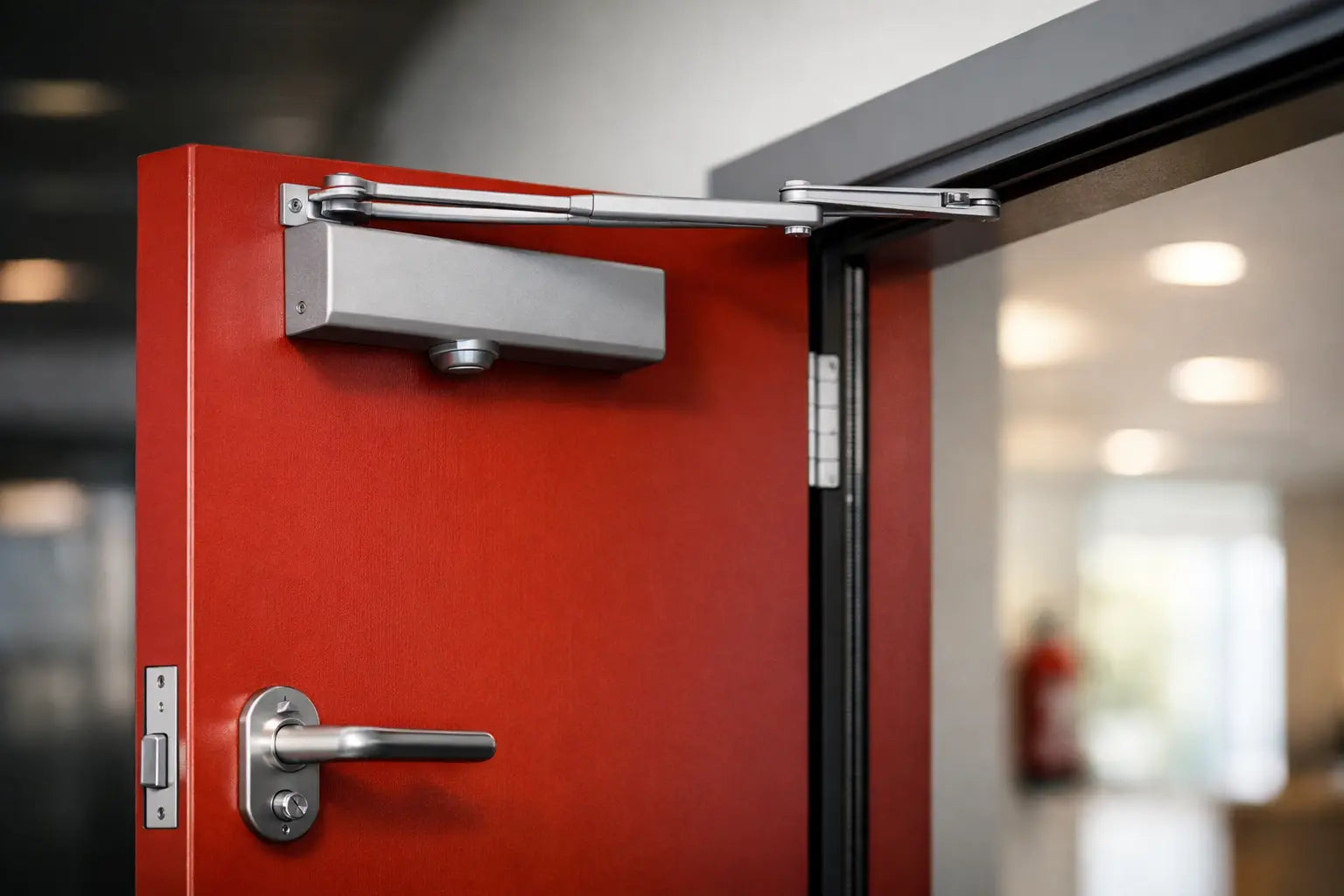
A fire door that almost closes is not performing as it should. The latch must engage correctly, the gaps must remain within the required specification and the door must close reliably after every use. This is why choosing the best fire door closers involves more than selecting a low-cost product or one with an attractive finish. The door closer must be suitable for the fire door's size, weight, configuration and intended use, as well as the requirements of the tested doorset.
For a flat entrance fire door, communal corridor, school, office or commercial refurbishment, the most suitable door closer can vary considerably. A surface-mounted overhead fire door closer is often a practical choice, while concealed closers or floor-mounted systems may be considered where aesthetics, accessibility or the door design require a less visible solution.
When selecting a fire door closer, consider the complete door assembly, including the door leaf, frame, hinges, latch, seals and other ironmongery. The closer should provide sufficient closing force to bring the door fully into the frame and allow the latch to engage without the door slamming excessively.
For FD30 and FD60 fire doors, always check the door and closer manufacturer's instructions and certification requirements before installation. The closer should be compatible with the specific fire door and fitted according to the approved installation method.
Getting the specification right from the beginning helps ensure the fire door closes correctly, maintains its intended performance and remains practical for everyday use.
What makes the best fire door closer?
A fire door closer is a controlled closing device. Its purpose is to return a fire door to its frame and close it firmly enough for the latch to engage. In a fire, this helps restrict the spread of smoke and flames through the building’s compartments.
The best option is therefore one that is suitable for the particular fire door, frame, hinges, latch, seals and intended use. It should have evidence of fire-door suitability, normally through relevant testing or certification, and be installed exactly as required by the manufacturer and the door assembly’s supporting information.
Look first for a closer rated to EN 1154, the European standard covering controlled door-closing devices. The product should also be clearly identified as suitable for use on the required fire-door rating, such as FD30 or FD60. Do not assume that any closer carrying an EN 1154 classification is automatically appropriate for every fire door. Check the product data, fixing instructions and any certification for the actual door type and application.
A closer also needs enough closing power. If it is too weak, a heavy leaf, a wide door or air pressure in a corridor can prevent reliable latching. If it is set excessively hard, it can make the door difficult to open, create a slamming action and cause frustration for residents, visitors and staff. Correct sizing and adjustment matter as much as the product itself.
The main types of fire door closer
Overhead surface-mounted closers
Overhead closers are the familiar body-and-arm arrangement fitted to the door face or frame. They are widely used because they are dependable, straightforward to inspect and available in a broad range of power sizes and finishes. For most FD30 and FD60 internal fire-door applications, a quality overhead closer is the most practical and cost-effective choice.
They are especially useful in rented properties, offices, education settings and communal areas, where regular visual checks are important. A visible closer makes it easier to spot loose fixings, leaking fluid, a bent arm or poor closing performance before it becomes a safety issue.
The trade-off is visual. An overhead closer is not invisible, particularly on a carefully designed oak, black or painted internal door. Many models are available in polished stainless steel, satin stainless steel, brass, black and white finishes, allowing the closer to coordinate with hinges, handles and other ironmongery.
Concealed fire door closers
Concealed closers are recessed into the top of the door leaf and frame, leaving very little visible hardware when the door is closed. They can be an excellent choice for premium residential schemes and interiors where clean lines are a priority.
However, they need more planning. Cutting into a fire door leaf can affect its construction and fire performance, so the closer must be specifically approved for that door design and fire rating. The door manufacturer’s evidence is essential. It is not enough for the closer alone to be fire-rated if the required preparation has not been tested or permitted.
Concealed options can also be more involved to fit, adjust and maintain. They work best when specified early, ideally as part of a compatible door set rather than added late to an already purchased door.
Floor springs and pivot systems
Floor springs are installed into the floor below the door and are generally paired with pivot hardware. They are often used on heavy doors, glazed entrance screens and commercial settings where a more discreet architectural appearance is required.
They can provide excellent control, but installation is more complex than fitting an overhead closer. The floor construction, threshold detail, pivot positions and door weight all need careful consideration. On a fire-rated doorset, every component must be compatible with the tested arrangement. This is a specialist specification, not a product to select on appearance alone.
Choose the power size for the door, not just the fire rating
Door closers are commonly graded by power size, often EN 1 to EN 7. Higher numbers generally indicate more closing force. The right size depends on the door width, height, weight, site conditions and hardware rather than simply whether the leaf is FD30 or FD60.
An FD30 internal door may need a different closer setting from an FD30 flat entrance door of the same width. The latter may be heavier, use compression seals, face greater pressure differences or include additional security hardware. Similarly, a wide commercial leaf with a pull handle may need more controlled power than a standard bedroom-to-corridor fire door.
Adjustable power closers can be useful where site conditions are uncertain, but adjustment should not be used to compensate for poor installation. If a door is binding on the frame, has incorrect hinge positions, damaged seals or an unsuitable latch, turning up the closer force merely masks the underlying problem.
Features that matter in day-to-day use
A reliable fire door closer should have separate controls for closing speed and latch action. Closing speed governs the main swing towards the frame. Latch action controls the final few degrees, where the door needs enough energy to overcome seals and engage the latch. Both should be adjusted carefully, following the manufacturer’s instructions.
Backcheck is another useful feature in busy locations. It provides resistance when a door is opened forcefully, helping reduce damage from a leaf being thrown against a wall or stop. It is not a hold-open function and should not be treated as one.
Avoid mechanical hold-open devices on fire doors unless the arrangement is permitted for the building and linked to a suitable automatic release system. A fire door wedged open, or held open by an unapproved catch, cannot perform its compartmentation role. In settings where access is needed, electrically controlled hold-open or free-swing solutions may be appropriate, but they need correct specification and installation.
Where accessibility is a concern, seek a balance between dependable self-closing and manageable opening forces. This may involve selecting an appropriate closer, reducing avoidable resistance from badly fitted seals or hinges, and considering the building’s particular access requirements. A closer should never be adjusted so lightly that the door fails to latch.
Check compatibility with the whole fire door assembly
The closer is only one part of the system. Fire doors rely on the correct combination of door leaf, frame, intumescent and smoke seals where required, hinges, latch or lock, glazing detail and installation gap. Replacing one component without checking the wider assembly can create a compliance problem.
Before ordering, confirm the required fire rating, door dimensions, handing, opening direction and fixing position. Check whether the door is single or double leaf, whether it has a rebated meeting stile, and whether it includes a threshold seal or smoke seals. For double doors, the closing sequence may also require a coordinator or other compatible hardware so the leaves close in the correct order.
The installation surface matters too. A closer needs secure fixings into suitable material. Fire doors with solid cores, composite construction or special facings may have defined fixing zones. Always follow the door and closer manufacturers’ instructions rather than moving a fixing position to make the fitting look tidier.
For many projects, a pre-assembled fire door set removes much of this uncertainty. The leaf, frame and compatible components are selected as a system, making specification and site installation more straightforward. Door Supplies Online can help buyers compare fire doors, door sets and matching fire-door ironmongery where a complete solution is the sensible route.
Common mistakes to avoid
The most frequent problem is selecting a closer by finish or price before checking fire evidence and door suitability. A satin stainless-steel closer may look right beside the handles, but it still needs the correct power and certification for the application.
Another mistake is assuming a door that closes is automatically compliant. Watch the final movement: does it close from any reasonable opening angle, compress the seals where fitted and fully engage the latch without being pushed? A door that stops short by a few millimetres is a door that needs attention.
Finally, do not overlook maintenance. Closers can lose adjustment over time, arms can loosen and changes to flooring, seals or building pressure can alter how a door performs. Routine inspection is particularly valuable in shared residential blocks, commercial premises and landlord-managed properties.
A well-chosen closer should disappear into everyday use while doing one vital job every time the door is released. Start with the door assembly and its evidence, then choose the closer that gives reliable closing, a suitable finish and a practical fit for the people using the building.
For more information about our interior or exterior doors or door accessories, give us a call at 01603 622261 and speak to a member of our expert team today, or email us at sales@doorsuppliesonline.co.uk. We look forward to hearing from you.