
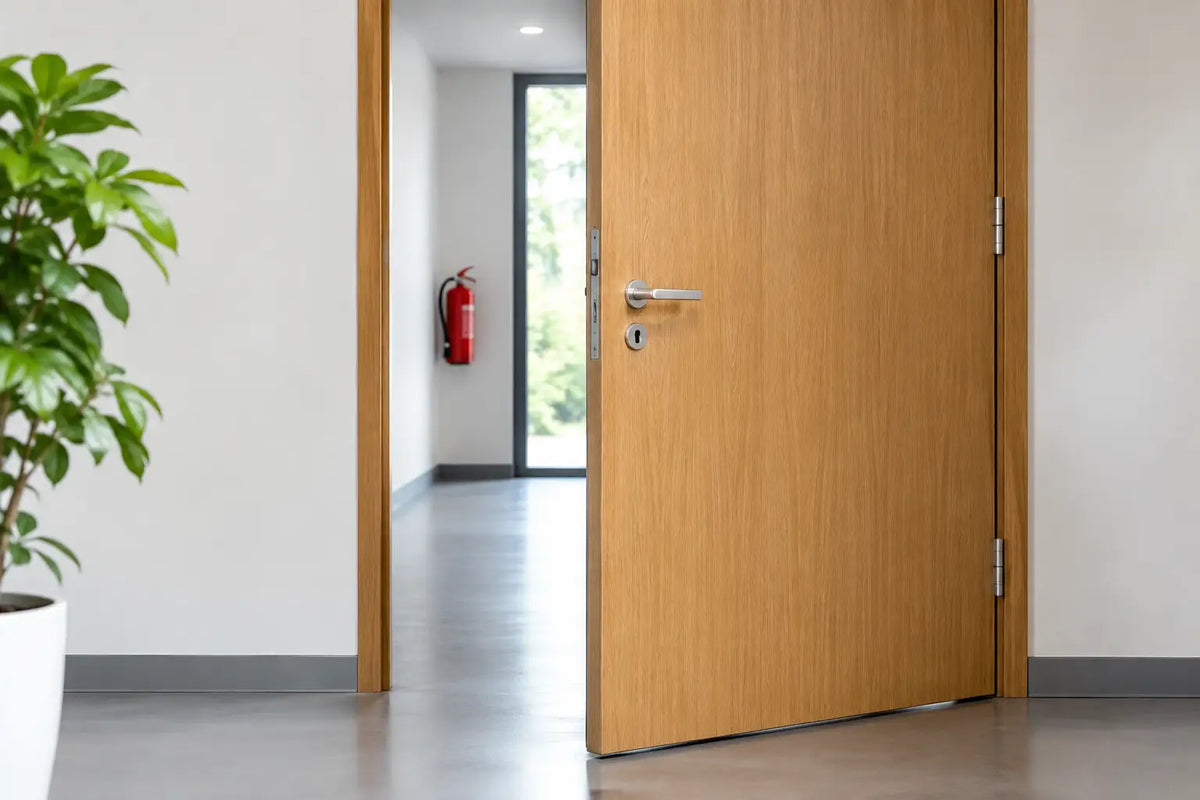
A flat entrance door does far more than separate your home from a communal corridor. A properly specified flat entrance fire door can be a critical part of a building’s fire safety strategy, while also providing security, privacy and an attractive entrance to your property. The right flat fire doors combine a suitable fire rating with compatible components, reliable security features and a finish that complements the interior.
For homeowners, landlords, property managers and developers, choosing a fire-rated flat entrance door is about more than selecting an FD30 door leaf in a preferred colour or style. The complete door assembly needs to work together to provide the required level of fire resistance and everyday performance.
The wall construction, existing door frame, door closer, hinges, locks, intumescent seals and any glazing can all affect how the finished installation performs. This is particularly important when replacing an existing flat entrance fire door, as the surrounding frame and hardware may need to be assessed for compatibility.
Whether you are upgrading a single apartment, refurbishing a block of flats or specifying doors for a larger development, start by identifying the fire rating and specification required for the building. You can then choose the door style, finish and hardware that provide a practical combination of fire protection, security and everyday usability.
What makes the best flat fire doors?
The best flat fire doors are correctly rated, fully compatible with the surrounding assembly and suitable for the building’s specific fire and security requirements. In many purpose-built blocks, a flat entrance door leading on to a shared corridor or stairwell will need to provide 30 minutes of fire resistance. This is commonly described as FD30 or FD30S, where the S indicates smoke control when fitted with the appropriate seals.
However, FD30 is not a universal answer. Some buildings, particularly those with particular layouts, heights or fire strategies, may require an FD60 door or a different certified solution. Existing building records, the responsible person, the managing agent, building control or a competent fire-door professional should clarify the required performance before an order is placed.
A fire door is a tested assembly, not simply a heavy door blank. Its performance relies on the leaf, frame, hinges, latch, closer, intumescent strips and smoke seals working together. Replacing only the leaf can be possible in some situations, but only where the existing frame and hardware are suitable and the installation can meet the relevant test evidence. This is why a complete fire door set is often the clearer option for major refurbishments and new-build work.
Start with the location and fire strategy
The term flat fire door can mean two quite different products. An entrance door protects the escape route outside the flat and may also need security features. An internal fire door separates areas within a dwelling, such as a kitchen, integral garage or protected stair enclosure where required by the building design.
Flat entrance doors need particularly careful specification. They may need a self-closing device, smoke seals, letterplate protection, a viewer and locks that allow occupants to leave easily without a key. In some projects, PAS24 security performance is also required. PAS24 is not a fire rating, but it can be an essential complementary standard for flat entrance doors where enhanced security is part of the brief.
Do not assume a standard external door, even a solid and secure-looking one, is suitable for a flat entrance. Equally, not every internal FD30 door leaf is designed for use as a front door to a flat. The product description and certification must support the intended location, including exposure conditions where relevant, security hardware and any required acoustic performance.
FD30 or FD60: choose the rating that is specified
FD30 doors are designed to resist fire for 30 minutes when installed as part of a suitable tested system. They are widely used in domestic and residential applications. FD60 doors offer 60 minutes of fire resistance and are more common in higher-risk or more demanding commercial settings, although they are also specified in certain residential buildings.
The higher rating is not automatically the better purchase. An FD60 door can be heavier, may need more substantial hardware and usually costs more. Installing a higher-rated leaf into an unsuitable frame does not create a compliant FD60 assembly. The best value comes from buying the rating required and ensuring every associated component is appropriate.
For a flat entrance door, look closely at smoke control as well as the fire rating. Cold smoke seals help limit the movement of smoke around the door edges, while intumescent strips expand in heat to close the gap between door and frame. Depending on the certification and door configuration, these may be fitted in the leaf, frame or a specific seal arrangement. Follow the manufacturer’s details rather than mixing components on assumption.
Pre-assembled sets reduce avoidable risk
A pre-assembled fire door set combines a matched door leaf, frame and often factory-fitted seals and hinges. For landlords, developers and busy trades, this can remove uncertainty around component compatibility and speed up fitting on site. It also produces a more consistent result across multiple flats or a larger renovation programme.
A doorset can be especially worthwhile when replacing an old flat entrance door and frame together. Older frames may be out of square, damaged or unable to accept the seals and ironmongery required by a modern fire-door specification. Starting with a matched set makes it easier to achieve correct gaps, reliable closing and a neat finish.
There are trade-offs. A pre-assembled set needs accurate structural opening measurements, consideration of delivery access and enough room for handling. If the opening is unusual, bespoke sizing may be needed. It is still often preferable to trying to adapt a standard-sized leaf to a frame that cannot support the required performance.
Select a design that suits the building
Fire safety does not mean settling for an institutional-looking door. Flat fire doors are available in flush, shaker, panelled, oak-effect, primed and painted finishes, allowing the entrance door to reflect the character of the property. A plain flush door is a popular choice for contemporary flat schemes because it is clean, practical and easy to coordinate across a development. Panelled designs can be better suited to period conversions and traditional communal areas.
Finish choice should be made with maintenance in mind. Primed doors give flexibility where a specific painted colour is needed, but they require proper finishing on site. Pre-finished options can save time and provide a consistent appearance, particularly across several properties. Oak veneers bring warmth but should be selected carefully to match adjoining internal doors, skirtings and architraves.
Glazed fire doors can introduce borrowed light to a hallway, but glazing must be fire-rated and included within the door’s approved configuration. You cannot cut a new vision panel into a solid fire door unless the manufacturer’s certification expressly permits it and the work follows that detail. The same caution applies to trimming, drilling and fitting letterplates or viewers.
Ironmongery is part of the specification
A fire door that does not close fully cannot provide the protection it was selected for. Door closers are therefore central to flat entrance door performance. The closer must be correctly sized for the door weight and width, installed to the approved arrangement and adjusted so the door shuts positively onto the latch without slamming.
Hinges, locks, latches, handles, letterplates and viewers also need to be suitable for fire-door use. A common mistake is choosing decorative hardware first and checking suitability later. Start with certified or fire-rated ironmongery, then select the finish - such as satin stainless steel, polished chrome, black or brass - that works with the wider scheme.
Where a door is fitted with a latch, it must engage properly every time. Hold-open devices, wedges and hooks should not be used to keep a flat fire door open. If access needs make a hold-open solution necessary, seek a suitable compliant system rather than compromising the door’s closing action.
Measure carefully before ordering
Measure the structural opening, not only the existing door leaf. Check width, height, wall depth, floor levels and whether the frame will need to be replaced. Also assess the direction of opening, clearance into the flat, any communal-corridor restrictions and how the product will be carried to the property.
Door handing matters for both convenience and escape. Consider where handles, viewers and hinges will sit, whether the open door obstructs circulation and whether residents can leave without difficulty. For shared developments, a consistent handing and finish can make maintenance simpler and improve the appearance of communal spaces.
If you are retaining a frame, inspect it closely for movement, splits, excessive gaps, previous alterations and unsuitable hardware cut-outs. A new fire-rated leaf cannot correct faults in a compromised frame. When there is doubt, a specialist inspection before purchase is more cost-effective than a failed installation after decorating is complete.
Buying with confidence
At Door Supplies Online, the practical route is to filter first by fire rating, format and finish, then review the product information for certification, compatible hardware and sizing. For straightforward replacements, a clearly specified FD30 door and suitable fire-door ironmongery may be enough. For flat entrance doors, multi-property schemes or uncertain existing frames, a complete doorset and technical advice usually offer a safer, more efficient route.
The right door should satisfy the project specification without creating unnecessary cost or installation complexity. Confirm the required rating, choose a tested system, allow for the correct closer and seals, and select a finish residents will be happy to live with. That is how a flat fire door becomes both a dependable safety measure and a well-considered part of the home.