
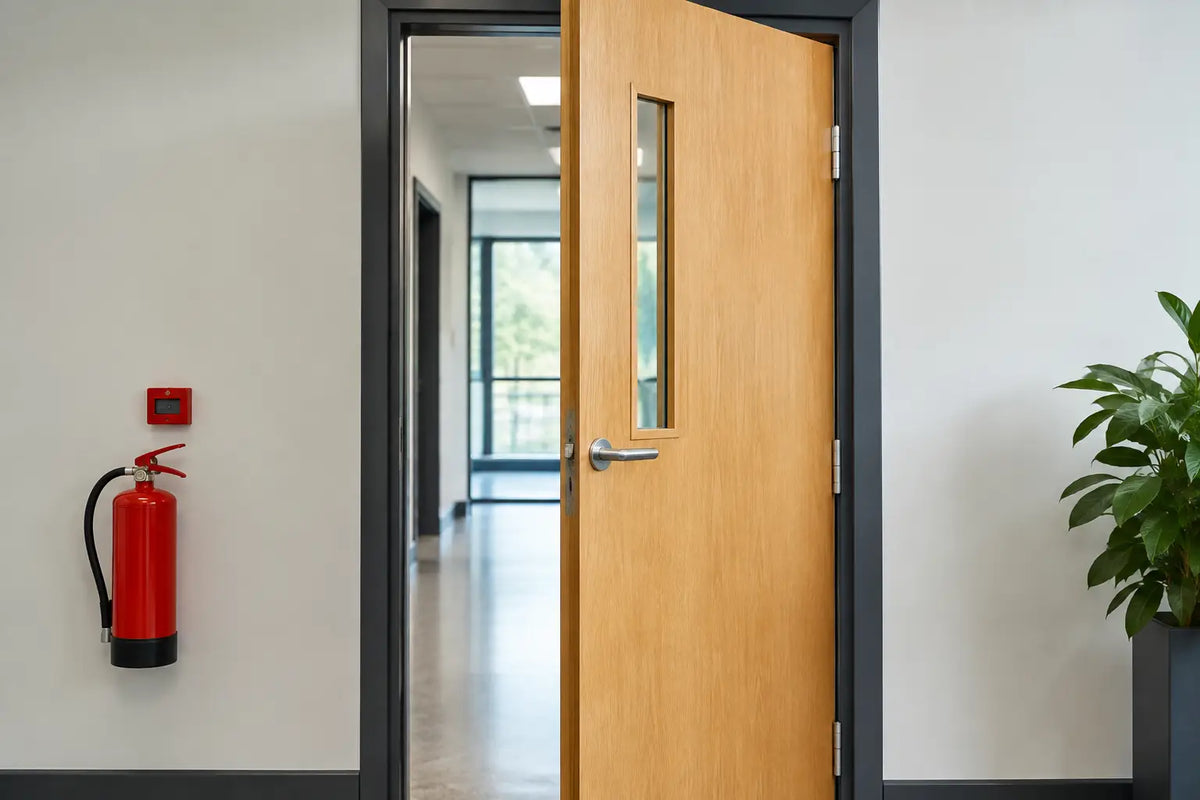
A fire door may look much like any other internal door, particularly when finished in oak, painted white or fitted with decorative glazing. The key difference is how it performs in the event of a fire. So, what is FD30? An FD30 fire door is a fire-rated door assembly designed to resist fire for at least 30 minutes when tested to the relevant standard.
For homeowners, landlords, property developers and trade buyers, this simple definition is only the starting point. FD30 fire doors are designed to help slow the spread of fire and smoke, providing valuable additional time for occupants to leave a building and for emergency services to respond.
An FD30 door is not simply a heavier door leaf that can be fitted into a standard opening with ordinary hinges. Its fire performance depends on the complete door assembly, including the door leaf, frame or lining, hinges, intumescent seals, latch or lock, glazing where applicable, and the correct installation method.
Choosing compatible components and installing them correctly is essential to maintaining the door's tested fire performance. Incorrect hardware, unsuitable gaps, poor installation or inadequate maintenance can affect how effectively the complete 30 minute fire door performs in a fire.
Whether you are replacing an existing internal fire door, upgrading a property or sourcing doors for a larger building project, understanding the requirements of FD30 fire doors can help you select a suitable, compliant door set for the application.
What does FD30 mean on a fire door?
The letters FD stand for Fire Door and the number 30 refers to a minimum 30-minute fire-resistance period. An FD30 fire door is intended to slow the spread of fire from one area of a building to another, helping to protect escape routes and give occupants more time to leave safely.
The rating is established through fire testing of a defined door assembly. Depending on the product and test evidence, this can include the door leaf, frame, intumescent seals, hinges, latch or lock, glazing system, closer and other specified hardware. That is why an FD30 label should never be treated as a claim about the door leaf alone.
You may also see FD30S. The additional S means the doorset has a smoke-control classification. In practical terms, it is designed to limit the passage of cold smoke as well as resisting fire. Smoke can be a serious hazard well before flames reach an escape route, so smoke seals are commonly required where the specification calls for them.
Why the complete FD30 door assembly matters
During a fire, heat causes intumescent material to expand. Intumescent strips fitted around the door or frame swell to help close the gap between the leaf and frame, restricting the route for fire and hot gases. This is a key reason why the perimeter gap, strip type and strip position must match the manufacturer’s instructions.
A fire door also needs fire-rated ironmongery. Hinges, latches, locks, letterplates, viewers and closers can all affect performance. A typical FD30 hinged door will require three suitably rated hinges, although the exact specification depends on the door’s size, weight and certification. Where a self-closing device is required, it must close the door fully onto the latch from any open position.
The frame is equally important. A certified FD30 door leaf fitted into an unsuitable frame, or installed with excessive gaps and the wrong packing or sealant, is not automatically an FD30 fire door assembly. For projects where speed, consistency and clearer responsibility matter, a pre-assembled fire door set can remove much of the uncertainty around matching the leaf, frame and essential components.
Fire door leaf or fire door set?
A fire door leaf is the door itself. It is often supplied for fitting into a compatible existing or new frame, but the installer must follow the fire test evidence and manufacturer’s data for the full specification.
A fire door set generally combines the leaf and frame as a tested system, with options for factory preparation, seals, glazing, hinges and other ironmongery. It can be the more straightforward choice for developers, contractors and anyone replacing multiple doors, particularly where the building specification requires documented performance.
Neither route is automatically better. A door leaf can be appropriate when a compatible frame is already in place and the installation is being handled by a competent professional. A doorset is often preferable where coordination, fitting time and confidence in component compatibility are priorities.
Where are FD30 fire doors used?
FD30 doors are widely used in domestic, communal and commercial settings, but their location should be determined by the building’s design, use and fire strategy rather than guesswork. Common examples include doors protecting an escape route, doors between a dwelling and an integral garage, entrances to flats from communal corridors, and internal doors in shared houses or multi-occupancy properties.
They are also frequently specified in loft conversions, commercial premises, schools, care environments and accommodation buildings. However, the required rating may be FD30, FD60 or another solution altogether. Building Regulations, fire risk assessments, lease conditions, insurer requirements and the advice of Building Control or a competent fire safety professional can all influence the final specification.
For existing homes, do not assume every internal door needs replacing with an FD30 model. Equally, do not assume a standard internal door is acceptable because it is solid or feels substantial. Fire safety decisions should be based on the property’s layout and applicable requirements.
Choosing an FD30 door without losing the look of the room
Fire performance does not mean settling for one plain, institutional-looking design. FD30 options are available in flush, shaker, panelled and contemporary styles, with finishes including primed, white moulded, oak veneer, unfinished oak and black. Many ranges also offer matching non-fire-rated internal doors, helping to keep a consistent style across a property while using fire-rated doors only where they are required.
Glazed FD30 doors are available too, but the glazing must be part of the tested specification. Fire-rated glass, glazing beads and seals are designed to work together under heat. It is not safe to cut a new opening into a solid fire door or replace fire-rated glass with ordinary decorative glass unless the door manufacturer specifically confirms the alteration is permitted.
Size is another practical consideration. Fire doors are heavier than many standard internal doors, and trimming allowances can be limited. Always check the product’s certification and fitting instructions before ordering or cutting. Excessive trimming can remove critical construction details and invalidate the tested performance.
Fitting details that should not be overlooked
Even a high-quality FD30 door needs accurate fitting. The door should sit squarely in the frame and close fully without binding on flooring, carpets or thresholds. Gaps around the edges must stay within the manufacturer’s permitted tolerance, which is often a narrow range rather than an installer’s personal preference.
Intumescent and smoke seals must be continuous, undamaged and correctly positioned. Hardware should be fixed through the door in accordance with the manufacturer’s guidance, using the required screws and reinforcements where specified. Any holes drilled for handles, locks, closers or access control equipment need to be allowed for by the test evidence.
Avoid common shortcuts such as wedging a fire door open, fitting unapproved hook-and-eye catches, removing seals because the door feels tight, or replacing a damaged closer with a non-rated alternative. A fire door that is routinely held open cannot perform its role when it matters. Where doors need to be kept open for access or ventilation, use an appropriate compliant hold-open solution selected for the building.
How to check an FD30 fire door in use
A simple visual check can identify obvious issues, although it is not a substitute for a professional inspection where one is required. Look for a fire-door label or plug, check that the leaf and frame are in good condition, and make sure the door self-closes and latches where a closer is fitted.
Check for missing or painted-over seals, loose hinges, damaged glazing, large gaps, drilled holes and alterations that are not supported by the manufacturer. In managed buildings, regular fire door inspections should form part of the wider fire safety regime. Landlords and responsible persons should keep records and arrange repairs promptly when defects are found.
Buying the right FD30 solution
Start with the opening size, handing, finish, required rating and whether smoke control is needed. Then establish whether you need a door leaf for a compatible existing frame or a complete doorset. It is worth checking the required hardware at the same time, rather than treating hinges, seals, latches and closers as afterthoughts.
Door Supplies Online offers FD30 fire doors, FD60 options, fire door sets and compatible ironmongery across a range of styles and finishes. For a specification-led project, having the product data, certification details and fitting requirements checked before purchase is usually quicker and less costly than correcting an unsuitable installation later.
An FD30 fire door is a life-safety product first and a design choice second. Choose a style that suits the property, but make sure the rating, components and installation all work as one tested system.