
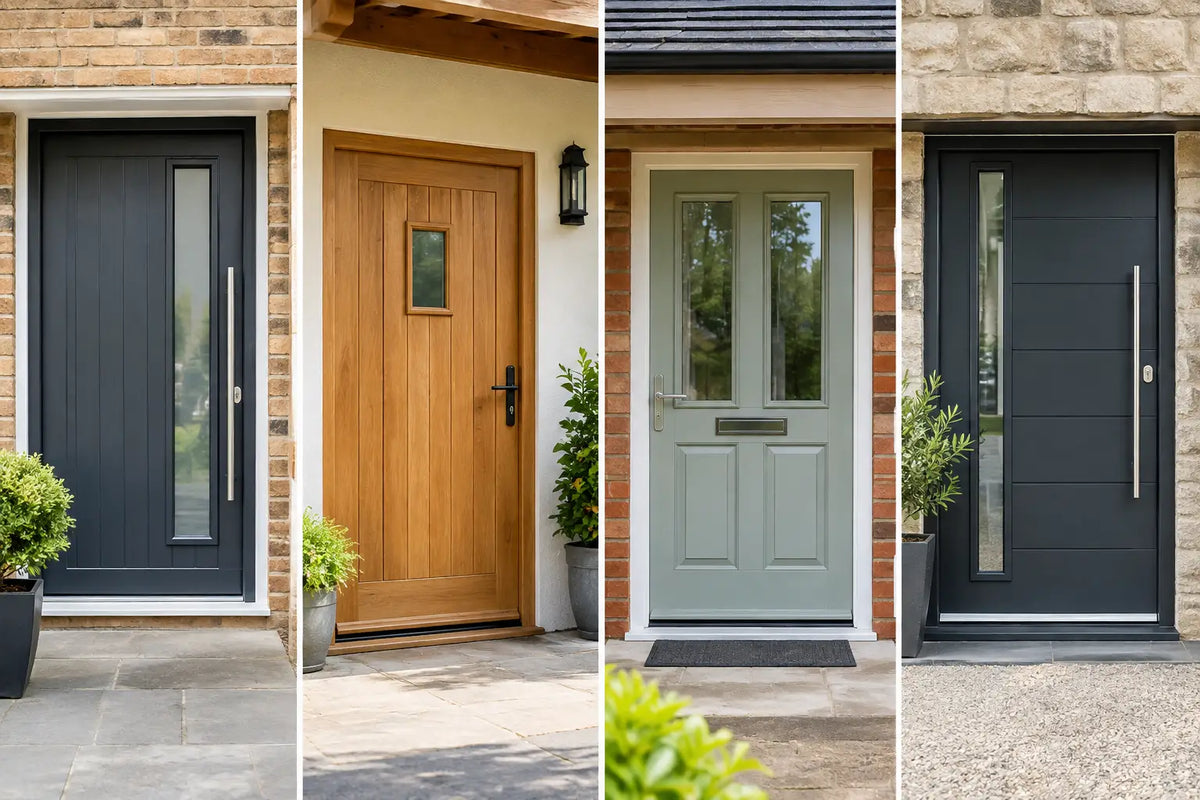
A front door has to do far more than create a good first impression. It needs to withstand wind-driven rain, daily use, changing temperatures and potential forced entry, while also complementing the style of your property. Choosing the best front door materials therefore means looking beyond appearance. The right material should suit your property, budget, security requirements, energy-efficiency needs and preferred level of maintenance.
For a period property or traditional terrace, a well-specified timber front door can provide an authentic appearance with plenty of character. For busy family homes where low maintenance is a priority, composite front doors offer a practical combination of durability, security and weather resistance. Aluminium and steel front doors can be suitable for contemporary properties where slim sightlines, modern styling and enhanced security are important.
However, the performance of an external door depends on more than the door material alone. The door frame, glazing, locks, hinges, weather seals and installation all contribute to security, durability and weather resistance. Comparing these elements as a complete doorset will help you choose the best front door material for your home.
Best front door materials at a glance
Timber offers authentic character and can be repaired, but needs regular protection from the weather. Composite provides a convincing traditional appearance with strong insulation and minimal maintenance. uPVC is a cost-conscious option that performs well when specified carefully, while aluminium brings modern lines and excellent stability. Steel is particularly strong and is often chosen for security-led or commercial-style entrances.
Do not judge a material by price alone. A low-cost slab can become an expensive choice if the frame, threshold, locks and fitting are poor. Equally, an excellent external door will not perform as intended if it is fitted out of square or without effective weather seals.
Timber front doors: traditional and genuinely versatile
Timber remains one of the most attractive choices for British homes, especially Georgian, Victorian, Edwardian and cottage-style properties. It has depth, warmth and a natural grain that other materials try to recreate. It can also be made to bespoke sizes and designs, making it useful where an opening is non-standard or planning expectations call for a traditional appearance.
A quality engineered timber door is generally more stable than a door made from a single piece of wood. Engineered construction uses carefully bonded sections to reduce movement as humidity and temperature change. Hardwood species and properly treated softwood can both work well, but the finish and maintenance schedule are decisive.
Timber needs inspection and repainting or re-oiling at intervals, particularly on exposed elevations. South-facing doors can suffer from UV fading, while sheltered but damp entrances may encourage paint failure if water is allowed to sit around joints. This is not necessarily a reason to avoid wood. It is a reason to buy a suitable exterior-grade product and allow for upkeep from the outset.
Choose timber when character matters most
Timber is a strong option for homeowners restoring original features, self-builders wanting a distinctive entrance, and anyone who values a repairable material. A scratched painted timber door can usually be prepared and refinished. With a composite or uPVC door, serious damage may be harder to disguise.
Composite front doors: the practical all-rounder
Composite doors combine different materials within one construction, commonly using a solid or reinforced core, insulated layers and a durable outer skin. Their key appeal is balance: they can offer the look of a painted timber door without the same level of routine maintenance.
A well-made composite door feels substantial, provides good thermal performance and is available in a wide range of colours, glazing options and panel designs. Traditional moulded styles work well on older homes, while flush or grooved designs can suit newer developments. Many homeowners also choose a contrasting internal and external colour where the product range allows it.
Not all composite doors are built to the same specification. Compare the door thickness, core construction, frame reinforcement, locking system, weather seals and declared doorset performance. Look beyond a close-up image of the outer skin. A strong multipoint lock, secure cylinder, reinforced hinges and correctly fitted frame have a direct effect on everyday security.
Composite is often the best fit where you want a reliable, insulated entrance door with a premium feel but do not want to repaint it every few years. It can cost more than basic uPVC, although the lower maintenance and heavier construction may justify the difference.
uPVC front doors: value-focused and low maintenance
uPVC remains a popular material because it is affordable, easy to clean and does not require painting. It performs particularly well for replacement projects where budget is a major factor, and modern designs are considerably broader than the plain white doors many people associate with the material.
Foiled finishes can provide wood-effect or coloured options, and glazed panels can bring useful daylight into a dark hallway. The strongest uPVC doors use quality multi-chamber frames, reinforced sections where required and dependable hardware. A poorly specified door may feel light or flex under use, so it is worth comparing the full doorset rather than selecting on appearance alone.
uPVC is not usually the first choice for a high-end architectural scheme or a sensitive period restoration. Its profile and finish may look out of place beside original joinery. However, for landlords, straightforward replacements and value-led renovations, it can be a sensible, durable solution.
Aluminium front doors: modern, stable and made for colour
Aluminium front doors are a leading choice for contemporary homes, extensions and architect-designed projects. The material is strong and dimensionally stable, allowing crisp lines, wide panels and slim-looking frames. Powder-coated finishes offer a broad choice of colours, including popular black, anthracite grey and heritage-inspired shades.
Because aluminium conducts heat, quality external doors use a thermal break to prevent excessive heat transfer through the frame and panel. Ask for the declared U-value for the complete doorset, rather than relying on a claim for the door leaf alone. Glazing specification matters here too, especially on doors with side panels or large glazed areas.
Aluminium is generally low maintenance, needing little more than periodic cleaning and checks to moving hardware. It is usually more expensive than uPVC and many composite options, but its clean appearance, colour durability and stability can make it worthwhile on a design-led project.
Steel front doors: strength where security leads
Steel entrance doors offer exceptional strength and a distinctive, architectural appearance. They are frequently specified for commercial premises, communal entrances and properties where security is a primary concern, but they also have a place in modern residential schemes. Steel-framed glazed doors can create a striking industrial look, provided privacy and heat loss are considered.
A steel door should be properly insulated and finished for exterior use. As with aluminium, thermal detailing is essential. The best specification combines a strong leaf and frame with secure locking, quality seals and a threshold designed to manage weather exposure.
For flats and shared buildings, fire performance may be as relevant as security. An entrance door to a flat can be a fire door in certain situations, so do not assume a standard external steel door is suitable. Check the required fire rating, smoke seals, certification and the building’s fire strategy before ordering.
What matters beyond the door material
Material is only one part of an effective entrance. Security should be assessed as a system. A recognised security standard such as PAS 24 can provide useful reassurance, but confirm that the exact doorset, glazing and hardware configuration are covered by the certification. A secure cylinder, ideally with anti-snap protection where appropriate, is just as important as a strong door panel.
Thermal performance deserves the same attention. For replacement external doors, the applicable Building Regulations requirements and any local planning conditions should be checked before purchase. Compare whole-door U-values on a like-for-like basis, and remember that side lights and glazed fanlights influence the performance of the entrance as a whole.
Think about exposure too. A door beneath a deep porch faces a very different environment from one on a coastal or west-facing elevation. A protected entrance gives more freedom with painted finishes, while an exposed doorway benefits from durable surfaces, drainage, correctly fitted weather bars and high-quality seals.
Finally, plan the finishing details early. Letterplates, knockers, handles, numerals and escutcheons should suit both the door style and the required security specification. If you are choosing a pre-assembled doorset, confirm which ironmongery is included and whether handing, opening direction and threshold type are correct before placing the order.
A front door is used every day, so the best choice is the one that still looks right and works properly years after fitting. Whether that means the grain of engineered oak, a low-maintenance composite design or a slim aluminium doorset, Door Supplies Online can help you specify an entrance that suits the property rather than simply filling the opening.
For more information about our interior or exterior doors or door accessories, give us a call at 01603 622261 and speak to a member of our expert team today, or email us at sales@doorsuppliesonline.co.uk. We look forward to hearing from you.