
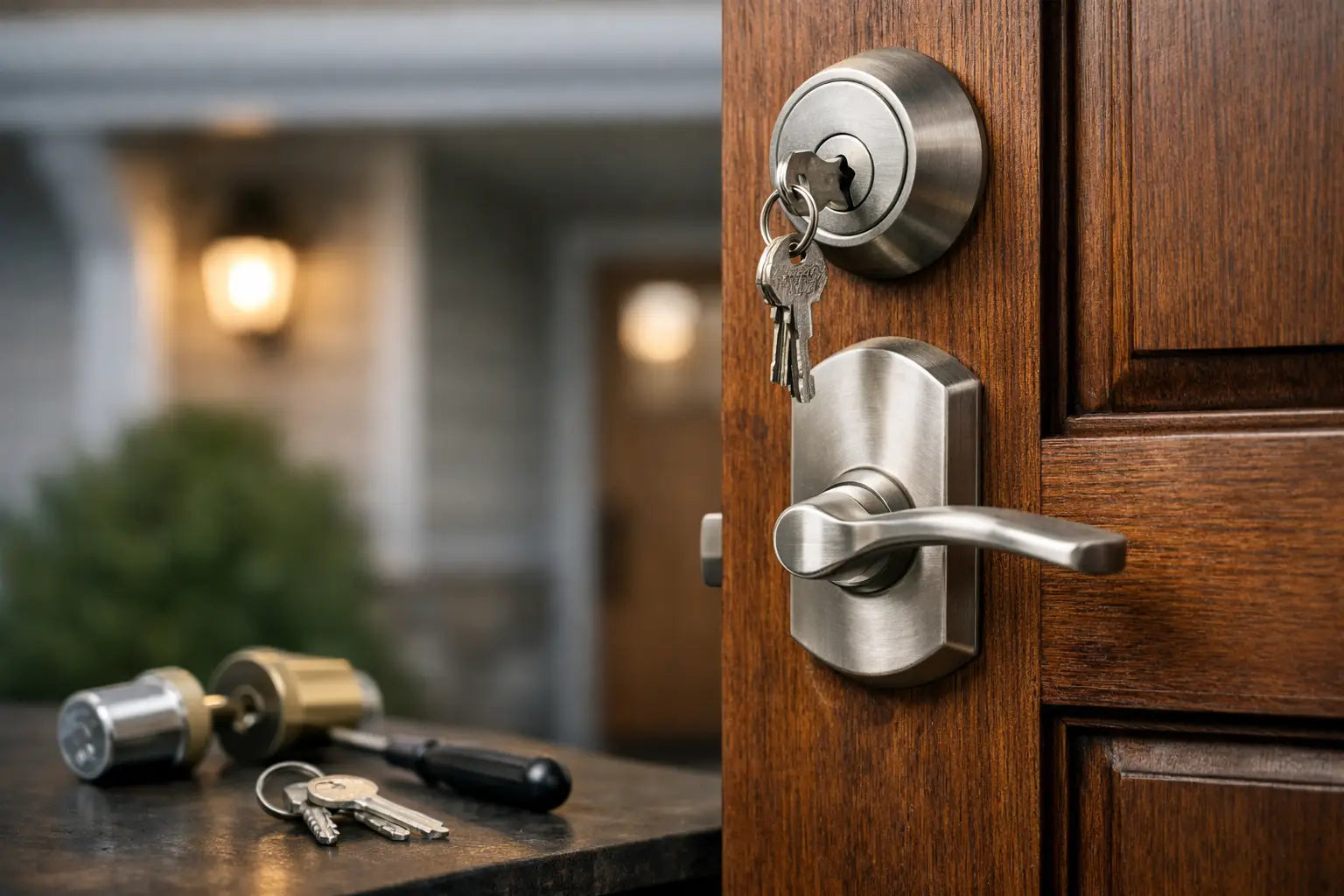
A new front door, side entrance or garden door may enhance your home's appearance, but its security depends on much more than the door itself. Choosing the right external door locks is essential for protecting your property and should take into account the door material, opening direction, level of security required and any insurance requirements. A high-quality front door lock should also be paired with compatible cylinders, handles, keeps and multipoint locking mechanisms, all correctly fitted to a strong, well-installed door frame.
For homeowners, landlords and trade professionals, the best approach is to specify the complete external door locking system rather than purchasing a lock in isolation. This ensures every component works together to provide maximum security, smooth operation and long-term reliability. It also helps avoid common installation issues, such as selecting the wrong euro cylinder length, mismatched door furniture or a lock that is unsuitable for outward-opening doors.
Start with the door and its use
An external lock should be selected for the door type first. Timber front doors commonly use a mortice deadlock or sashlock, often alongside a nightlatch. Composite, uPVC and many aluminium entrance doors normally use a multipoint locking system operated by a handle and secured with a euro profile cylinder. Steel security doors and flat entrance door sets may have a factory-specified lockcase and hardware arrangement that should not be substituted without checking the door manufacturer’s requirements.
Think about who uses the entrance as well. A main front door needs convenient daily access and dependable security. A rear door may need a thumbturn cylinder to allow a quick exit without finding a key. A side door to a garage, workshop or commercial unit may need a more hard-wearing arrangement, particularly where it is used regularly by staff or exposed to the weather.
The direction of opening matters too. An outward-opening door can leave hinges and lock hardware more exposed, while a door opening into a narrow hallway may be better served by a lock that allows straightforward egress. If the door is part of an escape route, do not choose solely on security credentials. The locking method must allow occupants to leave safely when the building is occupied.
Main types of external door locks
Multipoint locks for composite, uPVC and aluminium doors
A multipoint lock secures the door at several positions along its edge, usually with hooks, rollers, bolts or mushroom cams. Lifting the handle engages these points, then turning the key locks the mechanism. This provides good compression against seals and spreads security along the frame rather than concentrating it at one point.
However, three, five or more locking points do not automatically make one system better than another. The strength of the door, frame, keeps, cylinder and installation are equally significant. On an existing door, identify the lock correctly before ordering a replacement: measure the backset, centres between the handle spindle and cylinder, faceplate length and fixing positions. Small differences between gearboxes can prevent a like-for-like replacement from fitting.
The cylinder is a particularly important part of a multipoint arrangement. A quality anti-snap cylinder can help resist common forced-entry methods. For higher-security applications, look for suitable independent ratings such as TS 007 three-star or SS312 Diamond, and pair the cylinder with compatible security furniture where required by the product specification.
Mortice deadlocks and sashlocks for timber doors
A five-lever mortice deadlock is recessed into the edge of a timber door and operated by a key from both sides. It is a familiar choice for solid external doors because the bolt engages directly into a strike plate in the frame. A sashlock combines a latch for day-to-day closing with a deadbolt for security, allowing the door to be opened with a handle once unlocked.
For many domestic external doors, a BS 3621-rated five-lever mortice lock is a sensible benchmark and may be requested by insurers. Always check the policy wording rather than assuming a particular standard is mandatory. The lock must also be installed with the correct box strike, fixing screws and timber reinforcement. A strong lock fitted into a weak, split or poorly prepared frame will not perform as intended.
Nightlatches are often used on traditional front doors, particularly where a door needs to latch shut automatically. They can be convenient, but should be chosen carefully for the door style and security level. On glazed doors, consider the position of the lock and letterplate so that a hand or tool cannot easily reach internal release hardware.
Rim locks, gate locks and specialist applications
Rim cylinders and rim locks fit to the face of the door rather than within it. They are commonly used with nightlatches and may be appropriate for certain timber entrance doors. Their security depends on both the cylinder and the lock body, so replacing only the visible cylinder is not always a complete upgrade.
External gates, bin stores and side passages have different demands. A weather-resistant gate lock may be more suitable than an indoor-style mortice lock, especially where rain, frost and dirt are regular factors. For shared entrances, flats and commercial premises, access control, key management and fire escape requirements can change the specification considerably. Seek advice before altering locks on communal or certified doors.
Security standards are only one part of the specification
Standards help compare products, but they apply to different components. BS 3621 relates to thief-resistant mortice locks. TS 007 and SS312 are associated with enhanced cylinder security. PAS 24 is a test for the performance of an external doorset as a complete assembly, not simply a badge for an individual handle or cylinder.
That distinction matters when replacing hardware. Adding a high-security cylinder to an old door can improve one point of weakness, but it does not turn the whole entrance into a PAS 24 doorset. Similarly, fitting a heavy-duty lock to a warped timber door will not compensate for poor frame alignment or loose hinges.
For new-build and specification-led projects, security requirements can be influenced by Building Regulations, planning conditions, warranty providers or client standards. Approved Document Q is particularly relevant to security provision in applicable new dwellings in England. Confirm the requirements for the project before ordering, especially where doorsets are supplied pre-assembled or have certified fire, acoustic or security performance.
Match the lock to the hardware and finish
External hardware must cope with moisture, temperature changes and frequent handling. Handles, escutcheons, letterplates and knockers should be selected for their corrosion resistance as well as their appearance. Polished chrome, satin stainless steel, black and brass finishes can all work well, but their suitability varies by coating quality and location. In highly exposed or coastal settings, a more corrosion-resistant specification is worth considering.
Cylinder length is another detail that should not be guessed. Measure from the centre fixing screw to each end of the existing cylinder, taking account of the door thickness, handle backplate and escutcheon. A cylinder that projects too far beyond the furniture can be easier to grip or attack, while one that sits too short may be awkward to operate. As a general rule, it should sit flush or project only minimally from the security furniture.
On a timber door, check the lock case size, backset and handle centres before cutting. On a composite or uPVC door, do not force an incompatible spindle, gearbox or cylinder cam into place. For aluminium systems, use hardware approved for the profile where possible, as fixing methods and tolerances can differ.
Fitting, maintenance and replacement timing
Good installation is part of the security product. The door should close freely before the lock is fitted or adjusted. If you need to lift, push or pull the door heavily to turn the key, the frame, hinges or keeps may need attention. Continually forcing a multipoint handle can damage the gearbox and reduce the life of the system.
Use the manufacturer’s supplied fixings where provided, and avoid overtightening cylinder screws or handle bolts. Test the lock with the door open first, then closed, checking that every bolt or hook engages cleanly. Keep keys away from the door when it is not in use, and consider changing cylinders when moving into a property, after lost keys or when access by previous occupants or contractors cannot be accounted for.
Routine care is straightforward. Keep the door edge and keeps clear of dirt, check screws and hinges periodically, and use a suitable lock lubricant rather than heavy oil that can attract grit. If a lock begins to stick, deal with the alignment issue early instead of waiting for a failed mechanism or a door that will not secure.
Choose a complete, dependable solution
The best external lock is one that fits the door precisely, supports the required level of security and remains practical for daily use. For a straightforward replacement, accurate measurements and matching hardware are essential. For a new entrance, a coordinated doorset, cylinder, handles and frame specification can remove uncertainty and deliver a better finish.
Door Supplies Online offers external door hardware for renovation, replacement and new-build projects, with specialist options for timber, composite, aluminium and steel doors. When the door, lock and ironmongery are specified together, security becomes a considered part of the entrance rather than an afterthought.
For more information about our interior or exterior doors or door accessories, give us a call at 01603 622261 and speak to a member of our expert team today, or email us at sales@doorsuppliesonline.co.uk. We look forward to hearing from you.