
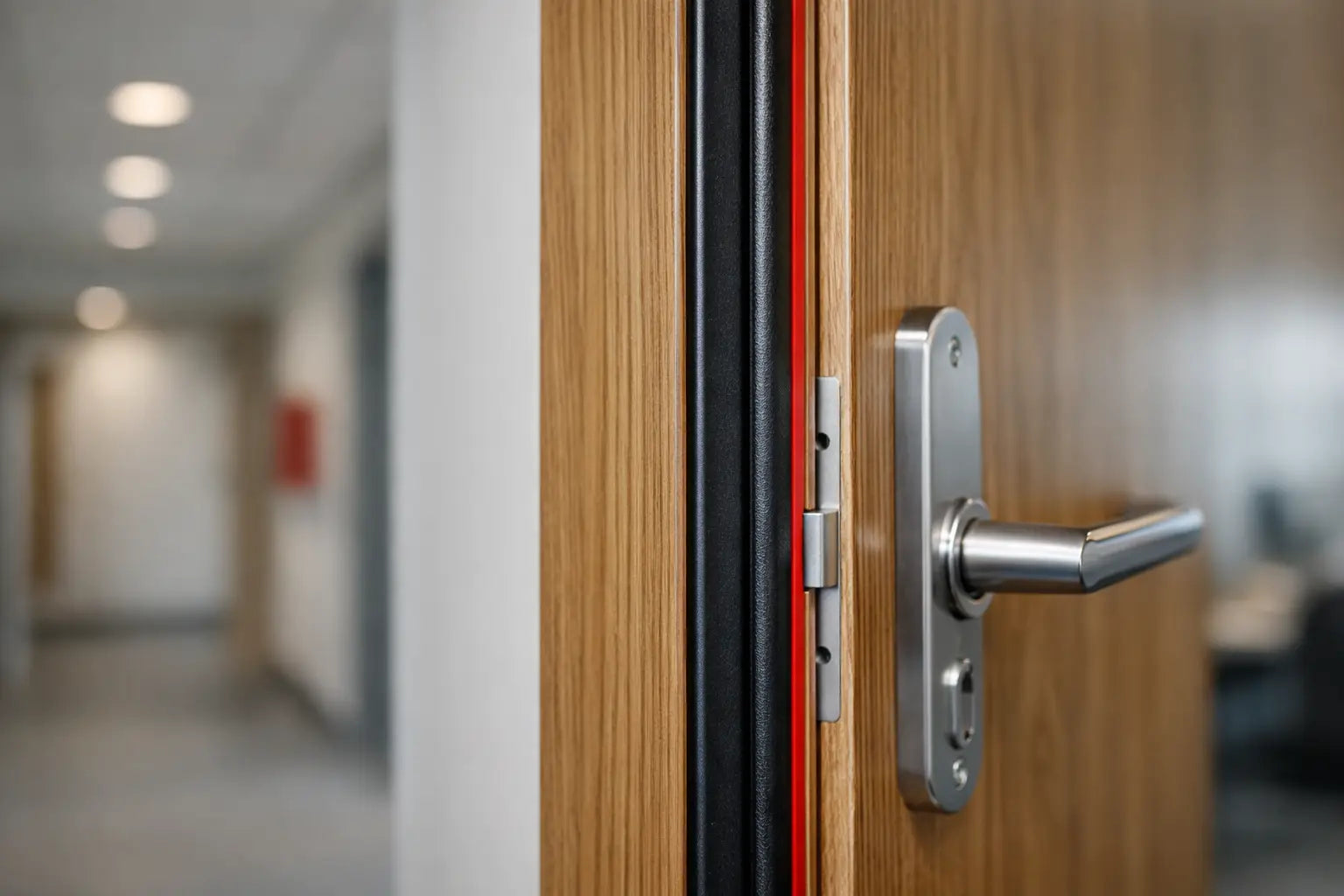
A fire door is only as effective as the complete fire door system around it. The door leaf may have an FD30 or FD60 fire rating, but excessive gaps, unsuitable hardware or missing seals can allow fire and smoke to spread more quickly than intended. This raises an important question: do fire doors need seals?
In most modern fire door installations, intumescent seals form an important part of the tested doorset or manufacturer's installation specification. Intumescent door seals are designed to react to heat and expand, helping to close gaps around the door leaf and restrict the passage of fire. Smoke seals may also be required depending on the door's location, certification and the requirements of the building's fire strategy.
For homeowners, landlords, contractors and trade buyers, fire door seals should never be treated as an optional finishing detail. The correct fire door seals must be compatible with the specific door, frame and installation, and should be fitted according to the manufacturer's instructions.
When checking or specifying an FD30 or FD60 fire door, consider the complete doorset, including the door leaf, frame, intumescent seals, smoke seals, hinges, latch, closer and other ironmongery. Ensuring these components work together is essential for maintaining the intended fire and smoke resistance of the complete assembly.
Do fire doors need seals in every installation?
Most fire-resisting doors need intumescent seals fitted either to the door edge or the frame. These seals are designed to expand when exposed to heat, closing the gap between the leaf and frame as a fire develops. Without them, flames and hot gases can pass through the perimeter gap, reducing the door's ability to provide its stated fire resistance.
However, the exact specification is not identical for every door. A fire door should be installed in line with its fire test evidence, the manufacturer's instructions and the requirements of the project. That evidence will identify the permitted frame, hinges, locks, closers, vision panels, glazing system and seal arrangement. A seal type that is suitable for one FD30 door may not be approved for another.
There are exceptions in older buildings and existing installations, but these should never be assumed. If an existing fire door has no seals, it may be an older design, incomplete, altered or incorrectly installed. A competent fire door inspector or suitably qualified installer should assess it before deciding what work is needed.
Intumescent seals and smoke seals do different jobs
The phrase ‘fire door seals’ often covers two separate products. They are commonly supplied together, but they have different roles.
Intumescent fire seals
Intumescent seals react to heat. In normal use, they sit within a groove in the door leaf or frame and do not obstruct day-to-day operation. When a fire raises the temperature, the material expands significantly, filling the clearance around the door and helping to maintain the fire-resisting barrier.
They are usually available as narrow strips in several widths and depths, often in brown, white, black or a finish chosen to blend with the door or frame. Some are fitted as a single strip, while others are installed in pairs or in specific positions detailed by the door manufacturer.
The dimensions matter. Choosing a wider strip because it appears ‘safer’, or cutting a strip to fit an unsuitable groove, can take the assembly outside its tested specification. Equally, fitting intumescent seals with ordinary adhesive, where a tested product requires another fixing method, may compromise performance.
Cold smoke seals
Smoke seals, often brush or blade seals, help restrict the movement of cold smoke before a fire becomes hot enough to activate the intumescent material. This is particularly significant because smoke can affect escape routes and occupants well before flames reach a door.
A combined intumescent and smoke seal is a common solution for doors that need both fire resistance and smoke control. You may see a suffix such as ‘S’ associated with a fire door classification, for example FD30S. The ‘S’ indicates smoke leakage performance, but the full specification still needs to be checked rather than assumed from the label alone.
Brush smoke seals can create a slight closing resistance. That is not necessarily a fault, but the door must still close fully and latch reliably. If a self-closing fire door does not shut from any position, it is not performing its intended function.
Where are smoke seals most likely to be required?
Smoke seals are commonly specified where a fire door protects an escape route or separates a higher-risk area from circulation spaces. In flats, communal corridors, flat entrance doors, protected stairwells, offices, schools, care settings and many commercial buildings, smoke control is often a central part of the fire strategy.
In a single private house, requirements can vary according to the layout, the number of storeys, loft conversions, open-plan arrangements and whether a door protects an escape route or an integral garage. A new-build or renovation project should follow the approved design and Building Regulations guidance applicable to the work. For rental property, houses in multiple occupation and commercial premises, the responsible person or dutyholder may also have wider fire safety obligations.
The practical answer is not to add smoke seals everywhere without checking. Some door types, especially certain acoustic or specialist doorsets, require a particular tested arrangement. Others may use threshold seals or drop seals as part of a combined fire, smoke and acoustic specification.
The gap around a fire door matters as much as the seal
A correctly selected seal cannot compensate for poor fitting. Fire doors need controlled gaps around the perimeter so they can open and close properly while remaining within the tested tolerances. In many typical installations, the gap at the sides and head is around 3mm, although the acceptable range must always come from the door manufacturer's instructions or certification.
An over-large gap is a common problem. It can be caused by a warped frame, an incorrectly sized leaf, poor packing, loose hinges or later adjustment. Fitting a thicker seal to disguise the issue is not a reliable repair. The underlying installation must be corrected, particularly on a rated doorset.
The bottom gap also needs attention. Depending on the test evidence and threshold detail, the permitted clearance may be different from the side and top gaps. A carpet change, new flooring or an uneven threshold can leave a fire door catching on the floor, or create a gap that is too large. This is why flooring should be considered before final door adjustment, not after.
Seals must work with the rest of the doorset
A fire door is not simply a heavy door leaf fitted with a strip around the edge. Its rating depends on compatible components working together. The frame should be suitable for the fire rating, and the hinges, latch, lock, closer, handles, letterplate, viewer and any glazing must all be appropriately specified.
For example, a self-closing fire door normally needs a suitable door closer and positive latching. Wedging it open defeats the door's purpose, even if the intumescent seals are correctly fitted. Similarly, replacing a lock or adding a peephole without checking its fire performance can weaken the assembly.
Pre-assembled fire door sets can reduce uncertainty because the leaf, frame, seals and essential components are selected as a compatible system. They are especially useful for projects with multiple doors, where consistency of fitting and clear installation information can save time on site. A complete FD30 or FD60 doorset is often easier to specify than sourcing individual elements and hoping they are compatible.
How to check whether your fire door has the right seals
Start by looking for labels, plugs or markings on the top edge of the leaf, the hinge side or the frame. These may identify the fire rating, manufacturer or certification scheme. Check the perimeter for continuous intumescent strips, normally housed in a routed groove rather than loosely surface-fixed.
Then inspect the condition. Paint build-up, cuts, missing sections and peeling seals should be addressed. A seal that has been painted repeatedly may not perform as intended, particularly if the paint bridges moving smoke brushes or prevents proper expansion. Do not remove seals to make a tight door easier to close without finding out why it is binding.
Also check that the door closes into the frame, engages the latch and is not held open by a wedge, hook or loose magnetic catch. On communal and commercial premises, routine fire door inspections should be part of the building's fire safety management. In a home, it is still sensible to inspect fire doors after decorating, replacing flooring or changing hardware.
Choosing replacement seals without compromising compliance
Replacement seals should match the original specification wherever possible. Measure the existing groove carefully, note whether the seal includes smoke brushes or blades, and identify the door's rating. Colour is useful for appearance, but it should never be the deciding factor.
If you cannot establish what was originally fitted, seek technical advice before ordering. The product description, test evidence and installation guidance should confirm whether the seal is suitable for the fire rating and configuration you are working with. This is particularly important for double doors, rebated meeting stiles, glazed doors, flat entrance doors and doors with drop seals or automatic thresholds.
Door Supplies Online can help buyers compare FD30 and FD60 doors, compatible frames, ironmongery and pre-assembled fire door sets, but the final specification must always reflect the building's fire strategy and the product manufacturer's requirements.
A properly specified seal is a small component with a major role. When buying or upgrading a fire door, make the seal arrangement part of the decision from the outset, alongside the rating, frame, closer and hardware. That approach gives you a door that looks right, closes correctly and is equipped to do the job it was installed for.
For more information about our interior or exterior doors or door accessories, give us a call at 01603 622261 and speak to a member of our expert team today, or email us at sales@doorsuppliesonline.co.uk. We look forward to hearing from you.