
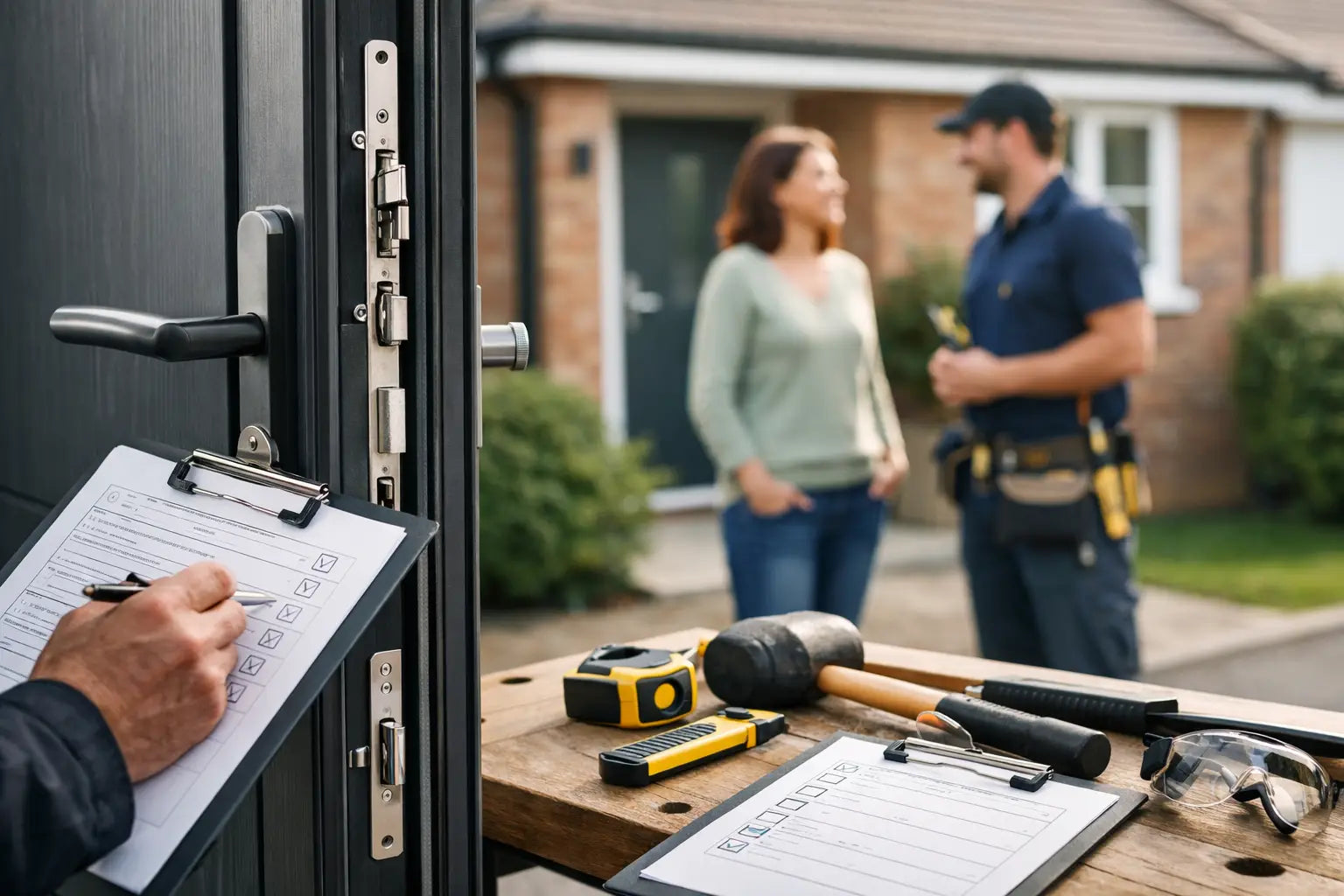
A smart new entrance door can transform the appearance, security and performance of a property, but choosing a secure door involves more than selecting a good-looking lock or solid door leaf. This PAS 24 entrance door guide explains what PAS 24 covers, where it is commonly required and what to consider when specifying a compliant entrance doorset for a home, apartment development or new-build project.
Understanding PAS 24 doors is particularly important when security performance is a key requirement. PAS 24 is a standard used to assess the security performance of door and window assemblies against common methods of opportunistic and forced entry. The assessment applies to the complete doorset, rather than simply the door leaf or lock in isolation.
When choosing a PAS 24 entrance door, consider the complete specification, including the door leaf, frame, hinges, glazing, locks, cylinders, handles, keeps and other hardware. Making sure these components form part of an appropriate tested and certified system is essential for achieving the required level of security.
Whether you're specifying a PAS 24 front door, flat entrance door or entrance doors for a larger residential development, checking the certification and installation requirements at the start can help ensure the finished doorset delivers the expected security, durability and performance.
What is a PAS24 entrance door?
PAS 24 is a UK security performance standard for doors and windows. A PAS24 entrance door has been independently tested to resist a series of physical attack methods intended to reflect an opportunist break-in. The assessment considers the door as an assembly, not simply the leaf or the lock fitted to it.
Depending on the tested configuration, this can include the strength of the door leaf and frame, the hinge side, locking points, cylinder protection, letterplates, glazing and the way vulnerable areas resist forced entry. In other words, fitting a high-security cylinder to an ordinary external door does not make it PAS 24 compliant.
You may see PAS 24 referenced as PAS 24:2016 or PAS 24:2022. The required edition should be confirmed at the start of the project, especially where a planning condition, employer's requirement, warranty provider or Building Regulations route sets out a particular specification. Always ask for evidence that relates to the exact door set being supplied, including the size, configuration, glazing and ironmongery where relevant.
When is PAS24 required?
PAS 24 is often requested for new-build homes, flat developments and specification-led refurbishment work. In England, Approved Document Q applies to new dwellings and sets security expectations for easily accessible doors and windows. A PAS 24-tested doorset is a common route to meeting those expectations, although the project should be assessed against the current regulations and its individual circumstances.
Requirements differ across the UK, and an existing householder replacing a front door will not necessarily be under the same obligation as a developer building new homes. That does not make PAS 24 irrelevant. For homeowners, landlords and renovators, it offers a clear benchmark when security is a priority. Insurers, managing agents and purchasers may also expect a higher level of entrance-door performance.
Flat entrance doors need particularly careful consideration. They sit between a private flat and a shared corridor or lobby, so security may need to work alongside fire, smoke and self-closing requirements. A domestic external door and a certified flat entrance doorset are not interchangeable products, even where they look similar from the outside.
Specify the PAS24 entrance door as a complete set
The most reliable route is to buy a tested doorset or a clearly defined door-and-frame package, rather than trying to assemble a compliant solution from separate components. PAS 24 performance can depend on details that are easy to overlook, including lock keeps, hinge positions, glazing beads, reinforcement, seals and fixing points.
Door leaf, frame and threshold
The frame matters as much as the door leaf. A secure door installed in an unsuitable, poorly fixed or incorrectly prepared frame can leave weak points around the lock side and hinge side. For outward-opening doors, inward-opening doors, double doors and doors with sidelights, the tested arrangement may differ again.
Threshold choice also deserves attention. It affects weather performance, accessibility and the finished floor level, while certain doorsets use a specific threshold as part of their tested build-up. Do not substitute it late in the job without checking with the manufacturer or supplier.
Locks, cylinders and ironmongery
A PAS 24 doorset will normally be supplied with a compatible locking arrangement, but the details still matter. Check how the door is locked, whether it has a multi-point mechanism, and what type of cylinder or escutcheon is included. Letterplates, viewers, pull handles, chains and electronic access controls can all affect security and certification when they form part of the tested design.
For rental homes and shared buildings, consider daily use as well as attack resistance. A door that is secure but awkward for occupants to lock correctly can create its own problems. Specify the handing, access control and keying arrangement before ordering rather than treating hardware as an afterthought.
Glazing and sidelights
Glazed entrance doors can meet PAS 24, but the glass, bead system and panel construction must be part of a suitable tested specification. Decorative glazing, large vision panels and sidelights bring in light and character, yet they also introduce extra security and privacy considerations.
If obscured glass, coloured glass or a particular glazing pattern is important to the design, confirm that it is available within the selected certified doorset. A visually similar replacement unit may not preserve the original security rating.
Installation is part of performance
Correct fitting is essential. The opening must be properly prepared, the frame kept square and plumb, and fixings installed in the right locations and into a suitable substrate. Excessive gaps, loose packers or foam used as a substitute for structural fixing can compromise both security and weathering.
For commercial and flat projects, keep installation records, product information and certification with the handover documents. This gives the client a clearer audit trail and makes future maintenance or replacement less complicated.
PAS24 and fire doors: do not assume one covers the other
PAS 24 addresses security. A fire-door rating addresses fire resistance. They are separate performances, assessed under different test evidence, and one does not automatically provide the other.
This distinction is crucial for flat entrance doors. A project may require an FD30S or FD60 doorset with self-closing action and smoke seals, as well as PAS 24 security performance. The correct answer is a doorset that has evidence for the required combination, not a PAS 24 front door altered with fire door components after purchase.
Changes can invalidate a certified fire-door or security specification. Trimming beyond permitted limits, replacing the closer, changing hinges, adding a letterplate or fitting unapproved glazing can all have consequences. Where fire performance is involved, follow the manufacturer's instructions and use suitably qualified installers.
Choosing the right material and finish
PAS 24 is not a style. Suitable certified door sets are available in several materials, so the best choice depends on the building, the desired appearance, exposure to weather and budget.
Timber doors suit traditional homes and period-sensitive schemes, with options ranging from painted designs to oak finishes. They need appropriate finishing and maintenance, particularly on exposed elevations. Composite doors are a popular choice for homes because they can offer insulation, low routine maintenance and familiar panelled designs, although colour and glazing options vary by range.
Aluminium entrance doors are often chosen for crisp contemporary lines, slim sightlines and long-term colour stability. Steel doors can provide a clean architectural look and are frequently considered for higher-use or more demanding environments. Whichever material you select, confirm that the exact size, opening direction, finish and glazed layout are covered by the PAS 24 evidence.
Thermal performance, weather sealing and acoustic control should also be considered. A door specified solely for security may not be the best overall fit for a busy road, an exposed coastal location or a property with accessibility needs.
Information to have ready before ordering
Getting the specification right early prevents delays, incorrect handing and costly changes on site. When speaking to a supplier or comparing door sets, have these details to hand:
- The project type, such as a replacement house front door, new-build dwelling or flat entrance.
- The required security, fire, smoke, acoustic and thermal performances, including the relevant standard edition where stated.
- Structural opening dimensions, wall build-up, threshold level and whether the door opens in or out.
- Required handing, finish, glazing design, hardware colour, access control and keying requirements.
- Whether supply only, a pre-assembled doorset or fitting support is needed.
Photos of the existing opening and a clear site measure are useful for replacement work. For developments, a door schedule should identify each location and performance requirement, rather than relying on a single generic "front door" description.
Common buying mistakes to avoid
The first mistake is treating PAS 24 as a label that can be applied to any secure-looking door. Ask for the product's applicable certification and check that it matches the proposed configuration. This is especially important when changing from a solid door to a glazed version, choosing a non-standard size or adding side panels.
The second is overlooking the frame, threshold and installation method. A tested doorset is designed to work as a system. Swapping components to save money can remove the assurance you were buying in the first place.
Finally, do not mix up a house front door with a flat entrance fire door. Both may be called entrance doors, but their performance demands can be very different. A specialist supplier can help identify whether you need a standard PAS 24 external doorset, a fire-rated flat entrance solution or a specification combining several requirements.
Before placing an order, take a final moment to compare the certification, configuration and installation details against your drawings or site conditions. That small check is often what turns a secure, compliant door from a product choice into a dependable entrance for years to come.
For more information about our interior or exterior doors or door accessories, give us a call at 01603 622261 and speak to a member of our expert team today, or email us at sales@doorsuppliesonline.co.uk. We look forward to hearing from you.