
A door that slams, drifts open or fails to latch properly is more than a minor inconvenience. It can damage the door frame and ironmongery, affect privacy, increase heat loss and, in the case of a fire door, compromise the performance of the complete fire-resisting doorset. Understanding the different door closer types makes it easier to choose the right hardware for the door, building and level of daily use.
The best door closer is not necessarily the strongest option available. Door weight, door width, opening direction, traffic levels, accessibility requirements, fire performance and the desired appearance all need to be considered. Common options include surface-mounted door closers, concealed door closers, overhead closers and floor springs, each designed for different applications.
For example, a lightweight internal oak door in a family home may require a very different solution from an FD30 fire door, apartment entrance door or heavily used commercial door. Choosing the correct door closer helps ensure controlled closing, reliable latching and smoother everyday operation without making the door unnecessarily difficult to open.
The main door closer types
Most closers use a spring and hydraulic control to return the door to its frame at a measured speed. The differences lie in where the mechanism sits, how it is fixed and how much control it provides.
Surface-mounted overhead closers
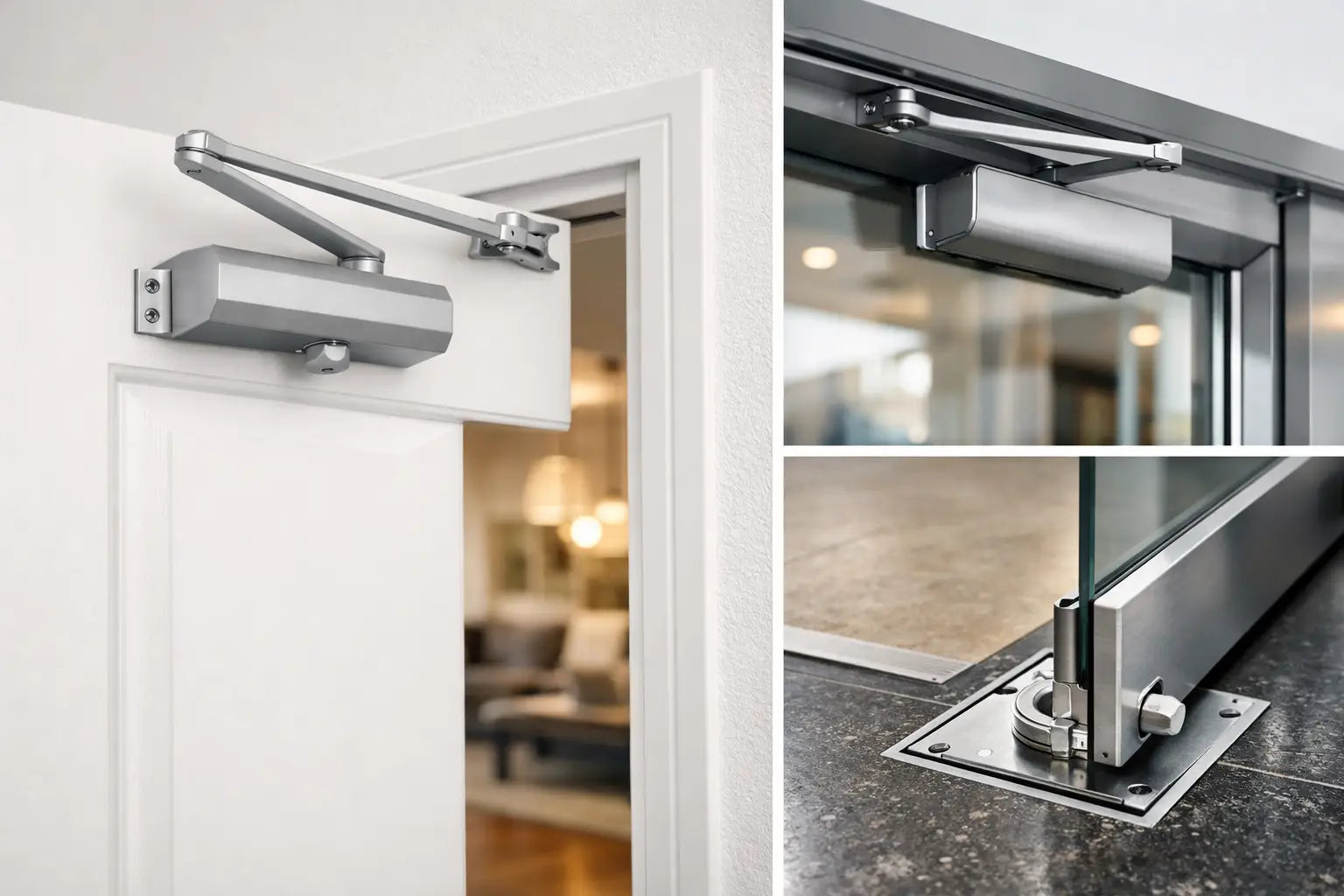
Surface-mounted overhead closers are the most familiar option. The closer body is fitted to the door or frame, with an arm connecting it to the opposite component. They are widely used on fire doors, communal entrances, offices, schools and commercial premises because they are proven, durable and straightforward to inspect.
A standard arm closer is a practical choice where appearance is secondary to performance. It is usually the most cost-effective route for a fire door, provided the closer is correctly rated and suitable for the relevant tested door assembly. Models are available with adjustable closing speed, latch action and, on many products, adjustable power.
There are several arm arrangements. A regular arm is commonly fitted to the pull side of the door. A parallel arm installation places the arm alongside the door on the push side, giving a neater projection and reducing the risk of the arm being knocked in public areas. Top-jamb fitting can be useful where the frame arrangement or opening direction makes standard fixing impractical.
The trade-off is visibility. Even colour-matched silver, black or brass-effect units remain a noticeable item of ironmongery, particularly on a carefully designed internal door. For many commercial and fire-rated applications, that is a sensible compromise for dependable operation.
Slide arm door closers
Slide arm closers are also overhead units, but replace the projecting scissor arm with a slim guide rail. This creates a cleaner, more contemporary appearance and is often selected for premium residential schemes, offices and flat developments.
Many slide arm models use cam action, which can make the initial opening movement feel lighter than a traditional rack-and-pinion closer. That can improve everyday usability, but specification still needs care. The closer must have enough power to close and latch the door against seals, hinges and air pressure, particularly on external or fire doors.
Not every slide arm closer is suitable for every fire door application or mounting position. Check the manufacturer’s certification, the maximum leaf size and the exact fixing arrangement before ordering. A closer that looks right but is not approved for the door construction is not the right product.
Concealed door closers
Concealed closers are built into the door leaf, frame or head of the opening, leaving little or no visible hardware when the door is closed. They are a strong choice for minimalist interiors, high-end timber doors and projects where clean lines are central to the design.
The visual benefit comes with tighter installation tolerances. The door and frame need sufficient material to accommodate the mechanism, and routing must be accurate. Concealed products are therefore best planned before the door is supplied or prepared by an experienced joiner, rather than treated as a late hardware decision.
They can be appropriate for some fire-rated doors, but only where the chosen closer, door leaf, frame, seals and installation details are covered by suitable test evidence. Cutting a recess into a fire door can affect its rating if it is not permitted by the door manufacturer’s instructions. For fire door work, a pre-assembled door set can simplify this decision because the core components are designed to work together.
Floor springs
A floor spring is installed in a recessed floor box beneath the door, with the mechanism connected through a bottom pivot. It is frequently used with glass doors, aluminium entrance systems, timber shopfront doors and heavier commercial leaves.
Floor springs are particularly useful where a door needs to open in both directions or where a top-mounted closer would spoil the design. They can also handle substantial door weights, depending on the model and pivot system. On a glazed entrance, the discreet appearance is often a major advantage.
Installation is more involved than with an overhead closer. The floor must be excavated to accept the box, the spindle position must be precise, and the installation should account for finished floor levels, drainage and possible underfloor heating. They are excellent products in the right setting, but rarely the simplest retrofit option.
Free-swing and hold-open closers
A conventional closer resists the opening movement and always returns the door once released. Free-swing closers allow the door to move more like an unclosered door during normal use, then close it when activated by the fire alarm system. They are useful in care homes, schools, hospitals and accessible shared spaces where a heavy self-closing door can be difficult to use.
Electromagnetic hold-open systems keep a door open at a chosen position and release it on an alarm signal. This can assist circulation and reduce wear where doors are regularly held open, but a fire door must never be wedged or propped open with an unsuitable device. Any hold-open arrangement on a fire door needs to be compatible with the fire strategy and installed correctly.
Selecting the right closing power
Door closers are commonly classified by EN power sizes, generally from EN 1 to EN 7. As the number rises, so does the closing force. A wider, taller or heavier door generally needs more power, as does a door exposed to wind or fitted with high-compression seals.
Choosing an oversized closer can make a door difficult to open, especially for children, older residents and wheelchair users. Choosing one that is too weak may leave the latch short of the strike plate. The aim is controlled, reliable closing with a door that remains practical to operate.
For a fire door, the latch is critical. The door needs to close fully into the frame so that the latch engages, with intumescent and smoke seals able to perform as intended in a fire. Do not assume that reducing the closing speed will solve a slamming problem. Excessive speed, incorrect hinge specification, a misaligned frame or a poorly fitted seal can all be part of the cause.
Fire door closer requirements
A fire door closer is part of a complete system, not an isolated upgrade. The door leaf, frame, hinges, latch or lock, intumescent protection, glazing and closer must be suitable for the required rating, such as FD30 or FD60, and fitted in line with the relevant instructions.
For a new fire door installation, check that the closer has appropriate fire test evidence and is suitable for the leaf size, weight and mounting method. Products certified to the relevant door closer standard, such as BS EN 1154, provide a useful starting point, but certification must still match the actual application. A closer may be suitable for a timber fire door yet not for a steel doorset, or approved in one position but not another.
Never drill additional holes, change fixing positions or substitute screws without checking the closer and door instructions. Small details can affect both long-term performance and fire-door compliance.
Installation details that affect performance
Even a quality closer will perform poorly if it is fitted to a binding door. Before installation, check that the leaf swings freely, hinges are secure, the frame is square and the latch aligns cleanly with the keep. On external doors, consider wind pressure and whether the door is subject to repeated gusts when opened.
Set the main closing speed so the door moves steadily rather than crashing into the frame. The latch action should provide enough final force for the latch to engage, without creating a sharp final slam. Backcheck can be valuable on busy doors because it cushions the opening movement before the leaf reaches the wall or door stop.
For heavier doors, paired doors, unusual openings or fire-rated projects, seek specification advice before fitting. Correct closer selection at the ordering stage is quicker and more economical than replacing hardware after decoration, handover or a failed inspection.
When comparing door closer types, start with the door’s job rather than its appearance alone. A visible overhead closer may be the best-value, serviceable solution for a fire door, while a slide arm, concealed closer or floor spring can be the better fit where design and everyday user experience carry more weight. The right choice should close confidently, latch every time and suit the door for years of regular use.
For more information about our interior or exterior doors or door accessories, give us a call at 01603 622261 and speak to a member of our expert team today, or email us at sales@doorsuppliesonline.co.uk. We look forward to hearing from you.