
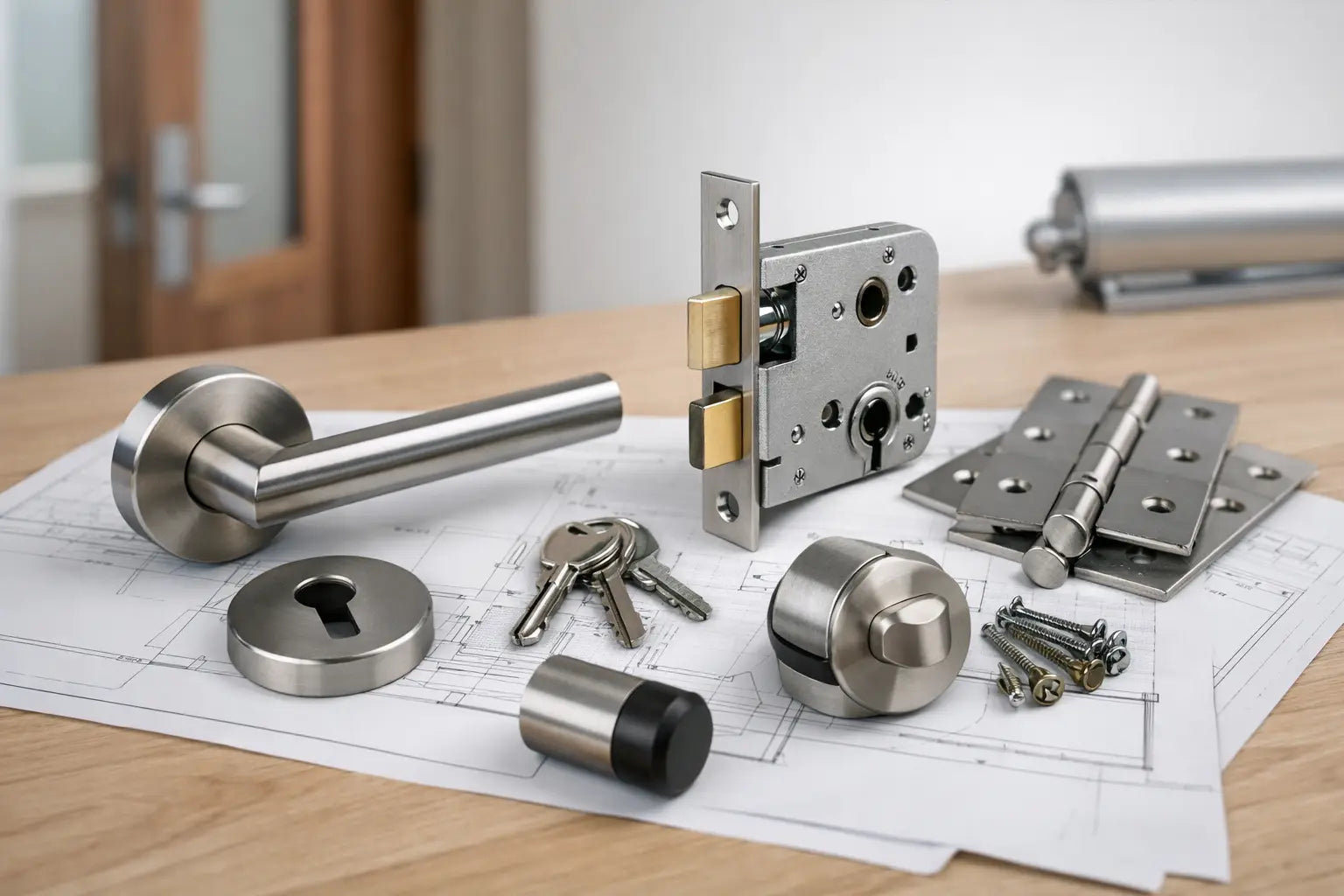
A new door may look perfectly installed, but without the right hardware, it can still feel incomplete or fail to perform as intended. Door ironmongery sets bring together the essential components, including door handles, hinges, latches, locks, and accessories, to create a coordinated, functional, and long-lasting solution. By choosing a complete door hardware set, homeowners, developers, and trade professionals can achieve a consistent finish throughout a property while simplifying the specification and ordering process for single-room renovations or large-scale developments.
Selecting the right door ironmongery set offers more than just matching finishes. A carefully chosen set helps ensure compatibility between the door, frame, and hardware, reducing installation time and avoiding issues caused by mismatched components. Whether you're fitting internal doors, pre-hung doorsets, fire doors, or external entrance doors, using coordinated ironmongery improves both appearance and everyday performance while delivering a professional finish.
What is included in door ironmongery sets?
A door ironmongery set is a selected group of compatible hardware for a particular door function. The exact contents vary, but a standard internal set will commonly include a pair of lever handles, a latch, and a pair or three hinges. Privacy sets for bathrooms and en-suites add a thumbturn and release, while key-locking sets include a sashlock, cylinder, or key escutcheons, depending on the lock arrangement.
For a cleaner, consistent result, it is usually best to specify the visible items in the same finish. That means considering the handle, hinges, latch faceplate, strike plate, escutcheons, door stops, and any privacy turn together. A polished chrome handle paired with satin stainless steel hinges can look accidental, particularly in a newly renovated home where the details are on show.
Sets are particularly useful when ordering several doors. Rather than selecting individual items room by room, you can choose a suitable configuration for each function and repeat it across the property. This reduces omissions and provides a more considered result from hallway to bedroom, bathroom, and living space.
Start with the door and its purpose
Before choosing a style, establish what the door needs to do. Internal passage doors between living areas normally require a latch and lever handles. Bedrooms may need a key-locking function where privacy or landlord requirements apply. Bathrooms need a privacy lock that can be released from the outside in an emergency. Cupboards may only need a pull handle, magnetic catch, or ball catch, depending on the door and the desired appearance.
External doors need a separate level of consideration. Security, weather exposure, locking type, and the door's manufacturer specification all matter. A multipoint lock arrangement, for example, requires compatible handles and a correctly sized cylinder. It is not sensible to treat external door hardware as a generic internal latch set with a heavier handle attached.
The door weight is equally important. Solid oak doors, glazed doors, and tall doors require hinges that can comfortably carry the load without sagging or binding. In many cases, three hinges are appropriate for a standard internal door, but particularly heavy, oversized, or high-traffic doors may require additional hinges or a higher load-rated option. Check the door manufacturer's guidance before finalising quantities.
Handing, thickness, and backset matter
Small measurements can stop an otherwise correct set from fitting. Confirm the door thickness before ordering, especially if using handles with a privacy turn, a tubular latch, or a mortice lock. Check that spindle lengths, bolt lengths, and fixing screws are suitable for the door.
You should also confirm the latch or lock backset. This is the distance from the door edge to the centre of the spindle or keyhole. A 64mm tubular latch is a common choice because it gives a comfortable distance between the handle and the door stop, but tighter door details can require a shorter option. The handle rose, and the lock positions need enough clear timber around them, particularly on glazed or panelled doors.
Door ironmongery sets for fire doors
Fire doors should never be specified by appearance alone. Every item fitted to a fire door can affect its performance, so the complete assembly must be considered. The door leaf, frame, hinges, latch or lock, intumescent protection, closer, and seals all need to work together in line with the relevant door test evidence and installation instructions.
An FD30 or FD60 door may require fire-rated hinges, typically fitted in the quantity and location stated by the door manufacturer. Where hinges have intumescent pads or are supplied with an intumescent liner, these should be used as specified. A latch or lock also needs to be suitable for the fire rating of the door assembly. Do not assume that a product described as heavy-duty or premium is automatically appropriate for a fire door.
Self-closing is another key consideration. Fire doors protecting escape routes or separating higher-risk areas are commonly required to close fully into the frame from any open position. The closer must be compatible with the door weight, the seals, and the ironmongery, then adjusted correctly after fitting. A handle that catches on a poorly positioned stop, or a latch that does not engage positively, can compromise everyday operation.
For flats, commercial premises, HMOs, and other compliance-led projects, refer to the door set documentation, fire strategy, and building requirements before placing the order. A pre-assembled fire door set may simplify installation, but any replacement or additional ironmongery should still be selected to suit that specific assembly.
Choose a finish that suits the wider scheme
Once function and compliance are covered, the finish can do its job. Matt black ironmongery creates a defined, contemporary contrast against white, grey, and natural oak doors. It works especially well when repeated across hinges, handles, and bathroom turns, although it can show dust and fingerprints more readily in busy family spaces.
Satin nickel and satin stainless steel offer a quieter, more versatile finish that suits modern and transitional interiors. They are practical choices for properties where kitchen taps, lighting, and cabinet hardware already use brushed metal tones. Polished chrome reflects more light and can suit a crisp, classic scheme, but it may need more frequent cleaning to keep its shine.
For traditional panelled doors, antique brass, aged bronze, and black antique finishes can add depth without making the door feel overly formal. Matching is not always about using identical metals throughout a home. A warm brass handle can sit well with darker kitchen hardware, for instance, provided the finish is repeated deliberately rather than used once in isolation.
Consider the shape as well as the colour. Lever-on-rose handles give a compact, modern look and work well with separate key escutcheons or bathroom turns. Lever-on-backplate handles create more visual presence and can be a practical choice where the lock and handle need to be presented as one piece. Knobs can be effective on lighter internal doors, but levers are generally easier to operate for children, older occupants and anyone carrying bags, washing or tools.
Avoid common ordering mistakes
The most frequent problem is buying hardware in isolation. A customer may choose attractive handles, then discover that the latch faceplate is a different finish, the hinges have the wrong radius, or the lock will not fit the stile of the door. Building the set around the door function prevents these issues.
It also pays to count doors by function rather than by room name. A house might have six passage doors, three privacy doors, two key-locking bedroom doors, and one cupboard door. That approach gives a clear hardware schedule and makes it easier to check that every door has the necessary components.
For larger projects, record the following details before ordering:
- door size, thickness, construction, and handing, where relevant
- required function: passage, privacy, key locking, entrance, or cupboard
- hinge quantity, finish, and load requirement
- latch, lock, or cylinder type, and required backset
- fire rating, closer requirement, and any manufacturer restrictions
- chosen handle style and finish across the project
Allow for the frame and door stops, too. A latch requires a correctly positioned strike plate, and a door without a suitable stop cannot close properly. Where doors are being replaced but frames retained, inspect the existing hinge recesses and latch positions before selecting new hardware. Minor differences in hinge size or corner radius can create unnecessary joinery work.
Specify once, order with confidence
Good ironmongery makes a door feel purposeful every time it is opened and closed. It should suit the room, feel comfortable in the hand, carry the door reliably, and meet any safety or security requirement without drawing attention to the compromises behind it.
If you are fitting one replacement door, a carefully chosen set keeps the process tidy. If you are managing a renovation, development, or commercial fit-out, a clear schedule of door ironmongery sets brings consistency to the whole project. Door Supplies Online can help make the choice simpler with specialist ranges suited to internal doors, external doors, and fire door applications. Start with the door specification, confirm the function, then choose the finish that makes the completed space feel properly finished.
For more information about our interior or exterior doors or door accessories, give us a call at 01603 622261 and speak to a member of our expert team today, or email us at sales@doorsuppliesonline.co.uk. We look forward to hearing from you.