
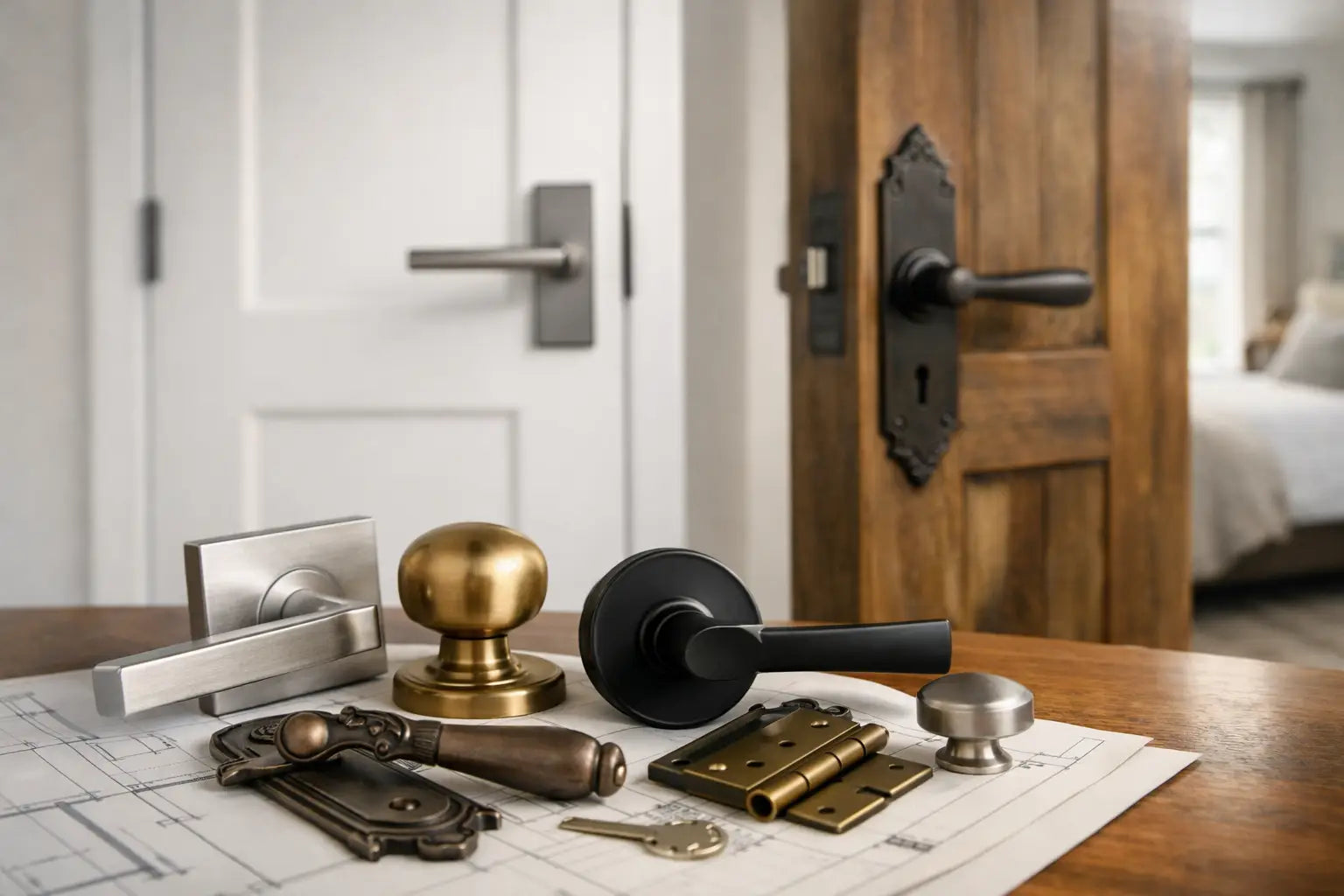
A new set of door handles can make perfectly good doors look carefully considered and more expensive. On the other hand, a mismatched combination of polished chrome levers, black hinges and brass locks can make an otherwise well-designed interior feel disjointed, even when every individual fitting is high quality. Knowing how to match door hardware is less about making every fitting identical and more about creating a clear, practical door ironmongery specification that suits the doors, rooms and level of use throughout your property.
For a single replacement door, choosing matching door handles, hinges, locks and latches is usually straightforward. For a renovation, extension or whole-house project, however, it is worth treating your door furniture and hardware as one connected scheme from the beginning. Choosing your preferred finishes, handle styles and essential hardware before ordering the doors can help create a consistent look throughout the property.
When selecting door hardware finishes, consider how polished chrome, satin nickel, matt black, brass and bronze will work with your existing fixtures, lighting, taps and other metal details. You do not necessarily need every fitting to be exactly the same finish, but combining too many unrelated finishes can make the overall scheme look inconsistent.
Planning your door ironmongery at the specification stage can also prevent practical problems and unnecessary costs. This is particularly important when ordering multiple doors or complete fire-rated doorsets, where the hinges, locks, latches, closers and other components may need to meet specific performance requirements. Reordering the wrong hardware after doors have been painted, hung or installed can lead to additional labour, delays and expense.
Whether you are upgrading one room or specifying door hardware for an entire house, establish the style, finish and performance requirements early. A consistent ironmongery scheme will help your doors look better while ensuring the hardware is suitable for the way each door will be used.
Start with a door hardware scheme, not a handle
The door itself should lead the decision. Traditional four-panel, Victorian and cottage-style doors tend to suit warmer or more detailed hardware, such as aged brass, antique bronze, pewter or a classic polished chrome lever. Shaker, flush and contemporary grooved doors work particularly well with clean-lined satin nickel, matt black or satin brass furniture.
That does not mean a black handle only belongs on a black door, or that oak needs brass. Contrast is often what gives a room definition. Matt black levers on white primed Shaker doors create a crisp modern look, while satin brass against dark painted doors feels more decorative. On oak doors, consider the undertone of the timber. Warm oak usually sits more naturally with brass, bronze and black than with very bright, blue-toned chrome.
Before choosing products, decide which elements must stay visually consistent throughout the property. In most homes, the handle finish, hinge finish and visible lock or bathroom turn should belong to the same finish family. Door stops, coat hooks, cabinet handles and stair fittings can coordinate too, but they do not all have to be exact matches.
Choose one dominant finish
Polished chrome, satin chrome, satin nickel, polished nickel, black, brass and bronze are all distinct finishes. The most common mistake is assuming similarly named products will look alike. Polished chrome is highly reflective and cool; satin nickel is softer and slightly warmer. Polished nickel can resemble chrome at first glance but has a warmer, richer cast.
If you are mixing metals intentionally, use one dominant finish on internal doors and introduce the second through lighting, cabinetry or bathroom brassware. Keep the treatment deliberate. For example, use matt black handles and hinges throughout, then add satin brass cabinet pulls in a kitchen. Avoid a different finish on every floor or room unless the design has a clear reason for it.
Match door hardware to the job it needs to do
A handle is only one part of the set. Every hinged internal door normally needs a lever handle or knob, latch, hinges and a door stop. Bathroom doors also need a privacy turn and release, while bedrooms, studies and shared-house rooms may require a key lock, euro cylinder lock or privacy function depending on the level of security needed.
Choose handles based on use as well as appearance. Lever-on-rose handles are flexible and contemporary, as the latch, lock and bathroom turn are supplied separately. Lever-on-backplate handles have a more traditional appearance and can be a sensible choice where an existing keyhole or latch opening needs covering. Knobs look elegant but can be less comfortable for users with limited grip strength, and may not be suitable where frequent access is expected.
Check the door thickness before ordering. Most internal handles are designed for standard internal door thicknesses, but solid core doors, fire doors, external doors and bespoke doors can differ. The spindle and fixing bolts must suit the door, while the latch case needs enough depth to position the handle comfortably away from the frame. A joiner can make adjustments, but selecting compatible components first produces a tidier result.
Let hinges support the finished look
Hinges are easy to overlook because they sit on the edge of the door. Yet they are visible whenever a door is open, and their finish can quickly undermine an otherwise coordinated scheme. A satin brass handle with bright chrome hinges generally looks like an afterthought.
For standard internal doors, select hinges in the same or a closely related finish to the handles. Ball-bearing hinges are a sound option for heavier solid-core doors and doors used frequently, as they are designed for smoother operation under load. Three hinges are often used on taller or heavier doors, but the correct number, size and grade depend on the door manufacturer and the installation.
Do not select hinges on colour alone. Their size must match the door weight and leaf thickness, and the hinge knuckle needs appropriate clearance within the frame. If you are replacing a door but retaining an existing frame, check the old hinge positions and sizes before buying new ironmongery.
How to match door hardware on fire doors
Fire door hardware is where style must follow compliance. An FD30 or FD60 door is part of a tested or assessed doorset arrangement, so the hinges, latch, lock, closer, seals and glazing specification may all affect its fire performance. A fire door cannot simply be fitted with whichever matching handles are available.
Use hardware that is suitable for the required fire rating and compatible with the door's specification. Fire-rated hinges are generally required, and they must be fitted using the correct screws. Intumescent hinge pads or other protection may also be required by the door manufacturer or the relevant test evidence. Never remove intumescent strips or alter the door edge simply to make a preferred latch or hinge fit.
If a fire door needs to self-close, the closer is not optional. Closers are available in finishes that coordinate with popular hardware ranges, but the closer must meet the performance requirement first. On communal, commercial, flat entrance and higher-risk settings, consider access control, panic hardware, smoke seals, acoustic performance and building regulations as part of the complete specification.
Pre-assembled fire door sets can reduce uncertainty because the door, frame, seals and core components are prepared as a compatible system. They are particularly useful where multiple doors need a consistent finish and reliable on-site installation.
Keep external doors separate from internal doors
An entrance door usually needs a different hardware standard from an internal door. It must withstand weather, repeated operation and security demands. A matching visual finish can still be achieved, but external pull handles, letterplates, cylinders, escutcheons and knockers should be specified for exterior use rather than selected solely to match an internal lever.
For a front, side or flat entrance door, establish whether the door requires a multipoint lock, security cylinder, PAS24 performance or fire rating before choosing furniture. Coastal properties and exposed elevations may also benefit from finishes with better corrosion resistance. Cheap internal-grade black hardware can fade, rust or lose its coating quickly when fitted outside.
Order the complete set before fitting starts
The simplest way to maintain consistency is to create a room-by-room schedule. Record the door type, handing, thickness, fire rating, hinge size, handle style, latch type and any locking requirement. It sounds detailed, but it prevents a common site problem: discovering that the bathroom turns are in a different finish, or that the latch bolt does not suit the chosen backplate.
Order a sample handle where possible, especially for brass, bronze and black finishes. View it beside the door, frame paint and nearby lighting in the actual property. Natural daylight and warm LED lighting can change how a finish appears. This small check is particularly worthwhile on larger projects where dozens of sets will be fitted.
When comparing products, check whether the price is for a pair of handles only or includes the roses, spindle, fixings, latch, hinges and locking accessories. A complete matching set may initially cost more than separate bargain items, but it saves time, avoids finish variations and gives a more professional result.
Avoid the mismatches that show up after installation
The most noticeable errors are rarely dramatic. They are small inconsistencies repeated across a house: round roses upstairs and square roses downstairs, different black coatings, a bathroom release in chrome, or standard hinges on one heavy door that begins to drop after a few months.
Also consider proportions. A slim lever can disappear on a wide, tall door, while an oversized handle can overwhelm a narrow four-panel door. Match the scale of the furniture to the door and use the same rose shape, handle profile and finish across doors that are visible together, such as a hallway, landing or open-plan living space.
A coordinated hardware scheme should make doors feel like part of the property rather than separate purchases. Start with the door type and performance requirement, choose a finish you can repeat confidently, then specify every working component around it. That approach gives you a result that looks right on day one and continues to perform long after the fitting team has left.
For more information about our interior or exterior doors or door accessories, give us a call at 01603 622261 and speak to a member of our expert team today, or email us at sales@doorsuppliesonline.co.uk. We look forward to hearing from you.