
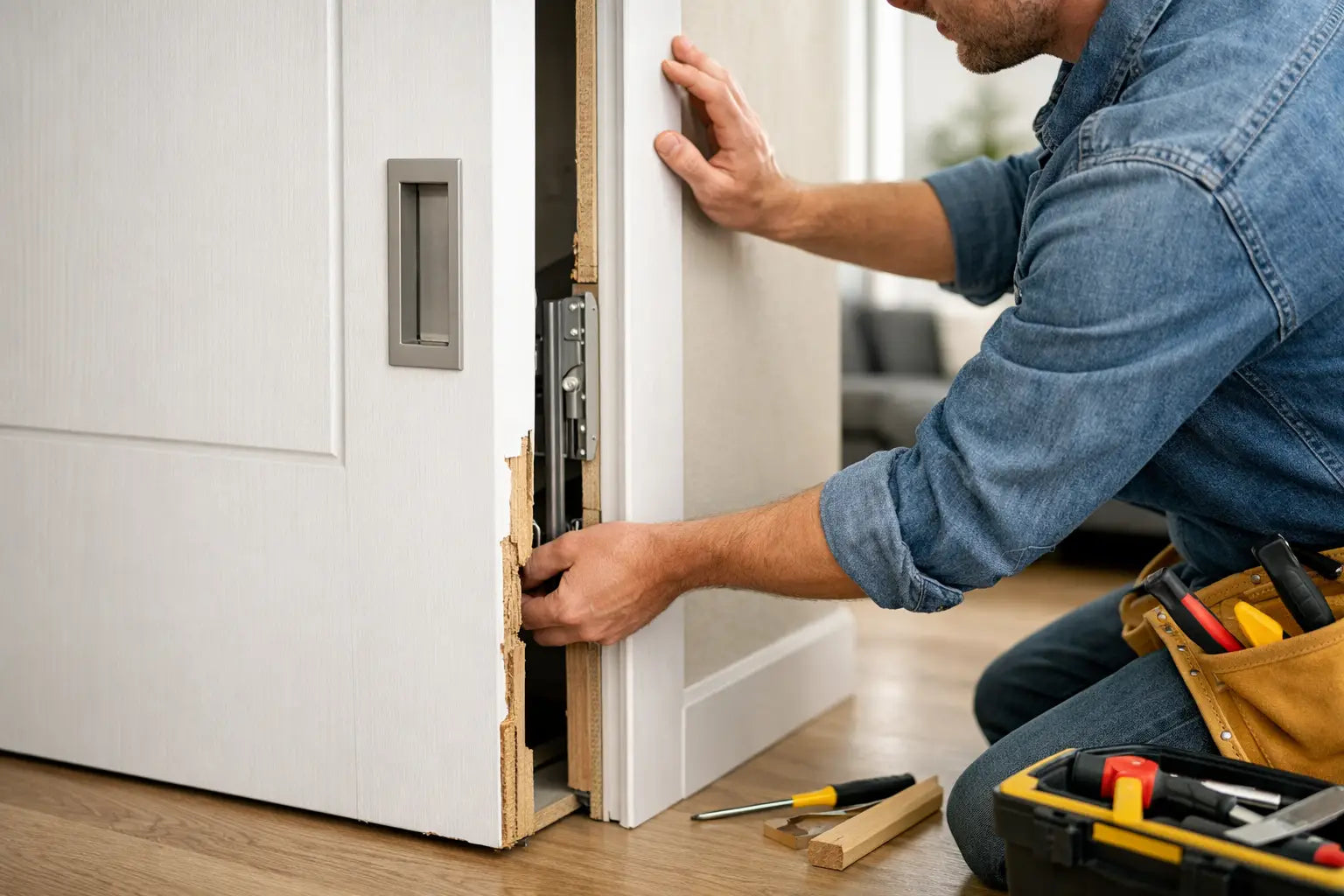
A well-installed pocket door should slide smoothly into its concealed wall cassette and close flush with minimal effort. When a pocket sliding door scrapes, sticks halfway, rattles inside the wall or refuses to close correctly, it can quickly become frustrating to use. Fortunately, many common pocket door problems are caused by alignment issues, worn rollers or running gear, damaged guides or installation problems that can often be identified without removing the wall.
Common signs that a pocket door needs attention include difficulty opening or closing, uneven gaps around the door, excessive movement, rattling sounds and a door that does not sit squarely when closed. The first step in any pocket door repair is to establish where the problem is coming from. Check the visible parts of the system, including the door leaf, bottom guides and door pulls, before investigating the concealed track and hangers inside the pocket.
The most common pocket door problems
The door sticks, scrapes or feels heavy
A door that catches at one point usually points to a clearance or alignment issue. Look first at the floor. A bottom guide that is too tight, loose or out of position can make the door scrape as it enters the pocket. Dirt, grit and small offcuts lodged in the guide can have the same effect, particularly on doors fitted close to a kitchen, utility or renovation area.
Check the gap between the bottom of the door and the finished floor along its full travel. If the gap closes up at one end, the door may hang unevenly. On many systems, the height can be adjusted at the hanging brackets accessed at the top of the door. Make small, equal adjustments and test the movement after each one.
If the door scrapes only when it is fully open, inspect the entrance to the pocket. A bowed stud, protruding screw, loose plasterboard edge or swollen timber can foul the door inside the wall. This is more likely in older properties, bathrooms and rooms affected by damp. Do not keep operating the door until the cause is clear, as repeated friction can damage veneer, paint or lacquer.
The door will not close fully
When a pocket door stops short of its closing position, the cause may be more straightforward than the track itself. First check whether the door has a soft-close mechanism and whether it is correctly engaging. Some systems use an activator fixed to the top edge of the door; if it has moved, the soft-close unit may catch too early or fail to draw the door home.
A poorly positioned floor guide can also push the bottom of the leaf sideways, leaving the leading edge proud of the lining. Check that the guide holds the door upright without pinching it. The door should sit parallel with the finished wall when closed.
On double pocket door arrangements, closing issues can be caused by two leaves being set at slightly different heights. This is particularly noticeable where the doors meet in the centre. Adjust the hangers until the meeting edges align, then check any flush pull, latch or rebated detail works as intended.
The door rolls open or closed by itself
A door that will not stay where you leave it is often a sign that the head track is not level. Even a small fall can allow the weight of the door to carry it across the opening. This is not normally solved by tightening the floor guide, which guides the leaf but does not carry its weight.
If the system is newly fitted and the track can still be accessed, check it with a spirit level. Correcting the track position is the proper repair. In some cases, a soft-close or hold-open accessory can improve day-to-day use, but it will not compensate for a substantially out-of-level installation.
It is also worth considering the door weight. A solid-core, fire-rated or glazed door can be considerably heavier than a lightweight hollow-core leaf. The track, hangers and cassette must be specified for the actual door weight, not simply the opening size.
Noisy rollers, clicking or grinding
Pocket doors should not be completely silent, but grinding, loud clicking or metal-on-metal noise needs attention. Dust on the track, worn rollers or a loose hanger are common causes. Vacuum the accessible track area and wipe it with a dry, lint-free cloth. Avoid coating the track with general-purpose oil or thick grease. These products attract dust and can make the problem worse over time.
If the noise began after decorating or building work, paint, plaster dust and debris may be affecting the rollers. If cleaning does not improve movement, inspect the visible hanger fixings and guides for looseness. Roller assemblies that are worn or damaged should be replaced with compatible components from the system manufacturer wherever possible.
The door wobbles or rattles
A slight amount of movement is normal, especially with a wide or tall door. Excessive side-to-side wobble, however, usually means the bottom guide is missing, incorrectly fitted or worn. The guide keeps the door in line as it travels; without it, the leaf can swing and strike the pocket entrance.
Check that the guide is suitable for the door thickness and the groove, channel or guide arrangement used on the bottom edge. A guide designed for a thinner leaf may not control a thicker oak or solid-core door properly. Conversely, an overly tight guide can create the scraping problem described above.
Rattling can also come from loose pulls, edge trims or a soft-close unit that has not been firmly secured. Tighten accessible fixings carefully, taking care not to overtighten screws into engineered timber or veneered faces.
How to diagnose a fault before removing anything
Pocket door repairs become costly when components are removed before the issue has been isolated. Begin by observing the door through a complete open-and-close cycle. Note exactly where it catches, whether the noise occurs in one direction or both, and whether the door is level when it is shut.
Then check the obvious accessible points: the floor guide, flush pulls, leading edge, closing jamb and any visible top-hanger adjustment points. A torch held along the floor and door edge can reveal rubbing marks or an uneven gap. Fresh scuffs often identify the contact point immediately.
If the door needs to come off the track, follow the manufacturer’s instructions for that particular system. Most quality pocket door systems allow the leaf to be removed from the opening side by releasing the hangers, but the method varies. Support the door throughout the process, particularly with heavy solid-core or glazed leaves. A two-person lift is sensible for larger doors.
Installation issues that cause trouble later
A pocket door system is not just a door sliding on a rail. The cassette or studwork has to remain square, plumb and rigid after the wall is finished. Poorly braced framing, a track fixed out of level or plasterboard screws driven into the pocket zone can all create faults that only show up once the door is in use.
Door size and thickness matter too. The finished leaf must match the system’s permitted dimensions, weight capacity and clearances. Trimming a door excessively can weaken it or leave too little material for hangers and bottom guides. This is especially relevant with factory-finished, panelled, glazed and fire-rated doors, where site alteration may affect appearance, performance or certification.
The finished floor level should be allowed for before fitting. A system installed before flooring may need a planned clearance for tile, engineered wood, carpet or underlay. Retrofitting a thicker floor without checking this gap is a frequent reason for a door that suddenly starts scraping.
Fire-rated pocket doors need a different approach
Never treat an FD30 or FD60 pocket door as a standard internal sliding door. Fire-rated pocket door assemblies rely on compatible leaves, seals, frames or cassettes, ironmongery and installation details to achieve their stated performance. Altering the door, replacing components with non-compatible parts or removing seals to cure a sticking issue may compromise fire resistance.
If a fire door is binding, does not close correctly or has damaged intumescent or smoke seals, arrange an assessment by a competent installer or fire-door professional. The correct solution may be an adjustment, but it must preserve the tested or certified specification. This is particularly important in flats, communal areas, rental properties and commercial buildings.
When to repair and when to replace the system
A loose guide, minor hanger adjustment or dirty track is normally a practical repair. A bent track, failing rollers or a damaged soft-close mechanism can often be resolved with compatible replacement parts, provided the cassette and wall opening are sound.
Replacement becomes more likely when the hidden pocket structure has been damaged, the original system is underspecified for the door weight, or access is impossible without opening a finished wall. In that situation, assess the whole assembly rather than repeatedly treating the symptom. A correctly specified pocket door system, matched to the leaf size, weight and intended use, is far better value than an ongoing cycle of repairs.
Before buying any replacement component, measure the door thickness, opening width, door height and available headroom, and identify the existing system if possible. Door Supplies Online can help make that specification process clearer, particularly where a new cassette, door leaf, pull or suitable ironmongery is required. A pocket door that glides properly is easy to overlook - which is exactly how it should be.
For more information about our interior or exterior doors or door accessories, give us a call at 01603 622261 and speak to a member of our expert team today, or email us at sales@doorsuppliesonline.co.uk. We look forward to hearing from you.