
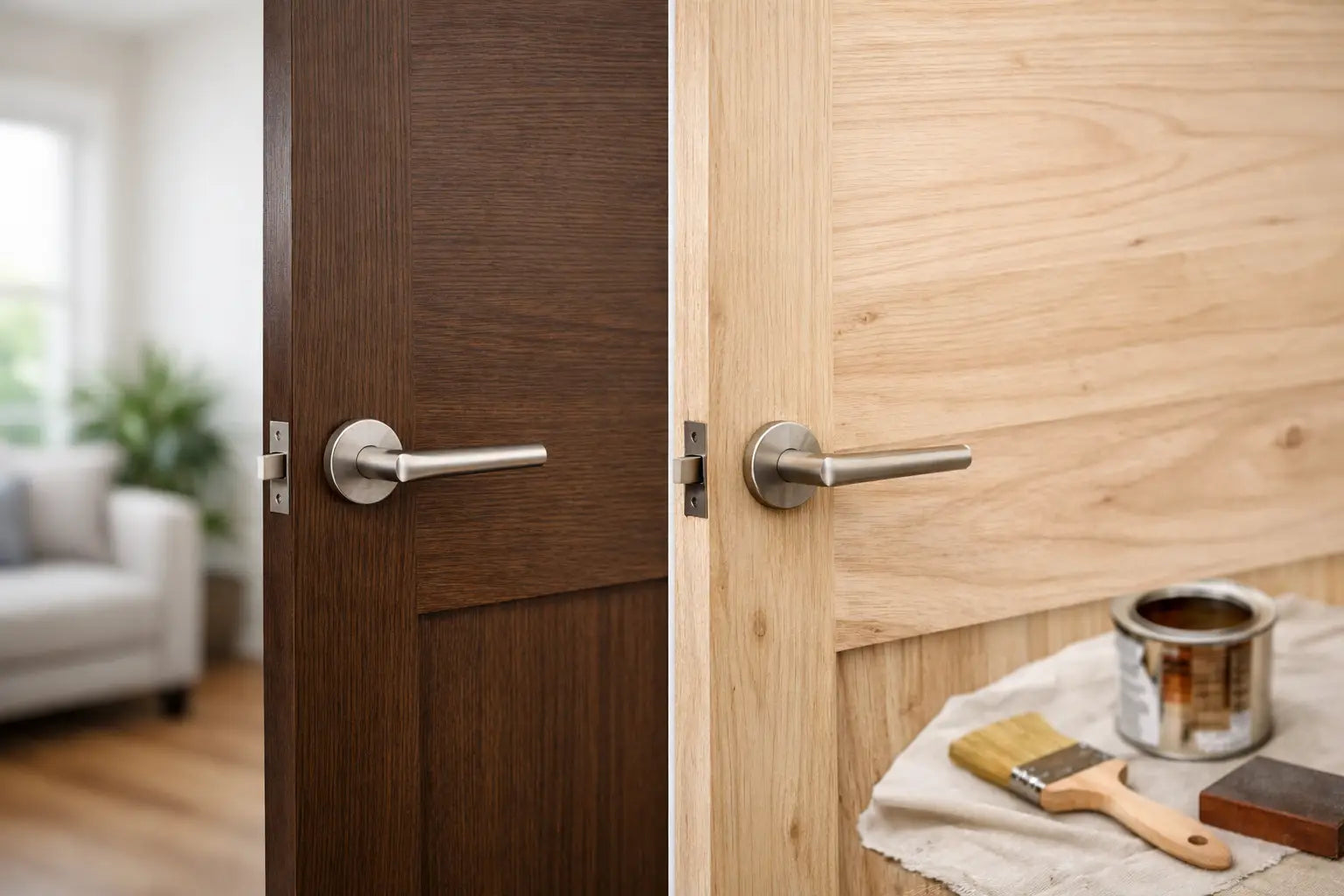
A door can look excellent in a product image yet become one of the slowest parts of a refurbishment once finishing begins. Choosing between pre-finished vs unfinished doors affects far more than the final colour. It can influence installation time, labour costs, durability, maintenance and how accurately the finished door matches the wider interior design.
For a fast replacement, coordinated new-build interior or refurbishment where rooms need to be back in use quickly, pre-finished doors are often the practical choice. They arrive with the finish already applied, reducing the amount of on-site preparation, painting or staining required. By comparison, unfinished doors provide greater flexibility for projects where you need to select a specific paint colour, stain or finish.
For period properties, bespoke joinery projects and interiors where an exact stain or paint shade is important, unfinished doors can offer much greater control over the final appearance. However, they also require additional finishing work before or during installation.
Ultimately, deciding between pre-finished and unfinished doors depends on the door construction, location, required finish, project timescale and available labour. The best option is not simply a matter of personal preference; it should suit the practical requirements and specification of the project.
What is a pre-finished door?
A pre-finished door arrives from the manufacturer with its decorative finish already applied. This may be a clear lacquer over an oak veneer, a stained timber effect, a painted surface such as white or black, or a modern laminate and foil finish. The factory finish is designed to provide a consistent appearance and a degree of day-to-day protection without the need to sand, prime, stain or lacquer the main faces on site.
This makes pre-finished internal doors particularly useful on occupied homes, rental properties and larger developments. There is less mess, less drying time and less opportunity for variation between doors. A matching range of frames, architraves and ironmongery can also make a substantial project feel considered rather than pieced together.
Pre-finished does not mean completely maintenance-free. It still needs careful handling during delivery and fitting, and minor surface damage may be harder to disguise than it would be on an unfinished timber door. Any cut edges, hinges recesses or alterations must be dealt with in line with the manufacturer’s instructions.
What is an unfinished door?
An unfinished door is supplied ready for preparation and finishing after delivery. It may be unfinished oak veneer, knotty pine, hardwood, primed white or a paint-grade moulded design. Depending on the product, it may need sanding, filling, priming, staining, painting, varnishing, oiling or lacquering before it is installed or shortly after fitting.
The major advantage is choice. An unfinished oak door can be kept pale with a clear lacquer, warmed with an oil, or stained to sit alongside existing flooring and furniture. A primed door gives decorators a sound starting point for a specific paint colour, whether that is a soft neutral for a traditional hallway or a deep blue-grey for a contemporary renovation.
That flexibility comes with responsibility. The finish must be suitable for the door material and room conditions, applied evenly and allowed to cure properly. A poorly sealed door in a humid bathroom, for example, is more likely to stain, swell or show premature wear around the lower edges.
Pre finished vs unfinished doors: the practical differences
The headline difference is time. A pre-finished door can normally be fitted as soon as it has acclimatised and the opening is ready, subject to any permitted trimming and the fitting instructions. This is valuable where a joiner is working to a tight programme or where homeowners want to avoid several days of dust, fumes and wet paint.
An unfinished door introduces additional stages. The door needs to be prepared, coated and dried, often before final hanging. If several coats are required, the finishing process can extend well beyond the day of installation. That is not necessarily a disadvantage, but it should be allowed for when comparing quotations.
Consistency is another distinction. Factory-applied finishes are generally even across a set of doors, which is useful in open-plan spaces and developments with multiple rooms. Site-applied finishes can be equally attractive, but results depend on the product, preparation, application method, lighting and the skill of the decorator.
There is also a difference in repairability. Small marks on an unfinished painted door are usually straightforward to fill and repaint. A damaged pre-finished veneer or laminate face can be more difficult to blend invisibly, particularly where the finish has grain, sheen or a complex colour tone. Conversely, a quality factory lacquer may stand up very well to ordinary household use and reduce the need for early redecorating.
Cost: look beyond the price of the door
An unfinished door may have a lower initial purchase price, but it is not automatically the lower-cost option. Add primer, paint or lacquer, abrasives, brushes or spraying equipment, protection materials and the time required to complete the work. Professional decoration across several doors can materially change the total project figure.
A pre-finished door often costs more upfront because the manufacturing process is already included. However, it can reduce on-site labour and help avoid programme delays. For landlords preparing a property between tenancies, or contractors fitting a full house lot, that time saving can be worth more than the difference in unit price.
It is also worth pricing the complete installation. Include the frame or lining, architrave, handles, hinges, latches and any privacy hardware. A finished door paired with mismatched timber components can undermine the intended result. If a fully coordinated appearance is important, check which matching finishing products are available before committing to a door style.
Where pre-finished doors make the most sense
Pre-finished doors suit projects where speed, consistency and a clean installation are priorities. They are a strong choice for modern homes using oak, black, white or grey finishes throughout, as well as flats and rental properties where downtime needs to be kept to a minimum.
They are particularly practical when replacing several internal doors at once. The finish is selected upfront, the doors can be installed in sequence, and there is no need to create a separate decorating phase for every room. Glazed pre-finished designs can be especially useful in darker halls or kitchens, bringing light through while retaining a coordinated finish.
Be realistic about alteration, though. Most doors have a defined maximum amount that can be trimmed from the edges. Trimming beyond that allowance can affect appearance, construction and performance. A pre-finished edge may also need resealing after cutting, so this should be discussed with the installer before the door is ordered.
When unfinished doors are worth the extra work
Unfinished doors are usually the better route when the finish must be genuinely bespoke. That might mean matching original joinery in a Victorian house, using a particular paint system across skirting and panelling, or selecting an oil tone that complements newly laid oak flooring.
They are also useful where future redecoration is likely. A paint-grade unfinished or primed door can be refreshed as room colours change, provided it has been correctly prepared and maintained. For homeowners who enjoy having control over every detail, that adaptability is often the deciding factor.
Natural timber doors deserve particular care. Timber varies from one veneer sheet or board to another, and a sample may not show every grain variation in the finished set. Test the chosen stain, oil or lacquer on an offcut or discreet area first. This small step can prevent an expensive surprise once a full coat has been applied.
Fire doors need a separate decision process
The finish of an FD30 or FD60 door should never be treated as a purely decorative choice. A fire door is a tested assembly, and its performance relies on the compatible leaf, frame, seals, hinges, latch or lock, glazing specification and installation method. The door’s certification and manufacturer’s instructions take priority over any general finishing advice.
Some fire doors are supplied pre-finished, while others are designed to be painted or finished on site. Check whether the selected coating is permitted, whether all faces and edges require sealing, and how much trimming is allowed. Do not obscure labels or plugs that identify the fire rating, and do not change intumescent strips, hinges or glazing details to suit a preferred look.
For communal entrances, commercial settings and other higher-risk applications, a pre-assembled fire door set can simplify specification by supplying compatible components together. It still requires correct installation, but it removes much of the uncertainty that can arise when individual parts are sourced separately.
Choose the finish around the way the door will be used
A busy family kitchen, a quiet bedroom, a student rental and a high-specification renovation place different demands on a door. Consider how often the door will be handled, whether children or pets are likely to mark it, how much natural light falls on the surface and whether the room experiences moisture or temperature changes.
Choose pre-finished if you want a dependable, consistent appearance with less site work. Choose unfinished if achieving an exact colour, stain or long-term redecorating flexibility is more valuable than a faster installation. Before ordering, confirm sizes, handing, glazing, permitted trimming, finish requirements and the hardware needed for the complete door assembly. That preparation is what turns a good-looking door into one that performs properly for years.
For more information about our interior or exterior doors or door accessories, give us a call at 01603 622261 and speak to a member of our expert team today, or email us at sales@doorsuppliesonline.co.uk. We look forward to hearing from you.