
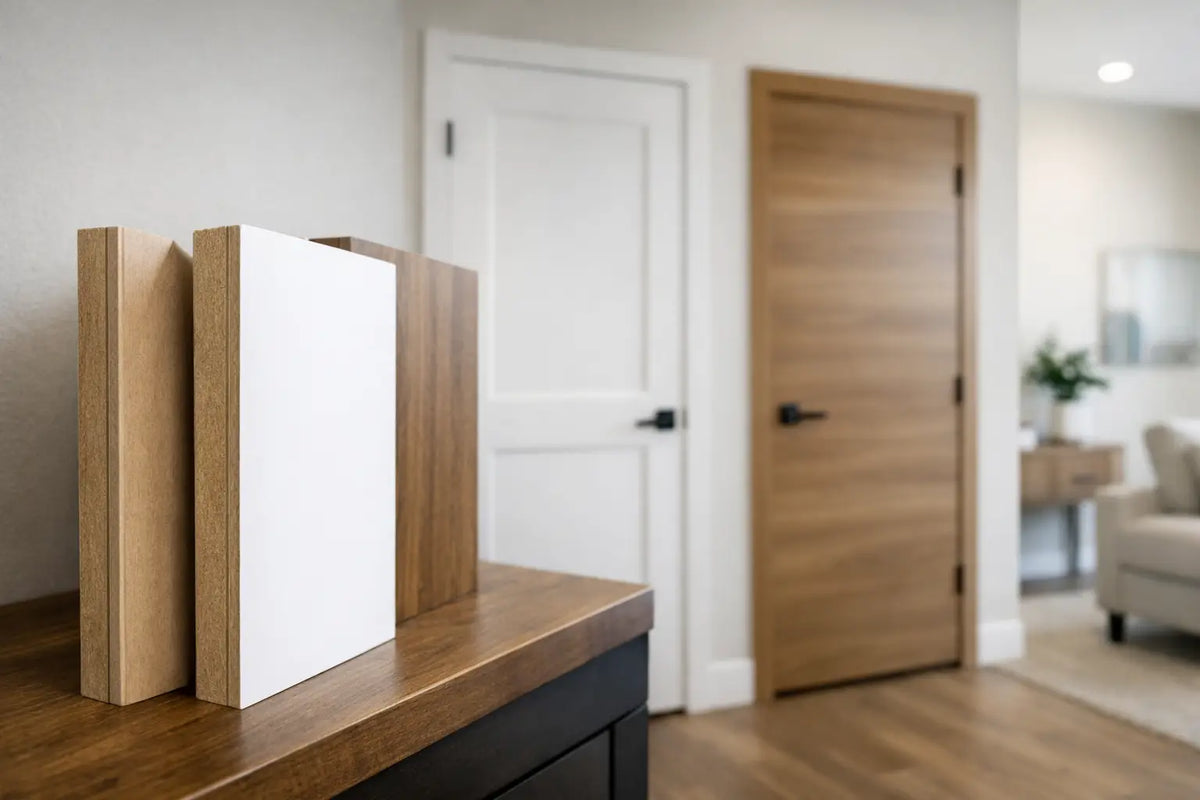
A smooth, painted four-panel door may look like solid timber, but in many UK homes it is more likely to be made from engineered materials such as MDF. If you are asking “what is MDF interior doors?”, understanding the material can help you make a more informed choice based on finish, cost, durability and where the door will be used.
MDF interior doors are engineered internal doors made wholly or partly from medium-density fibreboard (MDF). The material is manufactured by breaking down softwood and hardwood fibres, combining them with resin and wax, and pressing them into dense, uniform boards. Unlike natural timber, MDF has no natural grain, knots or changing grain direction, making it particularly well suited to producing clean lines, moulded profiles and smooth painted finishes.
One of the main advantages of MDF internal doors is their consistent appearance. Because the material is uniform, it can provide a smooth surface that is ideal for painted doors, from classic white four-panel designs to contemporary flush and moulded styles. MDF can also be easier to manufacture into precise decorative profiles than some natural timber products.
For homeowners replacing a single bedroom door, or trade buyers specifying MDF doors throughout a new-build or development, MDF can provide a practical way to achieve a consistent interior style. It can offer a cost-effective alternative to many solid timber doors while reducing some of the natural variation associated with timber.
However, MDF is not suitable for every application. Standard MDF internal doors are primarily intended for interior environments and should not automatically be used in areas exposed to moisture or demanding conditions. For bathrooms, kitchens or specialist applications, always check the manufacturer's specification and choose a door specifically designed for the environment.
Whether you're comparing MDF interior doors with solid timber, looking for painted internal doors or simply trying to understand what MDF doors are, the construction and intended application should be considered alongside appearance and price.
What are MDF interior doors made from?
The description “MDF door” can cover several constructions, so always read the product specification rather than relying on the name alone. A budget moulded door may have an engineered core with MDF facings and a pressed panel design. A heavier solid-core door may use an MDF-based or composite core beneath its finish. Some premium painted doors use MDF components around a timber or engineered core to create deep profiles and reliable joints.
What unites them is the use of MDF where its strengths are most useful: flat surfaces, shaped rails, routed grooves, raised-and-fielded effects, and painted mouldings. It is particularly common in traditional Victorian, Shaker and cottage-style designs, as well as modern flush doors with clean recessed lines.
A door described as “solid MDF” should not be confused with a solid oak door. It is a dense engineered board product, rather than a door made from lengths of natural wood. It can feel reassuringly substantial, but weight alone does not tell you whether it is suitable as a fire door, acoustic door or external door.
MDF, moulded and primed doors
Many white internal doors sold for painting are MDF moulded or MDF-faced doors. They are commonly supplied primed, ready for a final coat in the colour of your choice. This makes them a sensible option where you want matching doors, skirting, architraves and wall panelling throughout a property.
Primed does not always mean ready to hang and forget. Check the manufacturer’s finishing instructions. The top, bottom and all cut edges may need sealing, while a compatible topcoat is normally required for a durable result. A good paint system protects the surface and produces the even, furniture-like finish for which MDF is chosen.
Why choose MDF internal doors?
The main attraction is consistency. Timber has natural character, but it also has knots, grain variation and a tendency to respond to changes in temperature and humidity. MDF is more uniform. When properly sealed and used in a suitable internal location, it gives a stable base for paint and accurately machined details.
It is also versatile from a design point of view. A simple white Shaker door can suit a new-build home, while a six-panel profile works well in a period-inspired renovation. Glazed MDF doors can bring borrowed light into halls, kitchens or living rooms, and matching solid doors can maintain privacy in bedrooms and bathrooms.
Cost is another factor. MDF-based doors are usually more accessible than comparable solid hardwood doors, particularly when several matching doors are required. That can free up budget for quality hinges, handles, latches, frames and professional fitting - all of which have a major bearing on how a door performs day to day.
MDF is easy to machine accurately, too. A competent joiner can trim, hinge and latch a suitable door cleanly, within the manufacturer’s permitted allowances. This is useful in older properties where openings are rarely identical. It does not mean every MDF door can be cut freely: excessive trimming can expose the core, weaken edges or invalidate a fire-rating certification.
The limitations to understand before buying
MDF is not naturally waterproof. Prolonged contact with water can cause it to swell, soften and lose its shape, especially at unsealed edges and the bottom of the door. It is therefore a poor choice for external entrances, exposed porches, outbuildings with damp conditions, or rooms where persistent moisture is likely.
For a standard, well-ventilated bathroom or en suite, an appropriate internal MDF door can work well if it is correctly finished and maintained. The key is protecting every edge, using a suitable paint system and resolving leaks or heavy condensation quickly. For demanding wet environments, seek products specifically designed and warranted for that purpose.
It is also worth considering impact resistance. MDF provides a smooth surface, but sharp knocks can dent or chip it. A busy rental property, school corridor or commercial setting may justify a more hard-wearing specification, depending on traffic levels. Small paint damage can often be repaired, but deep damage is less forgiving than a scratch in a quality timber veneer.
Finally, MDF doors can be heavy. Confirm that the frame is sound and use hinges that are correctly rated for the door’s weight. Three hinges are common for many internal doors, but heavy, tall or fire-rated doors may require a particular hinge type, quantity and fixing arrangement. Follow the door manufacturer’s instructions rather than applying a one-size-fits-all rule.
MDF interior doors compared with other options
An MDF door is not automatically better than a hollow-core, solid-core or solid timber alternative. The best choice depends on the room, the required finish and the performance you need.
Hollow-core doors tend to be lighter and economical, making them useful for low-traffic rooms where budget is the priority. They generally provide less sound reduction and can feel less substantial. Solid-core doors are often heavier, quieter and more durable, making them a strong option for bedrooms, home offices and busy family homes.
Solid timber doors bring natural grain and can be refinished, but they cost more and need suitable conditions and finishing to minimise movement. Veneered doors provide a real-wood appearance over an engineered construction, offering a useful middle ground where an oak or walnut look is wanted.
MDF comes into its own when a painted finish is the goal. If you want visible timber grain, choose a veneer or solid wood product instead. If you want a consistently smooth black, white, grey or bespoke-colour door with precise detailing, MDF is often the more sensible material.
Can MDF doors be fire doors?
MDF itself is not a fire rating. A door only becomes an FD30 or FD60 fire door when its complete tested specification meets the relevant performance standard. That specification can include the leaf construction, frame, intumescent strips, seals, hinges, latch or lock, glazing system, fixings and installation method.
Some certified fire doors contain MDF elements, but you must never assume a standard MDF internal door can be upgraded to fire-door status by adding strips or fire-rated hinges. If an opening requires a fire door, select a certified FD30 or FD60 product and install it exactly as specified. Where practical, a compatible pre-assembled fire door set can reduce uncertainty around the leaf-to-frame relationship and essential components.
The same principle applies to acoustic performance. A heavier MDF-based door may reduce sound better than a lightweight hollow-core door, but it is not an acoustic door unless it has been tested and specified as one. Gaps around the perimeter and beneath the door can matter as much as the door leaf itself.
Choosing the right MDF door for your property
Start with the room and the finish. For bedrooms, lounges and landings, a primed MDF panelled or Shaker design is a dependable, flexible choice. For darker painted schemes, check whether the door is supplied primed or pre-finished, and whether the stated finish can be overpainted.
Next, measure the opening carefully. Establish the door height, width and thickness, the handing of any rebated pair, and the amount of trimming required. Internal door sizes are often described in imperial terms such as 24in, 27in or 30in, but confirm the actual metric dimensions before ordering. Check the permitted trim on each edge, especially if you are replacing doors in uneven existing frames.
Then specify the hardware and frame as part of the same decision. A polished chrome lever can create a different result from an aged brass or matt black handle, even on the same white door. Consider latch backset, hinge finish, privacy hardware for bathrooms, and whether the frame, architrave and skirting will be painted to match.
For projects with several doors, ordering the full range together helps maintain consistent panel proportions, glazing style and finish. Door Supplies Online can help buyers compare standard internal doors, fire-rated options, frames and ironmongery so that style choices do not compromise the required specification.
A well-chosen MDF door should disappear into the room in the best possible way: it closes cleanly, takes daily use in its stride and gives the whole interior a considered, coordinated finish.
For more information about our interior or exterior doors or door accessories, give us a call at 01603 622261 and speak to a member of our expert team today, or email us at sales@doorsuppliesonline.co.uk. We look forward to hearing from you.